Haikuti
PeacemakerHaikuti is Aseida’s chief bodyguard and the Shadow Guild’s chief tactician, a powerful operator whose influence behind Murini helped determine the course of the aishidi’tat during the coup regime. His career turns on a sharp contradiction: he possessed the force and presence to rule, but Guild membership permanently barred him from political office; he could control events from behind a ruler, yet his strength as a tactician could not replace the strategic judgment his position demanded. When his concealed role was exposed, he chose confrontation over escape, and Banichi killed him.
Identity and Position
Haikuti served as the chief bodyguard to Aseida, the Kadagidi lord, but his importance reached far beyond that household. He had been the Shadow Guild’s chief tactician and, for two years, had effectively ruled the aishidi’tat from behind Murini. The account distinguishes that hidden command from formal authority: Murini issued orders and occupied the position of ruler, while Haikuti exercised influence from the curtains. Aseida himself claimed innocence of everything, and the account describes him as no great intellect; Haikuti, by contrast, was the experienced operator behind the apparent political leadership.
His background imposed a decisive limit on his ambitions. Haikuti belonged to the Assassins’ Guild, and anyone who had once belonged to it was forbidden ever to hold political office. At the point when the panicked legislature was agreeing to whatever Murini presented, Haikuti could, despite his unlordly origins, have removed Murini and seized power in his own name. The Guild rule made that route unavailable. His authority therefore remained indirect, exercised through a ruler who could be manipulated but could also act in ways Haikuti could not govern.
Rule from Behind Murini
The narrative presents Haikuti as having the disposition of an aiji: charismatic, forceful, and unwilling by nature to accept authority above him. In a revealing counterfactual, it suggests that if he had actually held the aijinate, he would not have wasted power on petty-minded vengeance. Yet he was personally barred from rule, and he did not treat fine control over Murini as his principal problem. His attention was occupied elsewhere. The distance between his temperament and his official position thus shaped the political arrangement: a man inclined to command worked through a ruler whose decisions he did not adequately constrain.
Haikuti’s defining professional quality was tactical rather than strategic. He could act effectively against an immediate target, but the narrative identifies policy-making as a task beyond his proper strengths. Allowing Murini to issue orders was one such error. Those orders set the tone of the administration and helped make its course, in retrospect, foredoomed. The Shadow Guild later treated Murini as replaceable and ignored him in its own decisions, while exploiting the fear his actions had created and pursuing technical and legal maneuvers through the legislature. Shishogi, the Strategist, had taken the long view; Haikuti, the Tactician, let Murini generate enemies whom the Shadow Guild could then target. The contrast is not simply between two temperaments: it marks the difference between patient political design and the immediate use of force.
Strategic Misjudgments and Exposure
A second major error concerned the orbital situation. Haikuti and the Shadow Guild failed to understand orbital mechanics, the resources available in orbit, and Geigi’s ability to launch satellites and soft-land equipment. They assumed that grounding three shuttles would cut off the station’s supplies and starve its occupants, and they regarded Geigi’s possession of one shuttle already aloft as only a minor threat. Their plan rested on an incomplete understanding of what the opposing side could sustain and accomplish. It was another instance of tactical confidence failing to account for the wider system in which political power operated.
Haikuti’s involvement in violence also became a crucial part of the case against him. The Guild in exile knew he had been involved in the attack on Tabini at Taiben. Jago reported that Haikuti had remained untouched until the day before the account of that discovery, although his location was known. The Guild had kept his personnel records secret within its files, as it did those of other units, while the exiled members had reconstructed how appointments to particular offices had helped arrange the coup that installed Murini. Their information named people to watch and supplied a lead that was checked and reported back. Jago also said that the Kadagidi lord’s ban had isolated Haikuti from arrest by leaving him secure from the authorities. An attack on Tabini’s residence is described as something Haikuti might have conducted, rather than as an established fact.
The evidence initially carried a serious limit: Banichi and Algini had information from sources, but there was not yet absolute proof of what those sources had told them. Banichi expected trouble at the Kadagidi estate, and he and Algini had reason to anticipate it, but he did not tell Bren. He was caught between the opportunity to build a clear case against the Kadagidi and the need to protect the information source; the fact that he and Haikuti had clashed before further complicated his position. The later account of Haikuti’s death, together with the Guild’s corroborating knowledge, changes that uncertainty. Jago’s judgment becomes unequivocal: there is no remaining doubt in her mind.
Death and Significance
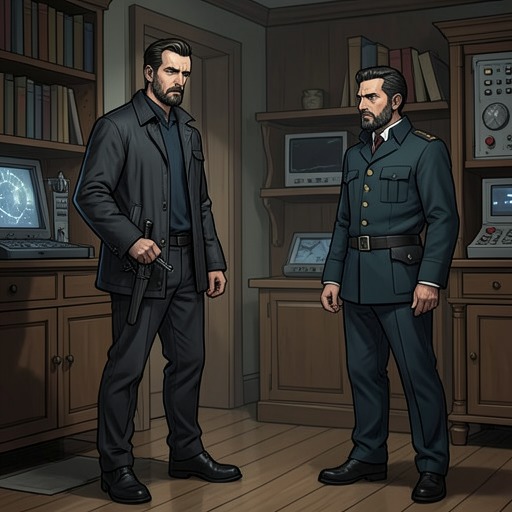
Haikuti had one last opportunity to run when he realized that Banichi was the person challenging him. His own nature determined his response: he shot first. Banichi shot true, and Haikuti died. The brief sequence makes his end an extension of the traits that had defined his career. The impulse to meet a challenge directly, effective in the kind of immediate operation for which he was suited, became fatal when escape remained possible. His death is not presented as a planned arrest or a political surrender; it is the final consequence of choosing to fire on Banichi.
The account’s image for the return of Haikuti’s mistakes is a red and black bus from Najida Province: the errors he had made in his career had finally come home by that route. Behind the image lies a sequence of reversals. Guild membership kept him from taking open power; reliance on Murini allowed another man’s orders to define the regime; tactical thinking failed to anticipate the consequences of policy and orbital logistics; and the secrecy that once shielded his position could not erase the knowledge held by the exiled Guild. His death also gives force to the Guild’s larger struggle over proof and legitimacy. The exiles wanted to restore the law by establishing the case against the sitting Council through the Guild’s own processes, rather than depending solely on Tabini’s decree or the power of the aijinate. Haikuti’s concealed record and eventual exposure make him central to that conflict: an effective wielder of covert power whose career demonstrates why the Guild’s rules and accountability matter.