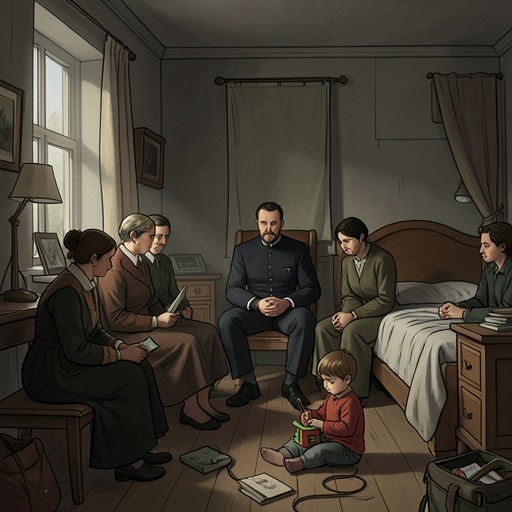
Jegari
PeacemakerJegari is one of Cajeiri’s bodyguards, distinguished in the narrative less by speeches than by his alertness and dependable service. During a journey shadowed by danger and political uncertainty, he keeps watch, reports what he can learn, and attends to the practical details around Cajeiri and his human guests. His small actions give the young heir a measure of continuity: even when communications are cut and plans shift, Jegari is present, prepared, and attentive to what Cajeiri needs.
Identity and Role
Jegari belongs to Cajeiri’s protective circle alongside Antaro, Lucasi, and Veijico. The four guards’ appearance helps define their public role: in black leather uniforms and carrying sidearms, they look official and impressive to Cajeiri, even though he had not previously thought of them as frightening. Their presentation is a visible sign of the security around him, particularly as the party travels in the aftermath of the destruction at Reunion Station and moves through a period of danger on the mainland.
Jegari’s familiarity with Cajeiri is also evident in the way Cajeiri addresses him as Gari-ji. Their relationship has the ease of long-standing service, but it is not merely formal. Cajeiri turns to him for information and practical help, while Jegari watches over both his principal and the arrangements surrounding the people who accompany him. The book presents this work through brief, concrete exchanges rather than through an account of Jegari’s background or private ambitions.
Watchfulness on the Journey
After sleeping during the train journey, Cajeiri wakes and sees that Jegari is awake across the aisle while Gene, Irene, and Artur remain asleep. The train has begun to slow, an unsettling change because the passengers cannot raise the window shades to see what is happening outside. Cajeiri asks Jegari where they are. Jegari believes they are entering Shejidan and expects that they will soon change tracks.
The answer does not end the uncertainty. Cajeiri asks whether there is news, and Jegari reports that the party is still running dark: they are communicating with no one and are not even using the locators. They have no news. When Cajeiri checks whether they are still bound for Bujavid, Jegari can only confirm that he believes they are. His report is limited, but its limits matter. He does not disguise the lack of information or offer false reassurance; he tells Cajeiri what he knows and marks what remains uncertain.
That exchange makes Jegari’s watchfulness part of the larger strain of the journey. The party is nearing the capital, but its silence from the outside world leaves its members without confirmation of events or even a clear view of their surroundings. Jegari is one of the few characters shown awake in this moment, attentive while the others rest and ready to answer when Cajeiri needs him.
Information and Daily Service
At Lord Tatiseigi’s house, Jegari’s attention shifts from the train to the rhythms of a household hosting Cajeiri and his guests. When he appears in the doorway, he is already in uniform and briefly tells Cajeiri that breakfast is waiting. The surrounding arrangements require care: Cajeiri dresses in his bedroom while Irene uses her own small room, and the guards change in the sitting room. Jegari’s prompt visit helps move the group from private preparations into the household’s breakfast service without confusion.
Jegari also serves as a source of political information. While Jase Graham calls on Lord Tatiseigi and political visitors come and go, Jegari quietly investigates what is happening. His findings give Cajeiri a partial account: the visitors are associated with the Conservative Caucus, Lord Tatiseigi is doing most of the talking, and there has been a serious incident at Guild Headquarters. Another member of the Ajuri family has died, in this case an older man who had caused trouble for many people. The information does not resolve the larger crisis, but it helps Cajeiri understand why adults are occupied and why he is being kept at a distance from events.
Cajeiri is especially concerned because Banichi and Bren Cameron have returned wounded. He is relieved to hear that they are not in hospital and wants to visit Bren Cameron’s apartment, but Madam Saidin tells him that Bren Cameron is back at work. In this sequence Jegari’s inquiries form part of the limited intelligence available to Cajeiri, while the answer about Bren Cameron’s condition comes from Madam Saidin. The distinction reflects how information reaches the boy: through scattered reports, with no single account giving him the whole picture.
Attending Cajeiri and His Guests
Jegari’s responsibilities extend to the human children travelling with Cajeiri. When Cajeiri considers whether his guests can attend the birthday festivities, Gene asks whether they can stay with Bren Cameron and avoid trouble. Cajeiri asks about cakes, and Irene explains the human custom of birthday cake. His recollection that he had encountered it aboard ship makes the exchange an instance of the group’s different customs meeting within ordinary conversation, rather than a formal political encounter.
On the day of the celebration, Cajeiri learns that his bodyguards cannot accompany him at breakfast because they must go ahead to Bren Cameron’s apartment. Jegari has explained that they need to speak with Tano and Algini about codes. Their absence disappoints Cajeiri: he wishes that someone had arranged a special breakfast for them as well. The episode gives Jegari’s work a further dimension. Security requires advance coordination, and that duty can separate him from Cajeiri even when Cajeiri would prefer to have his guards and friends together.
Clothing becomes another practical concern. Cajeiri is fond of an elegant black-and-gold brocade coat, but his father explains that wearing his mother’s gift is the more politic choice and that the counters have factored red into the numbers. Cajeiri yields, though unhappily, and asks Jegari whether he will recognize the new coat. Jegari assures him that he will and hurries toward their rooms to fetch it. The exchange shows Cajeiri relying on Jegari’s detailed familiarity with his clothes, while also exposing how a personal choice can be caught up in political considerations.
Responsibility and Loyalty
Later, when Cajeiri realizes that his speech is upstairs in the coat he has changed out of, he asks Antaro to retrieve the paper. Jegari immediately says that he should have realized the problem and calls it his fault. Cajeiri rejects that assignment of blame, explaining that he was the one who changed coats. The moment is small but revealing: Jegari is quick to take responsibility for an oversight, while Cajeiri is equally clear that responsibility belongs to him. Their exchange is not an argument over rank so much as a glimpse of mutual regard expressed through the care each takes over the other’s position.
Near the end of the supplied episodes, Cajeiri faces a choice and decides that he should go to his mother. His father agrees and urges him to come quickly. Cajeiri catches Jegari by the arm and sends him to apologize to the human guests and explain what has happened. Jegari immediately heads through the crowd to do so. The action carries forward the pattern seen throughout the journey: when Cajeiri’s attention is pulled toward family and urgent events, Jegari takes responsibility for communicating with the people left behind.
The narrative gives Jegari no separate resolution or account of his life beyond these scenes. Instead, his character takes shape through recurrence: awake when others sleep, ready with a cautious report, in uniform when service is required, and quick to act when Cajeiri gives him a task. His presence makes Cajeiri’s security more than a background fact. It is a continuing relationship built from observation, coordination, and practical loyalty.