Algini
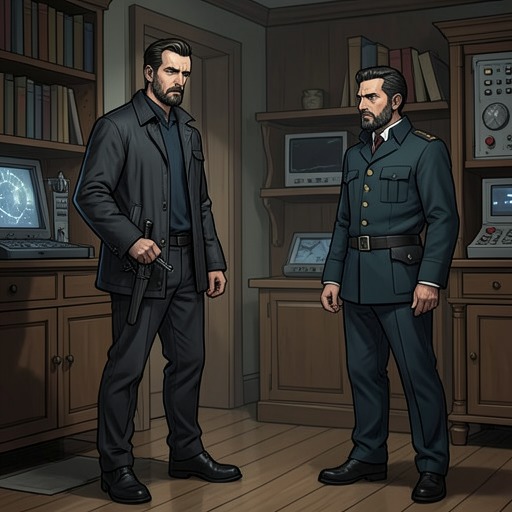
PeacemakerAlgini is a senior Guildsman and one of Bren Cameron’s closest protectors, serving within the bodyguard team that also includes Banichi, Jago, and Tano. His importance is clearest in the work that rarely announces itself: testing information, reading people, coordinating security, and helping Bren understand what danger requires. As the coup’s hidden machinery comes into view and the Assassins’ Guild struggles to repair itself, Algini’s steady judgment helps hold together both the immediate protective team and its larger political purpose.
Identity and Place in Bren’s Circle
Bren remembers arriving in his office as an inexperienced outsider, required to adapt to an unfamiliar world down to his clothes and the small amount of braid on his ribbon. Years later, he sits on a regular train with his bodyguard and the four people closest to him. He understands his bond with them through man’chi, the form of loyalty that gives their relationship its force. Algini belongs to this intimate circle: not simply a guard assigned to Bren, but one of the people Bren trusts and loves because they would risk themselves for him.
That closeness does not erase the professional structure of their relationship. Algini works as part of a disciplined Guild team, and his counsel often translates its rules and judgments into terms Bren can act on. When Bren worries that he has expressed himself badly or failed to function as he should, Algini answers that Bren is understood. His reassurance is not sentimental by itself; it helps keep a working relationship intact under pressure, while making clear that concern for Bren is part of the team’s daily practice.
The Coup Investigation and the Hidden Threat
After the coup, Bren and his bodyguard gradually recognize that Murini is not the sole explanation for what has happened. Algini and the bodyguards of Ilisidi quietly gather intelligence, including accounts from retired associates whose version of events conflicts with information arriving through other channels. Their inquiries run into the Assassins’ Guild’s procedures and secrecy. Some people who might have clarified matters are dead; others have been replaced. The investigation therefore depends not just on finding information but on judging who can safely provide it.
The inquiry eventually reveals that the Guild has not been broadly lost to disaffection. Rather, a small number of people in high positions have exploited strategically placed appointments and disinformation to damage operations over a long period. Algini and the other investigators begin to identify names, distinguishing those who can be trusted from those who cannot. The person behind the network proves not to be an exceptional field operative but a little old man at a desk. That distinction reframes the danger: the crisis has been enabled by access, records, and influence within the institution, not only by violence in the field.
The evidence is complicated by the careers and records of senior Guild members who retired two years earlier. Some had been marked for dereliction, medical unfitness, or even treason; other damaging notations followed resignations during Murini’s investigation, the later inquiry into the coup, or refusals to answer attempts at contact. It had seemed plausible that some were simply angry or disillusioned. The changing picture requires Algini and his allies to reconsider whether apparent failures of duty conceal unjustly tarnished names—or connections to the deeper conspiracy.
Loyalty, Judgment, and the Haikuti Conflict
Algini’s care for the team includes confronting uncomfortable questions about its conduct. After Banichi puts himself in danger during the confrontation involving Haikuti, Algini explains why Banichi is determined to remain active rather than be taken out of service. Banichi believes he may have chosen to pursue Haikuti instead of physically shielding Bren. Though he acted to protect Bren’s legal position and serve the interests of Bren and Tabini, his personal feud may have influenced which duty he placed first. Algini makes the distinction explicit: Banichi considers the action proper in one sense, but compromised by his personal motive. The team has told Banichi they would have made the same choice, yet he fears that standing down would let Haikuti affect the outcome.
The threat surrounding Haikuti is not merely a private feud. The exiled Guild members tell the team that Haikuti, an Eastern Guildsman, was involved in the attack on Tabini at Taiben and had remained untouched even though his location was known. Tabini’s ban on the Kadagidi lord had helped leave Haikuti safely beyond arrest, while the Guild’s secrecy kept his records protected. Banichi and Algini had expected trouble at the Kadagidi estate, but Banichi withheld that expectation from Bren to protect the information source and because the intelligence did not yet amount to proof. Algini’s account shows the strain between operational caution and the obligation to keep a principal informed: secrecy can protect an investigation, but it can also leave the person at its center exposed.
Security Work and the Guild’s Restoration
Algini’s experience is practical as well as investigative. He and Banichi know senior Guild units on sight, a capability that matters when a plan depends on distinguishing unfamiliar personnel. When the team needs a credible reason to approach the Guild, Algini identifies the value of obtaining an official document from Tabini bearing conspicuous seals and ribbons. The document can give them a matter they may properly bring before the Guild, while the recognition skills of Algini and Banichi provide support for the encounter.
During the movement from Bren’s apartment, Tano and Algini go ahead, armed with ordinary equipment, and pause by an old porcelain figure. Their position is part of a coordinated departure rather than a casual stop. Bren leaves with Banichi and Jago while Narani watches one direction and the advance team moves toward the lifts. Later, during the violent confrontation at the Guild, Bren circles around Banichi’s wounded side as Jago makes a corresponding move with Algini. A flashbang is thrown into the inner hall; a heavy door is slammed shut and rebounds under rifle fire, shedding splinters. Algini is again among those moving within the danger rather than observing it from a protected distance.
After Banichi is carried away for urgent treatment, Algini gives Bren the essential reassurance: a medical facility and surgeons are ready, and Banichi will receive priority care. He remains with Bren and Jago while Tano accompanies Banichi. The short report restores a measure of order at a moment when Bren can do nothing to stop the bleeding himself. Algini’s role here is both tactical and human: he knows what information Bren needs, and gives it without pretending that the danger has passed.
The Guild’s reorganization also reaches into communications. The new leadership chooses technical changes that lock units out unless they have been specifically cleared, rather than continue a compromised system, shut it down completely, or redefine signals in a way that might create dangerous confusion. Algini explains which groups will be able to communicate from the start, including the bodyguards assigned to Tabini and Lord Tatiseigi, while noting that Cajeiri’s bodyguard has not yet been cleared. The transition includes small interruptions, but is intended to exclude units whose records remain under review. Algini’s explanation makes the cost and logic of institutional repair concrete: access must be restricted even when that complicates coordination.
Counsel, Care, and Continuing Responsibility
Algini also helps manage encounters whose risks are political rather than immediately violent. Before Lord Topari arrives at Bren’s private home, Algini reports that Topari is in the lift with Jago and his own bodyguard. The household’s Guildsmen are briefed to stand by in case the rural bodyguard causes trouble. Instead of having Bren wait anxiously as if in a government office, the plan lets Topari be received as a proper guest, with hospitality and formalities giving anger time to settle. Afterward, Algini assesses him as suspicious and verbally reckless, but also affected by what he saw and unsettled by the possibility that the railroad discussion represents a proposed trade. His reading helps Bren see that an apparently unproductive conversation may have made some headway.
The same combination of discretion and care shapes Algini’s response when Damiri goes into labor during the public celebration. He directs two of her security guards to remain with her and sends another to advise Tabini privately, while telling Bren to stay with the team. Damiri walks under her own power, and the group takes a service passage rather than complicating the work of security in the public halls. As they approach her apartment, Algini reports that the hall is secure and the doors can be unlocked. Damiri’s attendants and Madam Saidin hurry out to meet them, and the group reaches her household without turning the passage into a public alarm.
After the birth, Algini joins the private debriefing with Bren, Banichi, Jago, Tano, and the household staff. The news is that Damiri has had no trouble and the baby is named Seimiro; the child arrived before Lord Tatiseigi could. This quiet gathering, after the security pressures of the celebration, returns Algini to the place he occupies throughout the crisis: beside the people whose safety depends on his judgment, sharing information in trusted company. His significance lies in that continuity. Whether tracking a conspiracy, preparing a Guild encounter, surviving gunfire, restricting communications, or guiding a laboring woman through a service corridor, he makes loyalty operational—care expressed through vigilance, accurate counsel, and coordinated action.