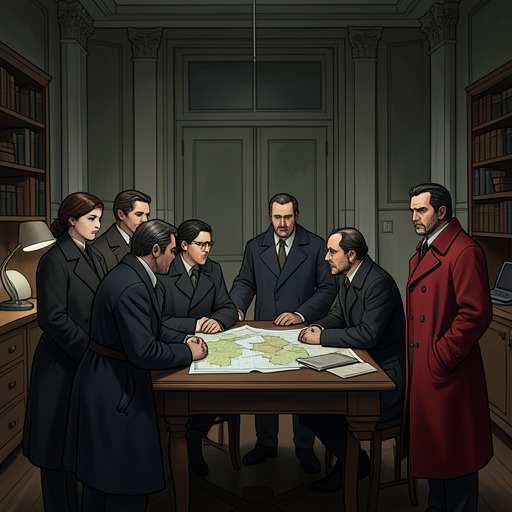
Ilisidi
PeacemakerIlisidi, the aiji-dowager, is a senior political authority whose influence rests not on holding office alone but on her capacity to act independently, command loyalty, and intervene when established institutions falter. In these events she moves from a secret journey toward Shejidan to a direct challenge within the Assassins’ Guild, then helps steer the political aftermath. Her cane and formal bearing mark her age, but neither makes her merely ceremonial: again and again, others must reckon with the force of her decisions.
Identity and Political Bearing
Ilisidi is a dowager of considerable age, though she admits nothing about it. On the train she sleeps, or at least keeps her eyes closed, dressed in many-buttoned black lace with both hands resting on her cane. The pose is formal rather than unguarded; even those traveling with her cannot be certain she is truly asleep. The contrast between apparent frailty and political readiness is central to her presence. She may sit still, but her attention and authority remain part of the situation around her.
Her influence is also visible in how others understand the rules of power. Under the Assassins’ Guild charter and its current rules, only two people can enter the Guild building and demand the Council’s attention regardless of its agenda: Tabini and Ilisidi. The possibility that she will exercise that right alarms Bren. She walks with a cane and is described as fragile, yet the contemplated action is not symbolic attendance; it is a demand that the Guild leadership answer for itself. The authority she wields is both personal and constitutional.
The Secret Return to Shejidan
Ilisidi’s journey back to the capital begins in circumstances designed to conceal its true purpose. She had been expected to host the preliminaries for Cajeiri’s birthday at Lord Tatiseigi’s Padi Valley estate in Atageini territory, with Jase Graham and three human children from the space station among Cajeiri’s guests. Instead, in uncommon haste, she gathers the party and heads south without first notifying Tabini. Their guards distrust outside communications channels, and the secrecy is not incidental: the party is moving toward a political emergency while limiting the information available to anyone who might compromise it.
The train itself is an instrument of concealment. It belongs to the northern districts and is supposed to be carrying spare cars toward Shejidan; in the account given to Transportation authorities, it is running empty. Its shades are down, as they would be in cars out of service. The cover story says a legislator in the capital has a family emergency in the north and needs a pickup at Bujavid station. The train can then return north and resume its regular operation. Because the rail system runs on a precise timetable, the movement cannot simply be hidden from other trains; Ilisidi’s party instead supplies an ordinary explanation for an extraordinary journey.
The crowded train carries the signs of a hurried, exhausting operation. Bren’s bodyguard, Ilisidi’s guards, and Lord Tatiseigi’s elder bodyguard have nodded off. The children, including Cajeiri and his three human guests, are collapsed at the far end, while Cajeiri’s young bodyguard continues to catnap by turns and stay on duty. Jase is asleep across from Bren; his guards are in the next car with five detainees. Jase is one of Cajeiri’s birthday guests, but Bren increasingly believes that Lord Geigi’s alarming briefing, rather than the celebration, is what brought him down from the station. The journey thus carries a family party, political principals, armed protection, and detainees under the appearance of an empty train.
The Guild Crisis and Ilisidi’s Intervention
The danger lies not in universal disaffection among Guild members but in corruption high in the organization. The investigators conclude that a small number of people placed in useful positions have spread disinformation across operations and caused extensive damage over a long period. They now believe they know the names involved and the identity of the person behind them: not an especially skilled field operative, but an old man at a desk. The distinction matters. The Guild’s ordinary membership is not treated as the enemy; the problem is a compromised upper level that has been able to manipulate records and operations.
Ilisidi intends to address the crisis directly, provided she and her party reach Shejidan safely and can assemble the right people without trusting a false name or a misleading lead. The plan carries risks beyond the immediate danger to the travelers. If the opposing side is confronted in a bloody clash, innocent Guild members may be caught in it, the wrong side may prevail, or the evidence may be lost. The case must be proved under law and before the membership. If Tabini has to impose a solution by decree, the Guild’s legitimacy may not survive, even if its leadership is removed.
That is why Ilisidi’s formal right to demand an audience matters. The exiled Guild members are likely to resist the idea of an Eastern dowager intervening in their dispute, but the charter places her among the two figures who can compel the Council to hear her. The challenge is meant to give the case institutional legitimacy rather than replace the Guild’s rules with the power of the aijinate. Ilisidi’s intervention therefore depends on a difficult balance: using exceptional authority to restore an institution whose authority would be damaged if it appeared to act only under political command.
At Bujavid, she makes clear that she has learned she was being excluded from the operation. Her response reaches Bren before her arrival: she sends a message announcing another message. When she enters the sitting room, accompanied by two bodyguards, staff quickly arrange a suitable chair beside Tabini and place others nearby. She sits upright with her cane at her side and immediately calls for the document. The scene gives physical form to her return to the center of events. She has not waited for an invitation to be brought up to date; she arrives to take part in the decision.
Protection, Regional Politics, and Aftermath
Ilisidi’s authority also rests on practical arrangements for protection. At the meeting with Tabini, she identifies unexpected assets that can protect the foreign guests, Cajeiri, and the others during the operation and against a possible second coup. Jase concurs with the plan. Bren reports that Jase can contact the station without going through the Messengers’ Guild and that Lord Geigi has substantially fortified the spaceport. Jase promises to defend the people on the floor if violence reaches Bujavid, though Bren does not claim that the entire building can be guaranteed safe. Ilisidi’s planning therefore joins local security to the possibility of support from the space station without treating either as a complete safeguard.
Her political work continues after the immediate crisis. When Tabini raises the risk that Lord Aseida’s arrest could damage Ilisidi’s name, she identifies Lord Topari as the person driving the challenge. She judges that Topari will contest even a television image on the grounds that it could have been edited. The dispute, in her reading, is not primarily about Aseida or the prerogatives of a lord. Topari’s real grievance concerns the trade agreement with Taisigin Marid, which he fears will undermine the Senjin rail line built by his grandfather and his own income from shipment fees. Ilisidi connects his objection to a longer-standing political hostility: he regards negotiation as weakness and sees the world in absolute terms. Her diagnosis separates the public argument about an arrest from the economic and personal interests propelling it.
She also manages the political consequences of the changes in Ajuri and Kadagidi. After her father’s death leaves Ajuri without a lord, Damiri observes that Kadagidi must also find a new lord and that the north faces further trouble. Damiri herself is a candidate for Ajuri, but Tabini does not want her in an office that has often been vacated. The political implications of her statement are clear to Tabini, whose glance shifts toward his wife. Ilisidi’s world of succession is consequently not separate from household relationships: a vacancy in a clan can become a question about Damiri’s position, her marriage, and the balance of power around Tabini.
After the encounter with Topari, Jase carries word to Lord Tatiseigi, Ilisidi, and Tabini so that each can prepare. The Conservative Caucus is to review the recording of the Kadagidi encounter and recommend a course on both the Ajuri question and the Kadagidi lordship. Ilisidi, meanwhile, plans to consult members of the Liberal Caucus; Dur is particularly relevant to the Ajuri situation because of his local and neighboring-association connections. Her response is coalition-building and consultation, not a unilateral announcement. Later, she reports good news from the Guild: investigators are sifting records and interviewing reliable people, and despite Tabini’s misgivings about those now in charge, they are setting matters right. She also describes a prospective arrangement for Lord Aseida in a small house supervised by the strong-willed lady of Corhenda, and notes that Lord Tatiseigi has a proposal for the Kadagidi succession. The details are concrete, but the broader pattern is the same: political repair requires records, witnesses, and workable placements, not merely the removal of an adversary.
Family, Counsel, and Continuing Influence
Ilisidi’s position within the family is inseparable from her political role. She is Cajeiri’s great-grandmother, and when Damiri’s condition requires her to leave the hall during Cajeiri’s Investiture, Tabini directs Jase to escort Cajeiri’s guests to Lord Tatiseigi’s apartment and asks Ilisidi to take his place in the hall. She is trusted to maintain the public occasion while the family responds to a private emergency. Afterward, Jase reports that Ilisidi took over and explained the situation to the worried young guests. Her intervention lets the children leave the hall without abandoning the ceremony’s responsibilities.
That same Investiture becomes the setting for Bren’s difficult conversation with Damiri. He explains that her great-uncle supported a Kadagidi with southern ties as a claimant to the aijinate and helped subvert the Guild, producing disorder across the aishidi’tat and pursuing Tabini while trying to seize Cajeiri. The Guild’s withholding of information had placed households and bodyguards at risk; Ilisidi’s aishid and Bren’s began investigating the organization and found the threads leading back to Shejidan and to Damiri’s great-uncle. Bren says Tabini rejected calls to dissolve his marriage to Damiri on political grounds and had insisted that she was not complicit in her great-uncle’s actions. He then urges her not to reject Ilisidi or her allies, but to learn from a woman who has survived the exercise of power without having sought it herself. Ilisidi’s influence reaches Damiri here through Bren’s advice: she is offered not as a simple model but as a political resource and possible guide.
The family history behind that possibility is complicated. When Damiri, then a young woman, becomes disaffected with her Ajuri father and leaves a family outing during the Winter Festivity in Shejidan, she presents herself to her Atageini uncle, Lord Tatiseigi, asking to be taken into the Atageini clan. Ilisidi’s cause had helped bring Tatiseigi back into relations with Ajuri. He writes to the Ajuri lord that Damiri is experiencing a crisis of man’chi and offers to keep her until she tires of life in her mother’s clan. Yet Tatiseigi has his own political need: he is childless and requires an heir. He sees Damiri as intelligent and enterprising, and hopes she might attach her loyalty to him. This history helps explain the dense field of kinship and succession in which Ilisidi acts, even when other family members make the immediate decisions.
At Cajeiri’s Investiture, Ilisidi is later seen relaxed and pleased, speaking with the head of the Merchants’ Guild and likely discussing the Marid situation. Her composure is not withdrawal from politics; conversation remains one of her instruments. The same evening, she sends Tabini a message under her personal seal, reassuring him that the numbers are felicitous and that she has seen to it. She also warns that Jase and the young guests will remember the event, and that their attendance will mark them if they are wise. Her message places political consequence alongside the ceremony’s public and personal meaning. Across these scenes, Ilisidi’s defining practice is to keep several scales of responsibility in view at once: the rules of the Guild, the safety of a household, the balance among regions, and the lessons a younger generation will carry forward.