Irene
PeacemakerIrene is one of three human children welcomed into Cajeiri’s household, where her quiet courtesy becomes part of the work of making human guests intelligible—and welcome—in Atevi social life. Physically tiny but the oldest of the three, she is neither simply a passive guest nor a flawless cultural interpreter: she watches for the rules, learns the expected forms, and sometimes steps forward before anyone else can answer. Her friendship with Cajeiri rests on a shared memory of their first meeting and is sustained by gestures that reach beyond formal hospitality.
Identity and Introduction
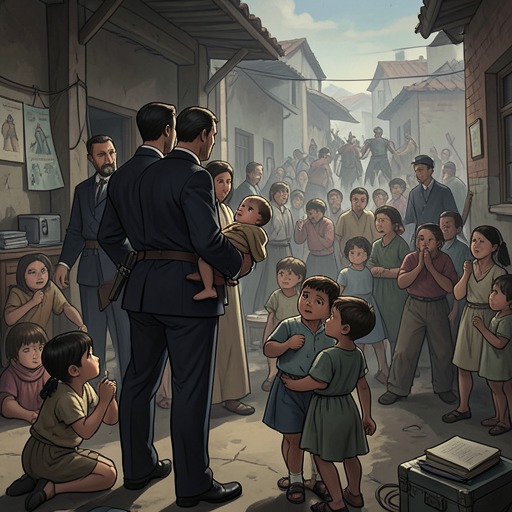
Irene arrives with Gene and Artur as one of the young guests for whom Cajeiri’s household must quickly arrange clothing and court appearances. The tailor Master Kusha judges her tiny in stature and, at the same time, the oldest of the children. He brings ready-made clothes suited to the three visitors and proposes alterations for their formal wardrobe. Irene’s later delight in the clothes shows that this practical provision becomes part of her experience of being received, not merely a requirement imposed on her.
Her identity is first established through an exchange Cajeiri remembers from their meeting in the ship corridors. He touches his chest and gives his name; Gene responds with the same solemn gesture, introduces himself and the others, and identifies them as human. Irene is present at this small ceremony of naming. The exchange gives their friendship a beginning that can be repeated: when the children later call one another friends, Cajeiri treats their original recognition as unchanged by the new setting around them.
Friendship with Cajeiri
Cajeiri openly names the children as his friends in front of household staff and attendants, then insists that he can give them birthday presents because adults do so. Irene, usually attentive to rules, points out that they are not supposed to say they are friends. Cajeiri answers that they still can, at least until they grow up. The distinction matters: Irene sees the boundary set by convention, while Cajeiri claims a space for their bond within it. The exchange ends not in a dispute but in laughter and the children touching hands in the human manner.
Their closeness also has a practical dimension. Irene is often quick to understand language, and she can help make an unfamiliar social situation manageable. Yet Cajeiri’s account of their first reunion shows that she is not always the first to grasp what a moment means: when he repeats the formal introduction, Gene understands and answers before Irene. Their friendship is therefore not presented as a simple arrangement in which one culture teaches and the other learns. The children meet across difference, sometimes through explicit explanation and sometimes by recognizing an old gesture.
Courtesy in Public
At dinner with Cajeiri’s parents, an unexpected question leaves the children in an awkward silence because Madam Saidin has not prepared them to answer it. Irene breaks that silence with a measured expression of thanks for the meal and for the hospitality. Gene and Artur follow with nods and agreement. Cajeiri is relieved that the response has not caused a social mistake; he has been acutely aware that the occasion depends on phrases the children have memorized and that Bren is not there to help fill gaps. Irene’s intervention is small in form but consequential in the scene: she supplies a safe answer at the moment when the prepared routine fails.
She shows the same composure at the end of another formal gathering. As the adults gather to leave, Irene thanks Cajeiri’s father and household for their hospitality and says the guests are honored. Her words prompt a brief astonished pause, after which Cajeiri’s mother asks her name. Irene answers directly. The moment makes her more than an object of adult curiosity: she addresses the household in its own formal setting, and the exchange gives the adults a chance to meet her as an individual.
Cajeiri later has to attend a public celebration and speak to hundreds of legislators in formal court dress. He complains to his friends about the hours of ceremony and the need to smile, while Irene responds that the occasion is good news. Her optimism does not erase the demands he describes; it offers a counterpoint to his dread. In preparing the children for public life, Jase helps them understand Atevi customs and Madam Saidin teaches them the appropriate phrases. Cajeiri also notices that his mother has taken an interest in Irene, though he remains suspicious, especially after a pointed remark about whether anyone had asked Irene’s mother. Irene’s presence thus draws attention across both the household and the political world beyond it, even when the reasons for that interest remain unstated.
A Guest in the Court
At a formal dinner arranged around a table with places for thirty-three, Irene and the other children are seated unusually high because they are minors in Jase’s care and are present as Cajeiri’s guests. The placement is a diplomatic choice, not a reflection of their own rank. A cushion is brought for Irene because she is shorter than the boys. The children sit very quietly, hands tucked in, their eyes moving over the glittering table and its guests; they have already eaten small sandwiches and teacakes and sip fruit drink carefully. Their behavior is watched within a room where hospitality and public display meet.
At a public exhibition, the children follow Jase’s cue when he and the others are acknowledged: they stand and bow respectfully. Their attention soon turns to a tall vase covered in parid’ja figures, which they go to inspect through the glass. Their interest in recognizable objects draws the attention of other visitors, who admire the artwork while discreetly watching the children. Irene is therefore present not only as a participant in carefully staged introductions but also as a curious young visitor whose movements make the human children visible to the wider audience.
On Cajeiri’s birthday, Gene and Artur greet him as soon as they emerge in the morning. Irene is still in bed, her pale hair disordered, and grabs her nightrobe in embarrassment when she realizes the attendants are present. Cajeiri assures her that the bedclothes have been layered so everyone is proper; an attendant confirms this without alarm. The brief episode brings the children’s informal shared life into the same frame as the household’s rules. Their closeness is ordinary enough to include a sleepy, awkward morning, but it still has to be negotiated within the standards of the adults around them.
Gifts, Memory, and Significance
When Cajeiri gives Irene and the others birthday cards, he explains that they are meant to keep and remember. Later Irene tells him that the children love the clothes and have received their own cards. Cajeiri urges them to treasure the cards because they are valuable onworld and unlikely to be encountered again in a lifetime. For Irene, the gifts connect the immediate pleasure of being dressed for court with a durable token of her place in the occasion.
The exchange is reciprocal. On Cajeiri’s birthday, Irene gives him a small handwritten notebook containing words he can use and instructions for pronouncing them. Her present is not an ornament but a tool for speaking: it offers language in a form he can carry and consult. Artur gives him a recharging light-up marble, while Gene gives him a pocket tool that unfolds into screwdrivers, picks, and a magnifying glass. The three gifts express different kinds of attention, and Irene’s turns her own linguistic skill toward Cajeiri’s needs.
Across these scenes, Irene’s characterization comes through in acts of attention rather than declarations about herself. She remembers the limits imposed by rules, recognizes when a prepared answer is needed, and speaks with courtesy when silence threatens to leave a social gap. At the same time, she accepts Cajeiri’s claim that friendship can persist despite those limits, and she answers his hospitality with a carefully chosen gift. Her presence gives the children’s cross-cultural contact a personal scale: formal dress, bows, cards, a shared joke, and a vocabulary notebook make the uncertain work of belonging concrete.