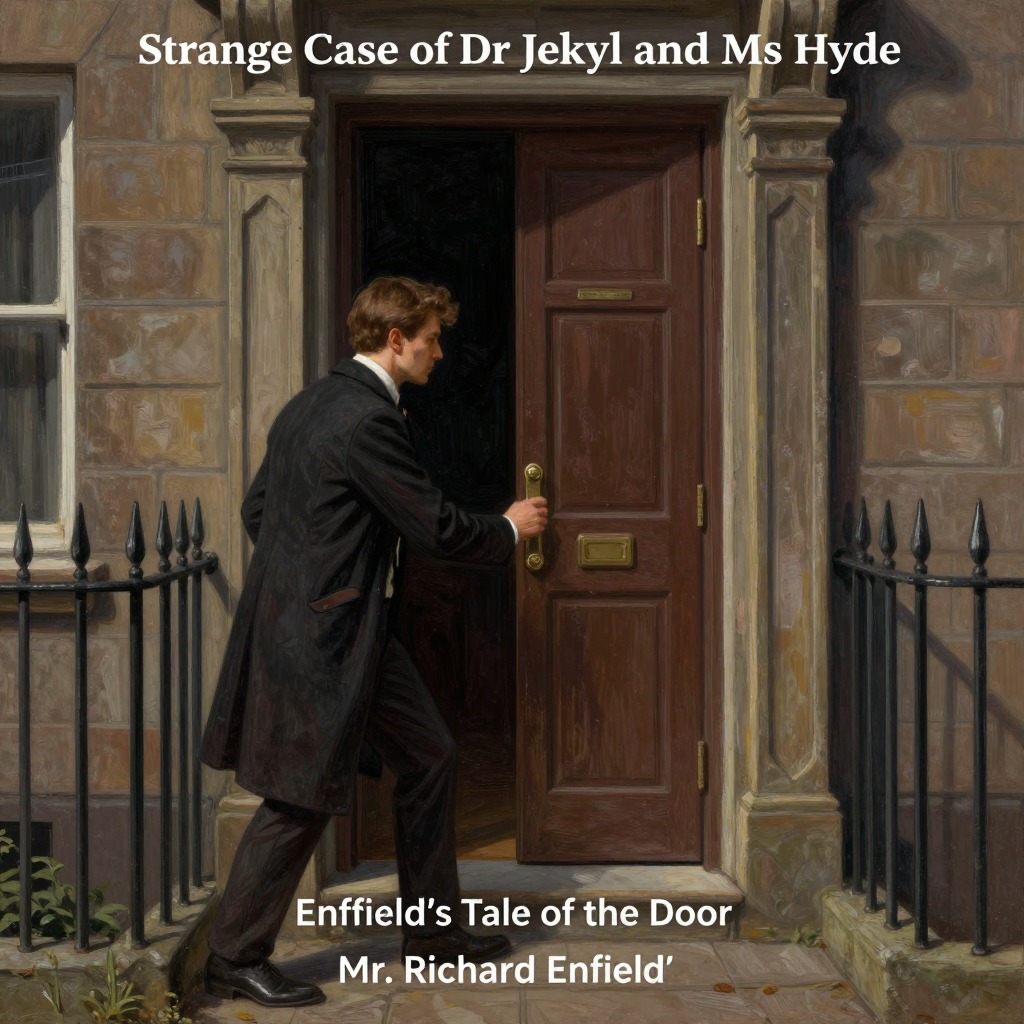
Enfield's rule
Enfield's rule is a personal principle of discretion articulated by Mr. Richard Enfield during his Sunday walk with Mr. Utterson, stating that the more a matter resembles Queer Street, the less one should inquire about it. The rule emerges as a direct consequence of the disturbing story Enfield has just told about the door in the by-street, and it becomes a tacit ethical code that governs the two men's subsequent conduct, shaping the narrative's approach to mystery and knowledge.
Origin and Statement
Enfield first states his rule after Utterson presses him for details about the door and the man who drew the cheque. Having just narrated the child trampling incident and the strange payment at the door, Enfield explains his reluctance to ask further questions: "I feel very strongly about putting questions; it partakes too much of the style of the day of judgment. You start a question, and it's like starting a stone. You sit quietly on the top of a hill; and away the stone goes, starting others; and presently some bland old bird (the last you would have thought of) is knocked on the head in his own back garden and the family have to change their name. No sir, I make it a rule of mine: the more it looks like Queer Street, the less I ask." The metaphor of the stone rolling downhill captures the unpredictable, escalating consequences of curiosity, and the phrase "Queer Street" — slang for a state of difficulty or trouble — becomes the rule's defining condition. Utterson immediately approves: "A very good rule, too."
Application and Consequences
Despite his approval, Utterson immediately breaks the spirit of the rule by asking the one question Enfield had avoided: the name of the man who walked over the child. Enfield gives the name "Hyde" but then, ashamed of his own long tongue, proposes a bargain: "Let us make a bargain never to refer to this again." Utterson agrees, and they shake hands on it. The rule thus becomes a mutual pact of silence, one that both men honor for nearly a year — until the Carew murder case forces the matter into public view. When they later pass the door again, Enfield declares the story "at an end at least" and expresses hope that they will never see more of Mr. Hyde. The rule has served its purpose: it has contained the mystery within the bounds of private discretion, allowing the two men to maintain their friendship without the burden of dangerous knowledge.
Narrative Significance
Enfield's rule functions as a narrative device that both delays and structures the revelation of the central mystery. By establishing a principle of deliberate ignorance, the rule creates a space of suspense in which the reader, like Utterson, must piece together clues from fragments and indirect testimony. The rule also reflects the broader Victorian culture of respectability and concealment that permeates the novel: the impulse to avoid scandal, to protect reputations, and to let sleeping dogs lie. Enfield's vivid metaphor of the stone rolling downhill anticipates the catastrophic chain of events that follows when the rule is finally broken — the murder of Sir Danvers Carew, the death of Dr. Lanyon, and the ultimate destruction of Henry Jekyll. In this sense, the rule is both a practical guideline and a thematic emblem of the dangers of curiosity in a world where the truth, once uncovered, may prove unbearable.