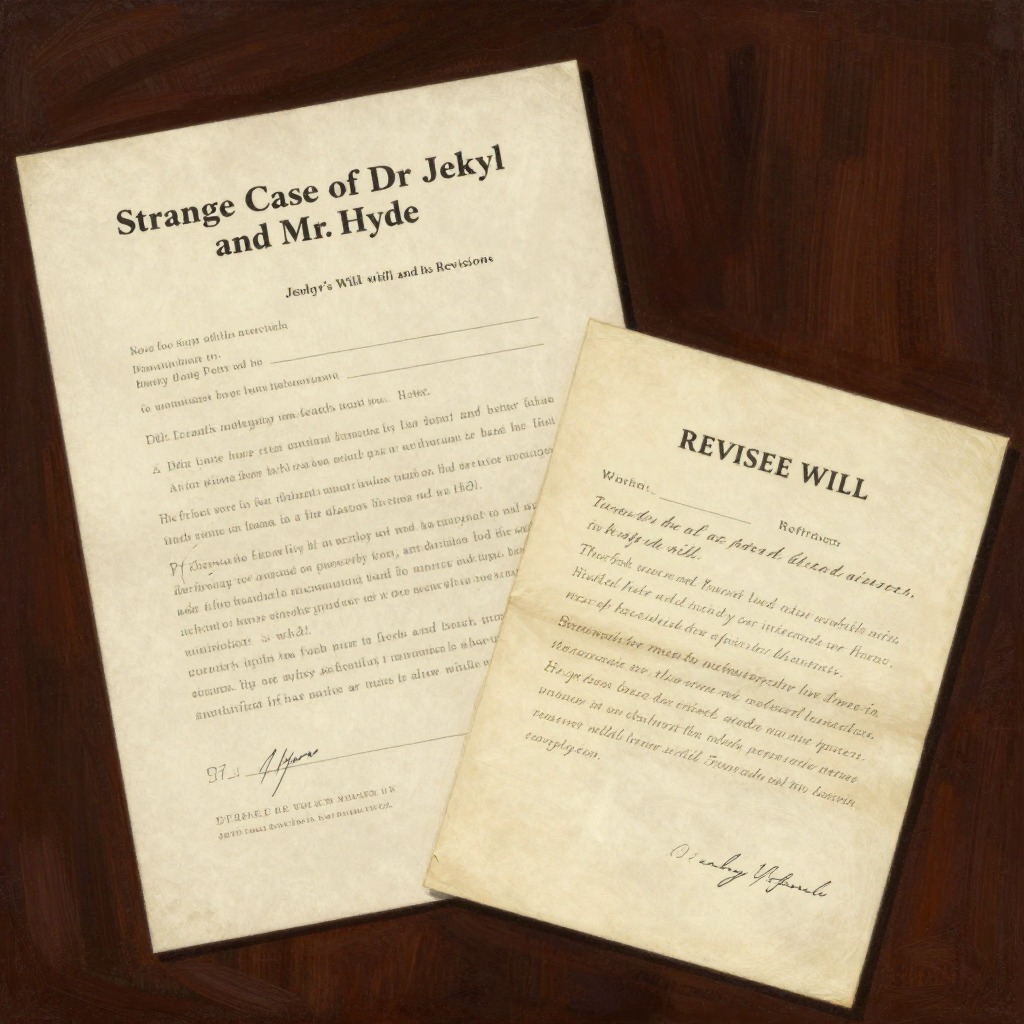
Jekyll's will disappearance clause
The Jekyll's will disappearance clause is a legal provision in Henry Jekyll's will that transfers his entire estate to Edward Hyde if Jekyll disappears or is absent without explanation for more than three calendar months, a condition that alarms Mr. Utterson and foreshadows the story's central mystery.
Origin and Legal Context
The will was holograph, drawn up by Jekyll himself without any assistance from his lawyer, Mr. Utterson, who had refused to lend the least help in its making. Utterson took charge of the document only after it was completed. The will provided not only that, in case of the decease of Henry Jekyll, all his possessions were to pass into the hands of his "friend and benefactor Edward Hyde," but also that in case of Jekyll's "disappearance or unexplained absence for any period exceeding three calendar months," the said Edward Hyde should step into Jekyll's shoes without further delay and free from any burthen or obligation beyond the payment of a few small sums to the members of the doctor's household. This document had long been the lawyer's eyesore, offending him both as a lawyer and as a lover of the sane and customary sides of life, to whom the fanciful was the immodest.
Utterson's Reaction and Suspicion
Utterson's indignation had initially been swelled by his ignorance of Mr. Hyde; but after hearing Enfield's tale of the child trampling incident, his knowledge of Hyde made matters worse. It was already bad enough when the name was but a name of which he could learn no more; it was worse when it began to be clothed upon with detestable attributes. Out of the shifting, insubstantial mists that had so long baffled his eye, there leaped up the sudden, definite presentment of a fiend. "I thought it was madness," he said, as he replaced the obnoxious paper in the safe, "and now I begin to fear it is disgrace." The lawyer's suspicion deepened when he learned from Poole that Mr. Hyde had a key to the laboratory and that all the servants had orders to obey him. Utterson conceived a spark of hope that Hyde must have secrets of his own, black secrets, but he also feared that if Hyde suspected the existence of the will, he might grow impatient to inherit. "Ay, I must put my shoulders to the wheel—if Jekyll will but let me," he added, "if Jekyll will only let me."
Connection to the Mystery
The disappearance clause proved to be a key element in the unfolding mystery. When Utterson later confronted Jekyll about the will, the doctor seemed seized with a qualm of faintness, shut his mouth tight, and nodded when Utterson asked if Hyde had dictated the terms about that disappearance. "I knew it," said Utterson. "He meant to murder you. You had a fine escape." The clause also reappeared in the second will that Utterson discovered in the cabinet after Hyde's death, drawn in the same eccentric terms but with the name of Gabriel John Utterson substituted for Edward Hyde. The lawyer, with indescribable amazement, read his own name and realized that Hyde, who had been in possession of the cabinet for days, had not destroyed this document despite having no cause to like him. The clause thus served as a legal mechanism that both revealed the depth of Jekyll's bondage to Hyde and provided a crucial clue to the nature of their relationship.