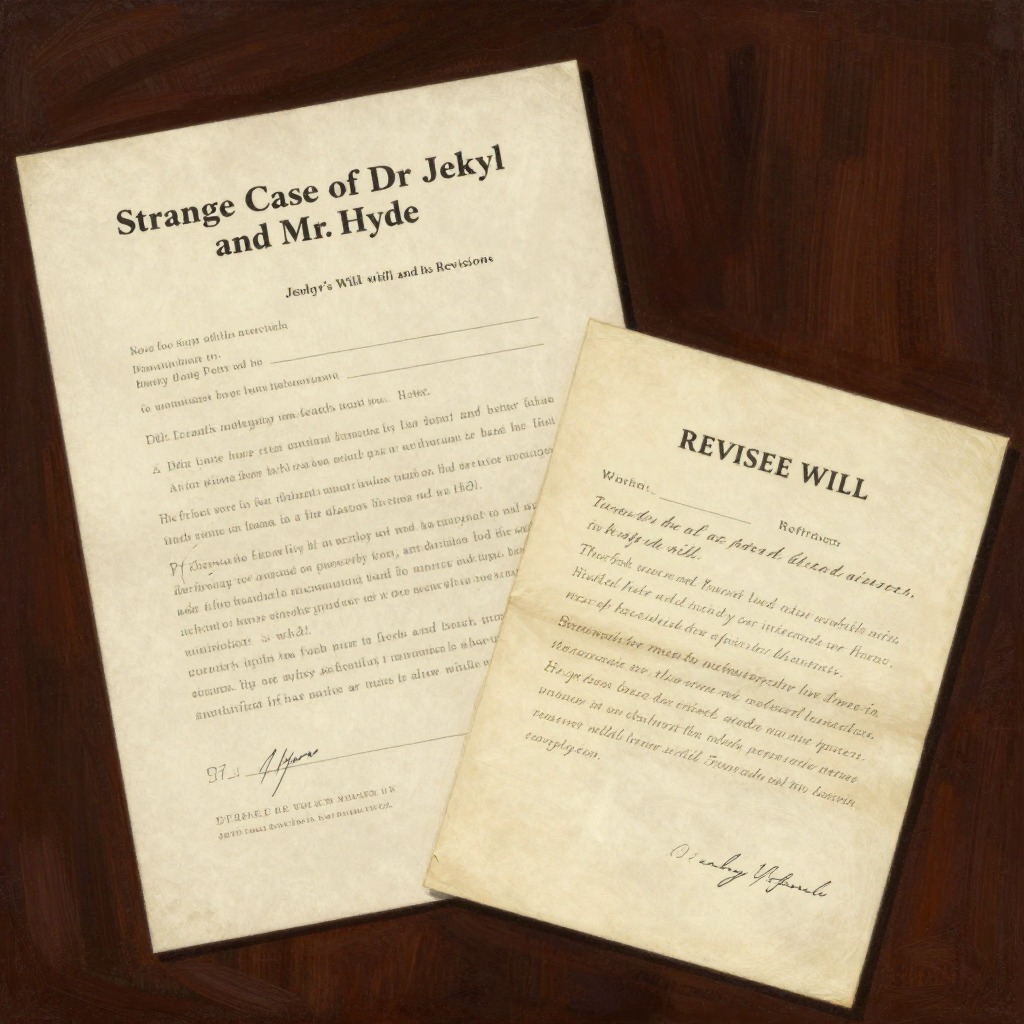
the second will (naming Gabriel John Utterson)
The second will (naming Gabriel John Utterson) is a revised testament discovered in Dr. Jekyll's cabinet after Hyde's suicide, which replaces Edward Hyde with Mr. Utterson as the sole heir, revealing Jekyll's final attempt to undo his catastrophic connection to Hyde and his desperate trust in Utterson.
Discovery and Contents
When Mr. Utterson and Poole broke into the cabinet on the last night, they found the body of Edward Hyde on the carpet and, on the business table, a large envelope bearing Dr. Jekyll's hand and Utterson's name. Inside, the first enclosure was a will drawn in the same eccentric terms as the one Utterson had returned six months before—serving as a testament in case of death and a deed of gift in case of disappearance—but with one staggering difference: in place of Edward Hyde, the lawyer read the name of Gabriel John Utterson. Utterson looked at Poole, then back at the paper, and finally at the dead malefactor stretched upon the carpet, his head spinning. He realized that Hyde had been in possession of the cabinet for days, had no cause to like Utterson, must have raged to see himself displaced, and yet had not destroyed the document.
Significance and Implications
The second will represents Jekyll's final, desperate attempt to sever his bond with Hyde and to place his affairs in the hands of the one man he trusted above all others. It is a testament not only to Utterson's integrity but to Jekyll's belated recognition that his connection to Hyde was a catastrophe from which he needed to be rescued. The will's survival—despite Hyde's hatred of being supplanted—suggests either that Hyde was too consumed by his own crisis to destroy it, or that some remnant of Jekyll's willpower prevented its destruction. For Utterson, the document is a shock that deepens the mystery: it confirms that Jekyll had been alive and present in the cabinet that very day, and that he had deliberately rewritten his inheritance to exclude Hyde. The will thus becomes a key piece of evidence that Jekyll had not simply been murdered or fled, but had taken a deliberate, if belated, step to undo the harm he had done.
Connection to the Broader Mystery
The second will echoes the original will's strange clauses—the disappearance clause, the transfer of all possessions to Hyde—but reverses their direction. Where the first will had been an eyesore to Utterson, a document that seemed to invite disaster, the second will is a gesture of reparation. It is found alongside a brief note from Jekyll dated that same day, instructing Utterson to first read Lanyon's narrative and then turn to Jekyll's own confession. The will thus forms part of the final packet of documents that Utterson carries home to read, the last pieces of the puzzle that will explain the entire mystery. Its presence in the cabinet, alongside Hyde's dead body and the crushed phial, completes the picture of a man who, in his final hours, sought to set right what he could, even as he knew his end was near.