219 North Delaware Street
Truman219 North Delaware Street was both a private family home and the fixed point around which Harry S. Truman’s life repeatedly turned. First associated with Bess Wallace’s family and her mother’s guarded household, it became the newlyweds’ shared address, then the home to which the former president returned in 1953. Its rooms, front gate, and courtyard gathered together the social distance of Truman’s courtship, the practical limits of the couple’s finances, the rhythms of his retirement, and his wish to remain close to his work even after death.
The Wallace home and the courtship
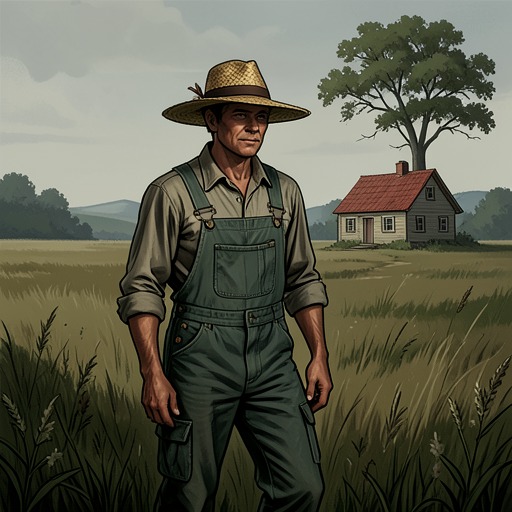
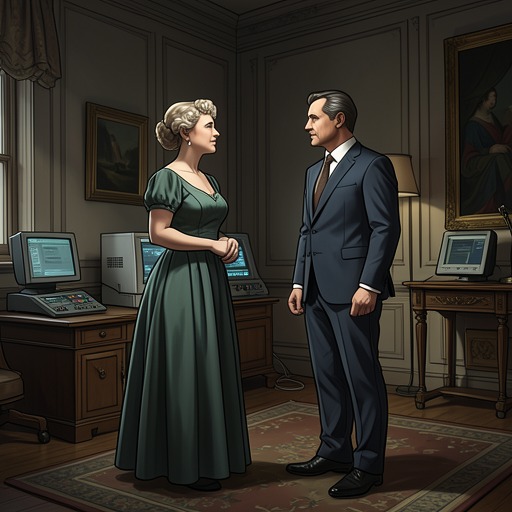
Before it became Truman’s home, the house embodied a world sharply different from his own. At 219 North Delaware Street, the front door had etched glass; the long parlor windows were hung with heavy lace curtains; plum-colored Brussels carpets, good china, and silver dessert forks signaled comfort and stability. For the debt-ridden farm boy courting Bess, each visit made the distance between their circumstances tangible. His prospects were already uncertain, but Madge Wallace’s dependence on her daughter compounded the obstacle: after her husband’s suicide, Madge clung to Bess as a source of strength and resisted anything that might take her away.
Madge did not consider Harry S. Truman a suitable match for Bess and tried to discourage the relationship. One recollection attributes to her the judgment that a farmer boy would not get anywhere; another Wallace family acquaintance later remembered that Madge thought no man good enough for Bess. The house thus stood not simply as a comfortable setting for courtship but as the center of a family arrangement Bess’s suitor would have to enter. Its order and privacy represented a way of life foreign to Truman, while Madge’s hold over the household made the question of marriage inseparable from where the couple would live.
Marriage and an extended household
Harry S. Truman and Bess Wallace married on June 28, 1919, at Trinity Episcopal Church in Independence. After a brief honeymoon, they returned sooner than planned because Bess worried about her mother’s health. At Madge’s request, they moved into 219 North Delaware Street and occupied Bess’s room at the top of the stairs on the south side. The home that had marked the gulf between the courtship couple’s worlds now became their shared residence, though not an independent household of their own.
The arrangement drew the wider family close around Madge. The household included Bess and Truman, Madge, Bess’s college-student brother Fred, and the elderly Mrs. Gates. Behind the house, beyond the driveway, two small one-story bungalows faced Van Home Boulevard; Bess’s brothers Frank and George lived there with their wives. The family remained together in a compact domestic complex under Madge’s watchful eye. Neighbors could regard her as an exemplary lady and, at the same time, a difficult person. Bess thought the couple’s stay temporary: they would remain only until her mother adjusted to the fact that she was married. Truman arrived with clothes, a few books, and a trunk of Army belongings—nearly all that he owned.
The return after the presidency
Decades later, the house became the obvious homecoming place when Truman left the presidency. He and Bess Wallace Truman had little practical room for an expensive move. Truman had no former-president salary or pension, no government office or staff allowance, and only his Army pension of $112.56 a month. The couple had inherited farmland at Grandview with Truman’s siblings, and they would soon become joint owners of the old house at North Delaware. Madge’s estate, excluding the house, amounted to $33,543.60; divided among her four children, Bess’s cash inheritance was $8,385.90. The couple were land-rich, but their circumstances offered little scope for an extravagant life.
Local speculation imagined a fine house in Kansas City or a new home on the Grandview farmland. An old family friend even selected an elegant house that he thought better suited a former president. But such suggestions missed the point: the Trumans intended to stay in Independence, and their return to the old Wallace home also reflected their limited financial choices. When their train reached town on January 21, 1953, an unexpectedly large crowd—perhaps ten thousand people—waited in the cold at the depot. Truman later described his first unguarded walk through town as a striking sign that his life had changed. Yet the return did not turn the house into a secluded retreat. Sightseers and curious visitors came almost daily, and delegations gathered outside the iron fence to peer in. Truman decided to leave the fence in place.
The house as a base for daily life
The home could seem quiet and too large, with only Bess and Vietta Garr there in the evenings; Truman and Bess called their daughter Margaret in New York each night. But it also became the anchor for an active routine. Truman resumed morning walks and drove to his Kansas City office, where he regularly arrived before nine. His first weeks brought 72,000 pieces of mail, and he kept up with it rather than withdrawing from public life. Visitors who wanted to shake his hand or talk could come to the office without an appointment, while the steady stream of onlookers outside the house made privacy difficult to recover.
As he worked on his memoirs, the house connected his daily present to the Independence of his past. The lights came on well before dawn, usually around 5:30, and the Kansas City Times was tossed over the iron fence from a passing car. Truman came down the porch steps in his shirtsleeves to retrieve it. Around seven, he left for a half-hour walk, locking and checking the front gate on his way out. His route passed the Victorian home of his Noland cousins and the church where he and Bess had met in Sunday School, then went through familiar streets toward the Square. He returned at about 7:30; after breakfast, he left again by the back porch with an aluminum briefcase holding manuscript pages. In his two-tone green Dodge, he drove west toward his office, carrying work from the house into the city and back again.
Family milestones and the final connection
The house remained a family setting as well as Truman’s working base. In 1956, Margaret’s wedding reception took place there after her marriage at Trinity Episcopal Church, the same church where her parents had married in 1919. The reception was held indoors, screened from the reporters and photographers gathered at the iron fence and the sightseers passing the house. In 1969, Harry S. Truman and Bess marked their fiftieth wedding anniversary at home with only a few friends dropping by; Bess explained that Truman was not well enough to stand for a long time greeting guests.
The house also held the longest view of the couple’s life together. In 1913, while away at the Grandview farmhouse, Truman had written that a week felt incomplete if he did not reach 219 Delaware at least once. In later years, few days passed without his being there. As his world narrowed, books became central to his life, and neighbors could see him through the window in his chair beneath a reading lamp. He died at Research Hospital and Medical Center in Kansas City in 1972, not in the house. But when shown the plans for his funeral, he objected to lying in state in Washington and indicated the courtyard at his library as the place where he wanted to be buried, so that he could, in his imagined words, get up and walk into his office. The home at North Delaware had been the enduring domestic center of his life; the nearby burial place he chose carried that same attachment to remaining close to home and work.