Jackson County, Missouri
TrumanJackson County, Missouri, was at once a place people crossed on their way west and a home they fought to possess. Its fertile prairie and river bottoms drew settlers from Kentucky, but its history was also shaped by forced migration, wartime destruction, and the struggle to govern a rapidly changing county. In the twentieth century, Harry S. Truman’s administration made roads a public commitment and helped define the county’s civic landscape, even as machine politics and election fraud shadowed its government.
Frontier Settlement and the Land
In 1841, Solomon Young and Harriet Louisa Young left Kentucky with two small children to settle in westernmost Missouri, then regarded as the extreme frontier of the United States. Their journey was part of a larger migration that had begun nearly two decades earlier, encouraged by reports of a new Eden in the far west and by Missouri’s admission to the Union as a slave state in 1821. Families named Boggs, Dailey, Adair, McCoy, McClelland, Chiles, Pitcher, and Gregg were among the early arrivals. By 1827, settlers had established Independence as the county seat; later migrants, including families named Noland, Freeman, Truman, Peacock, and Wallace, arrived in the hundreds.
Most newcomers were farmers of Scotch-Irish descent, many with little formal education. Their material circumstances varied: some had substantial means, while most were neither wealthy nor, by the standards of their own time, destitute. Many were Baptists and Democrats who identified strongly with a laboring, landholding ideal and admired Andrew Jackson. The county’s political culture could be blunt and fiercely self-reliant, traits that also encouraged stubbornness and quarrels.
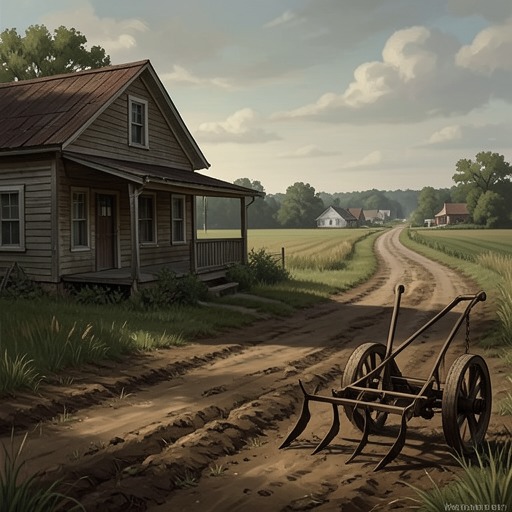
The landscape explains the attraction. Rolling, fertile country, clear springs, and the Blue and Little Blue rivers supported farms and settlements. Limestone, pasture, timber, and deep prairie soil were abundant; walnut was especially plentiful and prized for building. Yet bringing prairie under cultivation demanded heavy labor: cutting the sod could require six to eight yoke of oxen. The rich uplands around Independence were already being farmed by the time many later settlers arrived, so the promise of open land was accompanied by competition over who would control it.
The Mormon Conflict and Civil War
That competition became violent in the early 1830s. Members of the Church of Jesus Christ of Latter-day Saints began arriving in 1831, bought land, established a settlement and a ferry crossing on the Blue River, and opened a store and the town’s first newspaper. Their opposition to slavery and their growing numbers intensified local hostility. Joseph Smith declared Jackson County holy land and intended Independence to become the City of Zion. By the summer of 1833, the Latter-day Saints made up roughly a third of the county’s population, and local residents feared they could influence the coming election. A courthouse meeting produced a proclamation that they were no longer welcome.
Violence followed: a mob destroyed the Mormon press, attacked the settlement, and drove women and children from their homes; crops and barns were burned, and residents were beaten. After more than a thousand people were forced across the Missouri River, the conflict continued elsewhere. Governor Lilburn W. Boggs called out the militia and demanded that Mormons leave the state or face extermination. The conflict ended in 1839, when the Mormons departed for Illinois, but the episode established a lasting pattern in which disputes over land and political power could become coercive displacement.
During the Civil War, Jackson County became known as the burnt country. The violence harmed Union supporters as well as Confederates and their families. Judge Henry Younger, a Union man, saw his farm destroyed in a Jayhawker sweep and was later murdered; his son Cole joined William Quantrill’s guerrillas. Civilians elsewhere were killed, threatened, or made to watch their farms burn. Independence itself saw two major battles: the first in August 1862, when Quantrill’s band and Confederate forces overwhelmed a Union camp, and a second two years later, when fighting continued block by block for two days.
The Union’s General Order No. 11 brought destruction on a wider scale. Issued on August 25, 1863, it required civilians in Jackson, Cass, and Bates counties to leave their homes within fifteen days, except for people living near specified Union posts. Those who could satisfy a Union commander of their loyalty could remain in designated towns or cross into Kansas; others had to leave Missouri. Grain and hay left after the deadline were to be destroyed. About 20,000 people were driven from their homes, and Union cavalry took property and burned buildings and crops. Solomon Young had already signed a loyalty oath, yet his family was allowed only one wagonload of possessions. His daughter Martha Ellen later remembered the family’s journey north to Kansas City.
Government, Roads, and Public Works
When Truman became presiding judge of the county court in January 1927, he held office for two consecutive four-year terms, through January 1935. His remit was substantial: an annual operating budget of $7 million and roughly 700 employees, alongside responsibility for public services and more than a thousand miles of county roads. The county’s institutions included a hospital, homes for children and older people, two courthouses with jails, and a range of offices from the sheriff and treasurer to road overseers and health officials. Kansas City, Missouri, with nearly half a million residents, was part of the constituency Truman now represented.
Truman declared that county government should serve taxpayers efficiently and economically. Although he promised to appoint Democrats, he also insisted that public employees do a full day’s work. Contemporary assessments praised his command of county affairs and his administrative ability. His government hired Democrats from both local party factions, and it also placed his brother Vivian on the county payroll as a purchasing agent for the county homes.
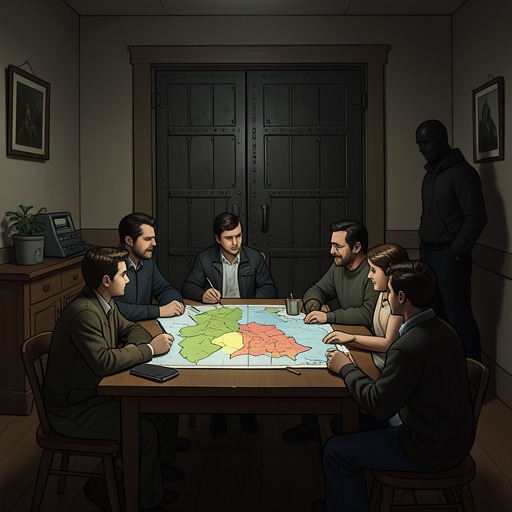
Roads became the administration’s defining project. Within days of taking office, Truman appointed a bipartisan board of engineers to survey the county and prepare a plan, accompanying them on hundreds of miles of inspections. Their report found that 350 miles of existing roads were inadequate for modern traffic and expensive to maintain. It proposed 224 miles of concrete roads, designed so that no farmer would be more than two miles from one, financed by a $6.5 million bond issue. Truman argued that voters would support the plan if contracts were honest and construction was first-rate. During his campaign for the bonds, voters received maps showing the proposed improvements and were told that contracts would go to low bidders under bipartisan engineering supervision.
The bond proposal also included a new Kansas City courthouse and jail, a new county hospital, and a home for children with intellectual disabilities. Voters rejected the courthouse, jail, and children’s home proposals but approved the roads and hospital on Truman’s forty-fourth birthday, May 8, 1928. The road bonds passed three to one. Truman’s first road contract, worth $400,000, went to a South Dakota firm; other contracts followed with companies not usually selected for county public works. By 1933, the roads had been completed as promised and within the approved funds and engineers’ estimates.
A further bond issue funded more roads, the Kansas City courthouse, and extensive remodeling of the Independence courthouse. The new courthouse in Kansas City was part of a larger Ten-Year Plan that also included a city hall and civic auditorium. Truman studied public buildings on a long automobile tour, traveling as far as Denver, Houston, Brooklyn, and Baton Rouge before settling on what he wanted for the county. His attention to the courthouse reflected the same insistence on public works as tangible evidence of civic ambition that had guided the road program.
Machine Politics and Electoral Scandal
County government operated alongside the influence of Tom Pendergast’s political organization. In the 1930s, Kansas City gained home rule and control of its police, strengthening the organization’s position. When Missouri failed to redraw congressional districts in 1932, candidates for the House had to run statewide. The large Jackson County vote consequently mattered across Missouri, giving Pendergast’s organization greater reach. The county’s infrastructure boom unfolded within this political setting: public improvements and machine power rose together, without being identical.
That political system was exposed by investigations into election fraud. Evidence assembled by federal investigators showed that about 60,000 ghost votes had been cast in Kansas City in 1936, with registration totals in some precincts exceeding the known population. The ensuing trials lasted nearly two years and produced 279 convictions. The investigation was pursued by federal district attorney Maurice Milligan and Governor Lloyd C. Stark, who had once benefited from the organization but turned against Pendergast. The episode made Jackson County’s political machinery a matter of national attention and revealed how ordinary citizens could participate in a system whose scale and methods had long been suspected.
The county’s history therefore resists a single image of either pastoral promise or political corruption. Its land offered exceptional agricultural possibilities, but control of that land repeatedly became a source of conflict and displacement. Its government could deliver carefully planned roads and public institutions while operating amid powerful political patronage and documented electoral fraud. Across those contrasts, Jackson County, Missouri, remained both a lived-in community and a contested political landscape.