Poland
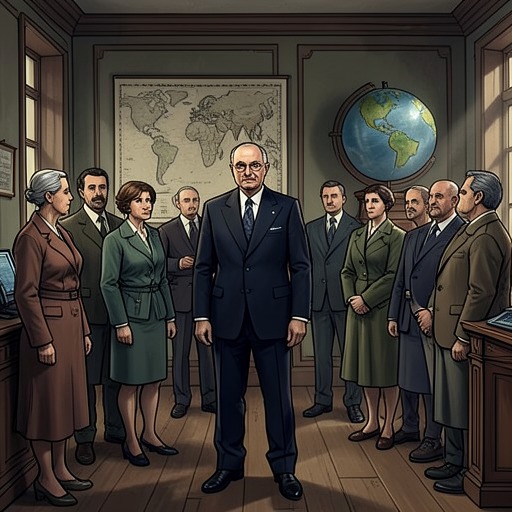
TrumanPoland is presented as the pivotal ground on which wartime Allied promises met the realities of Soviet power. Occupied by Soviet forces, the country became a test of whether the Soviet Union would honor the Yalta agreements and permit a political settlement acceptable to its former allies. For Harry S. Truman, the dispute was among his first urgent foreign-policy challenges as president: Poland’s future raised questions about free elections, political liberty, international cooperation, and the limits of American willingness to accommodate Moscow.
Occupation and the Yalta Commitments
In the weeks surrounding Franklin D. Roosevelt’s death, reports from Poland increasingly suggested that the settlement agreed at Yalta was breaking down. A State Department account provided to Truman described the Soviet Government as taking a firm, uncompromising position on major questions. In Poland, Soviet authorities were repeatedly failing to keep agreements made at Yalta, while the Soviet Union supported its own Warsaw Provisional Government as the body entitled to speak for the country. The book presents this not as a disagreement over diplomatic wording alone, but as a contest over who would exercise political authority in Poland and whether the country would have a government formed through a genuinely open process.
The reports also described a broader loss of independence. In March, Winston Churchill warned Roosevelt that Poland was losing both its frontier and its freedom. Averell Harriman reported that American prisoners of war liberated by the Russians were still being held in Russian camps under conditions he called unbelievable; the book places this report alongside the failure to exchange liberated prisoners. Harriman later explained to Truman that Russian control in Poland or Romania would mean more than influence over foreign policy: it could bring secret police and the end of freedom of speech. Poland thus represented, in the administration’s discussions, the human and political consequences of Soviet control as well as a breach of agreements between governments.
Roosevelt’s Unresolved Policy
Roosevelt had become increasingly concerned about Soviet conduct, yet he continued to seek cooperation. After Stalin accused Roosevelt and Churchill of arranging a separate peace with the Nazis during negotiations over the surrender of German forces in Italy, Roosevelt answered that distrust at the moment of victory could endanger the whole Allied undertaking. Churchill urged a firmer response to the Soviet Union. Roosevelt, however, still hoped that disputes could be managed: in his final communications with Stalin and Churchill, he pressed against mistrust while insisting that the United States must remain firm.
That combination of continued engagement and growing alarm shaped the problem Truman inherited. Harriman urged the new president to abandon any assumption that the Soviet Union would act according to accepted principles in international affairs, while also maintaining that workable relations remained possible if both sides made concessions. Truman acknowledged that complete cooperation from Stalin was unattainable, but he still hoped for substantial cooperation. Poland made the tension in that position concrete: accommodation could preserve the possibility of collaboration, but accepting a Soviet-backed political outcome without the promised elections risked conceding the substance of the Yalta settlement.
Truman Makes Poland a Test
Before meeting Molotov, Truman made clear that the dispute had consequences beyond Poland itself. He told Harriman that if the Polish question were not settled as agreed at Yalta, the Senate would very likely reject American participation in the United Nations. He intended to explain his position to Molotov plainly. The warning connected foreign policy to domestic consent: the administration’s ability to support a new international organization depended, Truman argued, on whether the Soviet Union kept its commitments in Poland. Poland therefore became a test both of Allied trust and of whether Truman could secure support at home for postwar cooperation.
When Vyacheslav Molotov arrived at the White House with his interpreter and the Soviet ambassador, Truman raised Poland directly. He said the United States would recognize no Polish government that failed to provide free elections. He also said the United States would proceed with the United Nations despite disagreements over other matters, while reminding Molotov that American foreign policy depended greatly on public support and that postwar economic assistance would require congressional approval. These points set out both the standard Truman demanded in Poland and the political limits on what his government could promise abroad.
The Dispute and Its Significance
Molotov replied that Allied cooperation required the three governments to treat one another as equals and argued that the Poles had worked against the Red Army. Truman cut off that defense, saying he was not interested in propaganda and wanted Molotov to tell Stalin that the Soviet Government had failed to honor its agreements. According to Charles Bohlen’s later account, Molotov turned pale and attempted to divert the conversation. Truman then stressed that he wanted friendship with the Soviet Union, but insisted that Poland remained the sore point: the United States would carry out the Yalta agreements and expected the Soviet Government to do the same. In Truman’s recollection, Molotov protested that he had never been addressed in that way; Truman answered by telling him to carry out the agreements.
The encounter did not resolve Poland’s political future. Its immediate significance in the narrative is that Truman made the country the clearest early measure of his approach to the Soviet Union: cooperation remained desirable, but it could not simply substitute for compliance with agreements or for free elections. The Polish question also exposed the overlap between international diplomacy and American politics. Truman’s position was directed at Molotov and Stalin, but it invoked the Senate, Congress, and the public as limits on American policy. In this way, Poland became more than the setting of a postwar dispute: it was the point at which the new president confronted the gap between Allied commitments and Soviet control, and where his administration began defining the terms on which cooperation could continue.