Japan
TrumanJapan occupies a decisive place in the final phase of the war described in the book: it is both the setting of an increasingly costly Pacific campaign and the intended target of a proposed atomic attack. The account connects the approaching end of the war to the immense American military effort, Truman’s public demand for surrender, and the difficult judgment that the weapon should be used against targets where civilians would also be at risk.
Japan and the mounting cost of the war
In the spring of 1945, the war in the Pacific remained unfinished even as the end of the war in Europe approached. A major daylight raid sent more than four hundred B-29 bombers over Tokyo for two hours. The account places that attack amid mounting American losses: by then, 196,999 Americans had died, while total American casualties—including those killed, wounded, missing, and captured—had reached 899,390. The weekly increase was 6,481. These figures made the cost of victory in the Pacific increasingly visible.
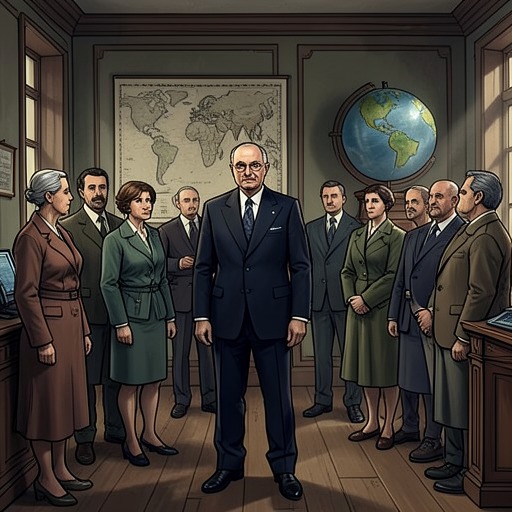
The scale of the task also defined Truman’s responsibility. He had succeeded Franklin D. Roosevelt as commander in chief of a force exceeding sixteen million men and women, with an enormous naval armada and military resources on an unprecedented scale. Yet the senior military leaders estimated that fighting in the Pacific might continue for another year and a half. Japan thus represented not merely a remaining opponent but the prospect of a prolonged campaign and further losses, at a moment when Truman had become personally responsible for decisions about how the war would end.
That responsibility had a domestic institutional dimension as well. Truman had argued that the war effort must remain under civilian control, warning that the growing influence of military leaders over industry and agriculture could shape the country’s postwar political and economic structure. The issue was not confined to Japan, but it framed the wider setting in which the United States mobilized its resources and considered the means of bringing the war to a close.
The demand for surrender
After Germany’s defeat, Truman publicly turned attention to Japan. In announcing the end of the war in Europe, he described victory as only half achieved and urged Americans to continue working until the remaining fighting was over. His separate statement called on Japan to surrender and warned that American attacks would grow in force and intensity, bringing further suffering without changing the ultimate outcome.
Truman also addressed what unconditional surrender would mean for the Japanese population. He stated that it did not mean the Japanese people would be exterminated or enslaved. This distinction accompanied the demand for surrender: the administration threatened escalating military force while rejecting the idea that surrender itself entailed the destruction or subjugation of the population. Japan’s position in the account is therefore defined both by the continuing military campaign and by the terms Truman publicly attached to its conclusion.
The atomic-bomb decision
In discussions over the atomic bomb, the Interim Committee and its scientific panel reached a set of recommendations concerning Japan. They advised using the weapon as soon as possible, without warning, against a war plant surrounded by workers’ homes or other buildings vulnerable to damage. The stated purpose of choosing such a setting was to create a powerful psychological effect among the population. The recommendation made civilian exposure part of the proposed means of ending the war, rather than an incidental concern outside the decision.
A demonstration against an uninhabited or purely military target had been considered, but the committee and scientific panel rejected that option. The scientists could not propose a demonstration they believed would produce the necessary shock. The discussion also acknowledged that a warning could be used to reduce the consequences of employing such a weapon, but the recommendations ultimately favored use without warning. These choices reveal how the deliberations balanced the desire to force surrender quickly against the likelihood of damage to inhabited areas.
The committee’s role was advisory; the responsibility for the recommendation rested with the senior official who presented the conclusions to Truman. The argument for using the bomb rested on the expectation that a tremendous shock might compel the Emperor and his military advisers to surrender, potentially saving lives in a longer war. Truman was reported to have agreed reluctantly, while believing there was no alternative. Japan consequently became the focal point of a decision whose claimed objective was to end the war, but whose proposed method deliberately sought an effect on a broad population.
Japan’s place in the account
The book presents Japan through a narrowing sequence of pressures: the Pacific campaign’s mounting casualties, the prospect of many more months of fighting, a public demand for surrender, and deliberations over an unprecedented weapon. Tokyo’s bombing illustrates the existing scale of the air war; the atomic-bomb discussions show how the search for a decisive end raised a different and more concentrated question about civilian exposure.
The account does not treat the decision as an abstract military calculation. It links the anticipated shock to the hope of ending the conflict and setting that expectation against the human cost built into the recommended target and the absence of warning. Japan’s significance in this passage lies in that convergence: it is the last major theater of the war described here, the object of Truman’s surrender appeal, and the setting around which the most consequential wartime judgment in the account was organized.