Truman family farm
TrumanThe Truman family farm at Grandview, Missouri, was both a demanding family enterprise and the place where Harry S. Truman learned habits that endured beyond his years as a farmer. He worked its fields, assumed responsibility for its debts and operations after his father’s illness and death, and later drew on the experience of rural roads when he pursued public construction in Jackson County. The farm offered security and time to think, but it also made his slow progress toward the life he wanted feel increasingly confining.
Setting and Daily Work
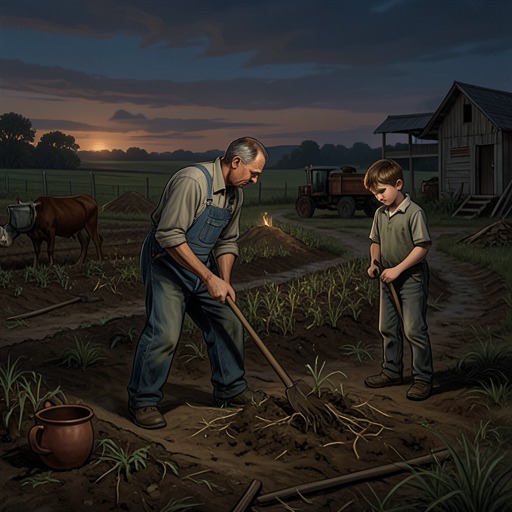
The farm’s rhythms were set by early mornings and physical labor. During his father’s lifetime, the workday began with a call from the foot of the stairs at 5:30 a.m.; Truman rode a cultivator through fields of young corn. He later remained an early riser, even after his father was gone, and valued the quiet morning hours for thinking. Farming meant working through long days as well as worrying about weather, debts, and whether hired men would work for him as they had for his father. In April 1915, he told Bess Wallace that he had been in the field from six in the morning until seven in the evening and felt he had to make the year succeed, even if that meant working night and day.
The farm was not separate from Truman’s other duties. While his father was seriously ill, he ran the farm, continued his road work, and drove John Truman to a doctor in Kansas City, Missouri, as often as four times a week. The illness brought family responsibility into direct conflict with the work that could not wait: his mother sometimes asked him to stay home rather than make the trips, while it remained essential to plant 200 acres of wheat. After his father underwent an operation at Swedish Hospital in October and returned home, neighbors began visiting as his condition worsened. Truman was rarely away from his father’s side. When John Truman died, Truman was already accustomed to carrying the farm’s work, but he understood that his father had been the person who had made it run. He later wrote to Bess Wallace that he now had quite a job on his hands.
Security, Debt, and Restlessness
The farm’s ownership and finances gave the family a measure of security even as they faced substantial obligations. A long dispute over Truman’s grandmother’s will ended with his mother retaining the farm, but legal fees consumed the money recovered. The land had already been mortgaged, and doctors’ bills and funeral expenses led Truman to sell Black Angus cattle he had recently acquired. His father’s debts and the losses associated with a zinc-mine venture added to his burdens. Bess Wallace lost what she had invested in the venture; Truman’s own loss was uncertain, given at different times as $11,000 and $7,500. The sums were borrowed, and the farm was mortgaged again in 1917.
At the same time, the farm was a valuable asset. After Harrison Young died in 1916, his share passed to Martha E. Truman and her children, leaving the farm solely in the family’s hands. Wheat reached $1.65 a bushel that year; by 1917, good land in Jackson County could sell for $200 an acre. The farm was estimated to be worth at least $100,000 and possibly twice that, although Martha E. Truman had no intention of selling. Good years could bring a clear income of about $4,000, and exceptional ones as much as $7,000, while a typical working family earned less than $1,000. Its value therefore meant more than prosperity: it was a reserve against financial trouble, and neighbors regarded the Trumans as capable farmers.
That security did not resolve Truman’s dissatisfaction. By the time he was thirty, he had spent eight years on the farm and remained devoted to his family and determined to win Bess Wallace, yet he hated what he regarded as his slow progress at home. A trip to Texas with Uncle Harry, intended to draw him into land speculation, came to nothing; a subsequent zinc-mine venture also failed to provide the imagined way forward. He pictured an ideal country house with Bess Wallace, while the old house at the farm needed paint and repairs because he was paying interest on a debt he said he had not made. His mother continued to support the mining venture with money, a choice that angered Vivian Truman, who believed he should focus on the farm. Truman later recalled that, when forced to choose between farming and zinc mining, he preferred farming.
From Farm Roads to Public Works
The farm’s influence reached beyond agricultural work. Truman’s experience of roads around Grandview, Missouri, joined his memory of roads in France and the practical lessons of years of automobile travel in a vision for public construction. His father’s determination to maintain roads had, in the book’s account, contributed to his death; Truman’s own ambition was to build roads honestly and to a high standard. He promised voters that contracts would go to low bidders and that bipartisan engineers would supervise construction. To make the proposed work tangible, voters received maps showing where improvements would be made.
The 1928 bond proposal combined roads with plans for a new courthouse and jail in Kansas City, Missouri, a county hospital, and a home for children with intellectual disabilities. Voters rejected the courthouse, jail, and children’s home, but approved the roads and hospital by a three-to-one margin. The vote came on Truman’s forty-fourth birthday, May 8, 1928. He followed through on his promise of competitive contracting, awarding a first contract of $400,000 to a South Dakota construction firm; other work went to firms not usually selected for public projects in Jackson County. The connection between farm roads and county infrastructure was not merely symbolic: the rural conditions he had lived with helped shape a concrete program of public works and his insistence on honest construction.
Family Life and Lasting Significance
The farm remained a family gathering place after Truman’s working years there. On Sundays, Harry S. Truman, Bess Wallace, and their daughter Margaret Truman drove to Grandview, Missouri, for a large midday fried-chicken dinner. Margaret remembered the atmosphere as markedly different from the formal household in Independence: Martha E. Truman was lively, opinionated, and closely associated with a vigorous rural world. Truman enjoyed her company, and the visits made the farm part of his family life as well as a place of work and memory.
Truman later described farm labor as drudgery and also as the best time of his life. A day riding a plow gave him solitude in which to think, even though he enjoyed and needed the company of others. His mother credited the farm with giving him common sense; he associated it with the pride required to run a farm and with the habits of rising early and working hard that he never lost. Ethel Noland believed he was never meant to be a farmer, and Truman’s own restlessness supports that distinction between occupation and education. He held on for ten years, doing his share and more, but the farm’s deepest legacy was not that it fixed his future. It furnished a practical grounding he carried into public life, while remaining the family home and the financial foundation from which he could imagine other possibilities.