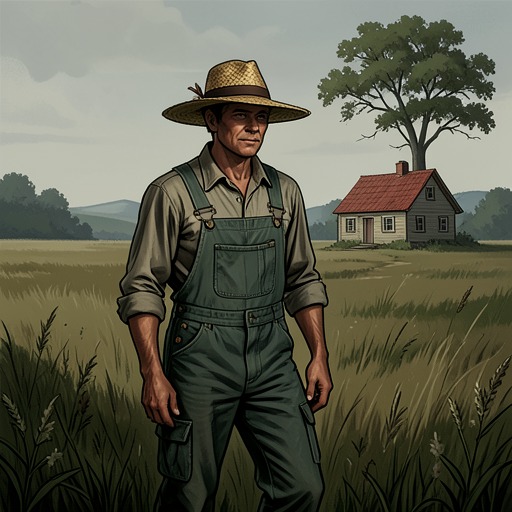
Blue River country
TrumanBlue River country was a region of western Missouri shaped by migration, farming, and the appeal of its rich prairie-and-river landscape. Its fertile ground drew settlers from Kentucky, but the area was not an empty frontier: by the time Solomon Young and Harriet Louisa Young arrived, much of the best land was cultivated and its ownership had already been contested. The region became the setting for the Young family’s rise as farmers and stockmen and for the rural life from which Harry S. Truman later left for military service.
Setting and Settlement
Blue River country lay in Jackson County, around the courthouse town of Independence, founded in 1827. By the 1840s, Independence had a permanent population of perhaps seven hundred, but spring migration swelled the crowds around Independence Square to two or three thousand. Travelers heading west filled its public houses and wagon shops; the two-story Noland House was promoted as the westernmost hotel in America, and the wagons built by Hiram Young, a free Black manufacturer, were prized for prairie crossings.
The settlement drew heavily on a migration from Kentucky that had begun nearly two decades earlier. Solomon and Harriet Louisa Young joined this movement in 1841 with two young children, among hundreds of newcomers bearing family names that would become part of the local community. Many settlers were farmers of Scotch-Irish descent, and their attachment to land and cultivation helped shape the region’s identity. They saw working the earth as a moral calling and regarded themselves as true Americans.
Land and Agricultural Conditions
The attraction was tangible: rolling, fertile country with clear springs, ample timber along the streams, and the Blue River and Little Blue River flowing out of Kansas Territory. Limestone quarries and bluegrass pastures recalled Kentucky, while abundant walnut, oak, ash, and other trees supplied material for homes and barns. Prairie grass and wildflowers covered stretches of open ground, with country south of Independence remaining largely unbroken prairie.
The soil’s richness demanded substantial effort to reach. Cutting through the dense sod required six to eight yoke of oxen; beneath it lay dark loam two to six feet deep, and in some river bottoms as much as twenty feet. The contrast between resistant surface and deep fertile earth made the region both difficult to cultivate and exceptionally promising for farmers.
The climate could be equally demanding. Temperatures sometimes shifted by fifty degrees within hours, and summers could be oppressively hot whether conditions were too dry or too wet. In 1844, severe flooding was followed by a tornado that destroyed trees and fences and killed people. The Youngs began farming near the Missouri River, then, possibly in response to the flood, claimed higher ground farther south.
Farms, Conflict, and Change
In 1844, Solomon Young made an eighty-acre public-land claim on Blue Ridge, about sixteen miles south of Independence near Hickman's Mills. The land was well drained, fertile, and suited to grazing, corn, and wheat, with views extending into Kansas Territory. He paid the minimum price of $1.25 an acre and had to occupy the property to secure title. While he traveled seventy miles to the land office at Clinton to file the claim, Harriet Louisa remained with their two small children in a shelter of fence rails and brush.
Blue Ridge became the family homeplace. As six more children were born, the Youngs acquired additional land and built a house and barn. Despite recurring financial setbacks, Solomon developed a reputation as one of the county’s best farmers and stockmen. His knowledge of horses, mules, and land supported a trans-prairie freighting enterprise, and his accumulated holdings eventually amounted to a small empire by Jackson County standards.
The land’s value also made it a source of conflict. In 1831, members of the Church of Jesus Christ of Latter-day Saints began arriving in the area. They bought land, established a settlement and a ferry crossing on Blue River, opened a store in Independence, and founded the town’s first newspaper. Some spoke against slavery, while their religious claims and community were met with hostility from local settlers. The account presents this confrontation as part of the region’s earlier history of contested land and belonging.
Truman-Era Associations
The agricultural landscape remained part of the family story generations later. In 1917, Harry S. Truman was farming at Grandview, Missouri, and could have remained there rather than leave for military service. His decision to go placed responsibility for the farm and for their mother on his sister, Mary Jane Truman. The episode gives the rural setting a personal consequence: leaving the farm was not simply a change in Harry’s own direction but a redistribution of family work and care.
The later Truman household was also rooted in nearby Independence. After their honeymoon, Harry and Bess Wallace returned there and lived with her family at 219 North Delaware Street. In 1923, while Harry pursued political and professional commitments, Bess remained at home; the couple’s private correspondence records both the distance between them and their continuing intimacy. The region thus serves not only as an agricultural backdrop but as the place connecting family labor, home life, and Truman’s movement from rural work into public service.