Blue Ridge farm
TrumanBlue Ridge farm was first an 80-acre frontier claim and eventually the homeplace of the Young family, where Harry S. Truman spent much of his early childhood. Its history is told through changing dwellings and generations: from the exposed shelter of an occupied claim to a substantial farmstead, and later to a crowded, spare farmhouse whose fields and daily work formed part of Harry’s upbringing.
Claim and Settlement
Solomon Young and Harriet Louisa Young began farming at the Parrish place near the Missouri River, within the projected outlines of Kansas City. Shortly afterward, in 1844, they made their first claim to public land on higher ground near Hickman's Mills, about sixteen miles south of Independence. The site, known as Blue Ridge, offered fertile, well-drained soil suited to grazing, corn, and wheat, and distant views across Kansas Territory. The move may have been prompted by the year’s disastrous flood, though the account does not establish that as the reason.
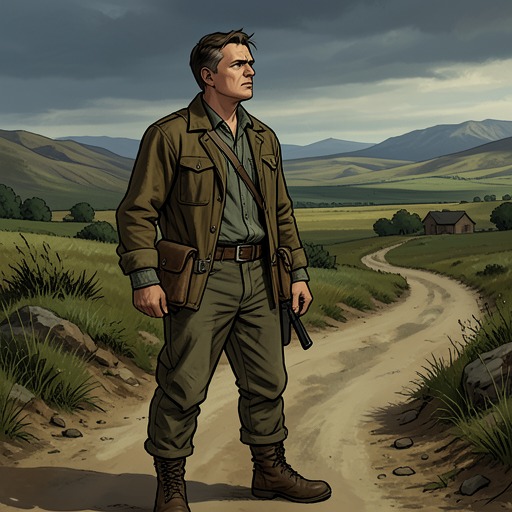
The initial claim was 80 acres, the minimum purchase under the Land Act, at $1.25 an acre, the minimum price for public land. Young had to occupy the property to gain title. Family stories remembered the couple arriving with “a gun and an axe and two babies and a blanket.” While Solomon rode seventy miles to the land office at Clinton to file the claim, Harriet Louisa stayed with their small children, Susan Mary and William, in a shelter made of fence rails and brush. The claim’s title thus rested not only on a transaction but on the family’s physical presence on the land.
A Growing Farmstead
The family expanded as the farm did. Six more children were born, larger parcels were acquired, and a house and barn were built. Blue Ridge became the Youngs’ homeplace. Solomon suffered repeated financial setbacks, yet developed a reputation as one of the county’s best farmers and stockmen. Skilled at judging horses, mules, and land, he traded them when opportunity arose, established a trans-prairie freighting enterprise, and eventually accumulated holdings that amounted to a small empire by Jackson County standards.
In 1868, as Martha Ellen Truman—then known as Mattie—turned seventeen, the family resettled on Blue Ridge in a new, more spacious house. Harriet Louisa had chosen its site. The white, wood-frame house, with green shutters, faced west at the end of a straight quarter-mile drive. Double rows of elms lined the drive, which Mattie had helped her father plant. A central hall separated two large front parlors; the dining room and kitchen occupied a rear wing enclosed by porches. Beyond the orchard stood a huge red barn built from heavy walnut planks and beams salvaged from the old mill at Hickman's Mills.
The immediate farm comprised 600 acres, with fields enclosed by squarely built limestone rock fences. Solomon appears to have recovered from wartime losses and resumed his prosperity. The open high ground became a place of pleasure as well as work for Mattie, who rode sidesaddle on one of several fine horses. Blue Ridge’s farm life also depended on practical skill: she learned to bake and sew and to use a rifle, while her father spared her the task of milking by advising that she need never learn it.
The Truman Childhood Landscape
By the time the Trumans returned to Blue Ridge, the farm’s older boundaries and landmarks remained. The rock fences still marked the property, and two large square limestone gateposts stood at the main entrance from the rock road. The elms had grown so tall that their shade covered the drive from road to house; beyond the house and orchard, the old walnut barn still stood, painted red. The Slaughters, prosperous farmers with eight children, were the only neighbors visible to the north, sharing nearly a mile of boundary with the Trumans. After dark, their lights were the only ones in view beyond the farm’s cropland, trees, and sky.
Harry’s connection to the place was also practical. Farm work filled his days: he hoed corn and potatoes, made hay, cared for horses, repaired equipment, sharpened tools, and mended fences. He learned about livestock from his father and became particularly fond of the hogs. The farm was therefore not just scenery around his childhood; it was a working environment in which he acquired knowledge through repeated tasks and close attention to animals, weather, and land.
The community around the farm changed while the landscape remained recognizably rural. Grandview, Missouri, grew about a mile to the south after two railroads—the Kansas City Southern and the St. Louis & San Francisco—cut through corners of the farm. Its post office, bank, grocery, feed and hardware stores, and two depots were a ten-minute ride down the rock road. The bells of Grandview Baptist Church could be heard on Sunday mornings. The railroad town brought nearby services and new connections, but the farm’s long boundaries, open fields, and limited view of neighbors continued to define its setting.
Household and Significance
The house occupied by the Trumans was more modest than the spacious dwelling described in 1868. After a fire, a small frame farmhouse had been built for Harriet Louisa; by the Trumans’ return, she still owned the whole farm. The plain white house, trimmed in dark green, had seven small rooms. Harry and his brother Vivian slept beneath the eaves over the dining room, in a tiny room with low windows reached by a narrow back stairway. There was no electricity, running water, or plumbing. The hand pump often froze in winter, and the upstairs room became stifling in summer. A telephone on the wall beside the front door was the one modern convenience.
Despite the cramped conditions, neighbors remembered the house as scrupulously neat. Its domestic order and the extensive farm work existed side by side: a crowded home, a working landscape, and a family presence stretching across generations. By 1887, John Truman had joined Solomon as a partner, and the Young homeplace became the setting for many of Harry’s earliest observations, beginning when he was three. Grandfather Anderson Shipp Truman had his own upstairs room, while relatives and children also shared the house; the household commonly numbered fourteen or fifteen people. Blue Ridge farm’s narrative significance lies in that continuity. The original claim, the family’s expanding farm, and the crowded home where Harry grew up are successive layers of one place, linking his early world to the land Solomon and Harriet Louisa had claimed decades before.