Independence, Missouri
TrumanIndependence, Missouri, was at once a frontier gateway, a courthouse-centered political community, and the enduring home of Harry S. Truman. Founded during a migration from Kentucky and animated by river traffic and overland trade, it became the setting for Truman’s local political career and the place to which he returned after the White House. The town’s significance in his life was more than symbolic: its streets, courthouse, home, and eventual library shaped the public stages and private routines that framed his story.
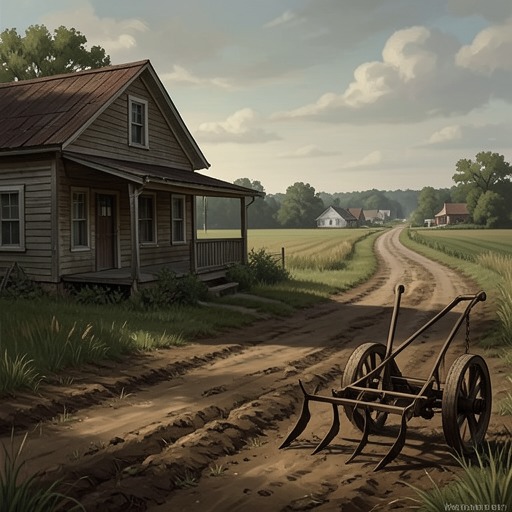
A Frontier Settlement and River Gateway
The town emerged from a large migration out of Kentucky that had begun nearly twenty years before the arrival of Solomon Young and Harriet Louisa Young. Accounts of a far western “New Eden,” including reports sent back by Daniel Morgan Boone, son of Daniel Boone, encouraged settlers to make the journey. Missouri’s entry into the Union as a slave state in 1821 was another part of the attraction for migrants. By 1827, early families including the Boggs, Dailey, Adair, McCoy, McClelland, Chiles, Pitcher, and Gregg families had founded a courthouse town on high ground in Jackson County. The surrounding region was often called the Blue River country; later arrivals, among them the Hickman, Holmes, Ford, Noland, Truman, Wallace, and Young families, numbered in the hundreds.
Most newcomers traveled by steamboat rather than wagon or horseback. From Louisville they followed the winding Ohio River past Henderson and Paducah to Cairo, then continued up the Mississippi River to St. Louis. There they changed boats and headed west on the Missouri River, called the Big Muddy, laboring against its current for 457 miles to a dramatic bend. Passengers disembarked at Wayne City or Westport, small, muddy river settlements only a few miles from Independence, then the frontier’s only town of consequence in the area. The route made Independence both a destination and the inland point of arrival for people and commerce moving west.
The town’s early bustle earned it the name Queen City of the Trails and the distinction, in the book’s account, of being the country’s first western boomtown. To settlers coming off the river, it could seem almost metropolitan: stores, blacksmith sheds, wagon shops, crowded streets, and continual activity. Wagon trains assembling for Oregon added to the traffic, while Mexican caravans from Santa Fe brought wagons, pack mules, and substantial sums of gold to trade for American goods. In one reported spring arrival, a caravan of twenty-two wagons carried $200,000 in gold specie. Like a seaport, Independence had a customhouse, an institutional marker of its role as a trading hub on the frontier.
The Square, the Courthouse, and the Town’s Character
By the time Truman knew it, Independence had become a small, tightly connected community. Its population was about six thousand and growing slowly. Residents knew one another and one another’s affairs; the town was churchgoing and conservative, and many preferred its settled pace. Kansas City, by contrast, appeared brassy, commercially minded, and filled with newcomers. Independence was described as southern in spirit and tempo, more southern than midwestern, and deeply attached to its established ways. This contrast remained important in Truman’s life: he could work in the larger political world without ceasing to identify with the smaller town whose people and histories he knew.
The courthouse dominated the townscape. At the center of the Square, on a shaded lawn, it had replaced a modest earlier building with a much larger red-brick renovation in the high-Victorian style. Its mansard-roofed clocktower rose five stories above the surrounding trees and could be seen for miles. More than an administrative building, the courthouse was the town’s visual and political focal point. Independence was solidly Democratic, and party affiliation was treated as a local inheritance, as routine as religious upbringing. The courthouse, in the book’s pointed formulation, was Democratic too: county government and the town’s political identity occupied the same conspicuous center.
The town retained its close-grained, familiar character even as it changed. Farmers crowded the Square on Saturday nights; during the rest of the week, evenings were quiet, marked by passing trains and the courthouse clock. The town directory continued to list many of the names associated with its earliest settlement, including Truman, Wallace, Noland, and several of the families who had arrived generations earlier. Truman knew nearly all of their family histories. That knowledge served his political work, but it also expressed a genuine attachment to the town. He enjoyed walking up to the courthouse square and talking with people, and had no wish to return to country life permanently, even though he liked visiting his mother and sister on the farm.
Home, Family, and Local Politics
Independence was also the center of Truman’s personal life. After he could travel more freely, he drove between the family farm and town in a polished automobile, presenting himself in a cap, white shirt, and Sunday tie rather than as a country boy. He took Bess and friends fishing on Blue River, picnicking near the waterworks by the Missouri River at Sugar Creek, or driving through the countryside. Their courtship unfolded in this local landscape, and on June 28, 1919, they married at Trinity Episcopal Church on North Liberty Street. The church was crowded with family and friends; the summer heat became so oppressive that the flowers wilted.
The Gates family home at 219 North Delaware Street offered a quieter counterpoint to Truman’s public ambitions. During his first county campaign, Bess did not participate because she had suffered a second miscarriage, following one in 1920. The losses were kept within the family. Truman’s public life therefore developed alongside private disappointment in the Independence home, where his family’s experience was not visible to the crowds and political supporters who came to know him. The address later became a familiar reference point for residents and visitors alike.
The county courthouse made Independence a launch point for Truman’s political career because the judges’ administrative authority reached deeply into local government. The eastern judge’s position was not a judicial post but the equivalent of a county commissioner. The three judges controlled county spending and could hire and oversee road supervisors, road gangs, clerks, and hundreds of other employees. They also determined county contracts, including those for a road system in constant need of maintenance and repair. One vote on the three-member court therefore carried practical weight, both through control of public funds and through political bargaining.
Truman opened his 1922 campaign for eastern judge at a March 8 rally in Lee’s Summit, with about three hundred people gathered for speeches, cigars, and music. Veterans were prominent, and the campaign was presented as an American Legion candidacy; members of his former Battery D unit attended alongside some supporters associated with the Pendergast organization. The local campaign eventually led to a still more powerful county office. After the Pendergast and Shannon factions had repaired their differences, Truman ran unopposed in the primary for presiding judge. In November the Democratic slate won, and Truman acquired substantial authority in county government. The courthouse that had towered over Independence’s Square was now the place where his political responsibilities took concrete form.
His public standing in town was not confined to elections. A completed $200,000 county courthouse, described as the building’s fifth remodeling since 1836, was dedicated on a September day with festivities lasting from morning into night. The program ranged from horseshoe pitching and an old fiddlers’ contest to music, a horse show, street dancing, a merchants’ parade, and a historical pageant. The formal ceremony began at two o’clock beside the refurbished four-faced courthouse clock, now set in a colonial cupola, and included speeches by Governor Park and Judge Harry S. Truman. The dedication joined civic celebration to the building’s continuing role in county life.
A National Figure Returns to Independence
As Truman’s national career grew, Independence remained the setting through which many residents understood him. After his nomination, three thousand people crossed the lawn behind 219 North Delaware Street to shake his hand as he stood beneath a rose arbor with Bess and their daughter, Margaret. Bess performed the expected public role despite her dislike of the crowds and ceremony. The old Victorian house itself appeared unassuming to visiting reporters, who noticed that it needed paint. The contrast between national prominence and an ordinary, aging family home became part of the town’s public image.
When Truman left the presidency, the journey back to Independence completed a long passage from the local courthouse to the White House and home again. About ten thousand people waited at the depot in the cold for his train, which arrived at 9:03, an hour late after crowds at earlier stops across Missouri. Truman was astonished and moved by the welcome. A few days later, before full daylight, he set out alone on his first walk through town in more than seven years without a military aide or bodyguards. He covered about fifteen blocks and passed Jackson Square. He later described that walk as the moment that most sharply marked the change in his life: the return of ordinary movement through the streets of his own town.
The welcome did not turn his return into a retreat from work. Truman kept his morning walks and maintained an office in Kansas City, where 72,000 pieces of mail arrived in the first two weeks. He came in regularly before nine and settled into the workday. At home on North Delaware Street, the old routine resumed as well: lights came on before dawn, usually around 5:30, and he went down the porch steps in his shirtsleeves to retrieve the Kansas City Times, thrown over the iron fence by a passing car. The president had returned to the same town rhythms he had long known.
Independence’s new attention to its former resident was visible in its streets. Cars and sightseeing buses passed slowly along North Delaware, and the depot displayed a sign identifying the town as the home of Harry S. Truman, thirty-third president. Truman objected to the number on grounds of historical accuracy, insisting that he was the thirty-second because Cleveland had served twice. Even an inaccurate sign revealed how strongly the town had begun to present itself through its association with him; his correction showed that the details of public memory mattered to him.
The Library and the Town’s Lasting Association
The town’s most consequential gesture was to donate Slover Park as the site for Truman’s presidential library. The quiet, picturesque park occupied a thirteen-acre knoll just beyond U.S. Highway 24, about a mile from 219 North Delaware Street. Truman considered Independence more suitable and accessible than Grandview. Using land at Grandview would also have imposed a significant financial sacrifice on him and on Vivian and Mary Jane, since that property was increasing in value. The park placed the institution within easy walking distance of his home and joined his public record to the town where his personal and political life had taken shape.
Truman moved from the Federal Reserve Bank Building into new offices at the library, whose formal dedication took place on July 6. The library’s establishment fulfilled one of the two things he had said he wanted most after leaving office; the other, becoming a grandfather, had also come to pass. Independence was no longer merely the town he had left for national service. It had become the home of his presidential papers and the place where his post-presidential life was organized.
Truman died at Research Hospital and Medical Center in Kansas City on December 26, 1972. Two days later, in accordance with his wish, he was buried in the library courtyard in Independence. The service was held in the library auditorium, with attendance limited to 250 invited people, among them Averell Harriman, Clark Clifford, Charlie Murphy, Harry Vaughan, and Sam Rosenman. The burial completed the town’s role in his life: the courthouse had marked his political beginnings, North Delaware Street his homecoming, and the library grounds his final resting place.