South Korea
TrumanSouth Korea, the southern portion of a peninsula divided at the 38th parallel, is the setting through which the book traces Harry S. Truman’s most consequential military decisions. Its fortunes shift from a rapid retreat that threatened the survival of its government to a dramatic reversal at Incheon, then to a bitter withdrawal after Chinese forces entered the war. South Korea’s place in this story is both geographical and political: defending it tested the United Nations, American presidential authority, and the principle that military operations remained subject to civilian direction.
Territory and Division
South Korea comprised the territory below the 38th parallel, a boundary drawn hastily in the final week of World War II to organize the surrender of Japanese troops. The line divided the peninsula between Soviet forces to the north and American forces to the south. It had no grounding in Korean history or geography; American officers selected it late one night at the Pentagon partly because it already appeared on most maps. What had been intended as a temporary administrative arrangement became a decisive political and military boundary.
The southern republic was slightly larger than Indiana and had a population of about 20 million—twice that of North Korea. Its economy was chiefly agricultural, while most of the peninsula’s industry lay in the north. The contrast did not mean that the south was secure: the advancing North Korean People’s Army soon pressed its forces toward the southeastern end of the country. The main road and rail route from Seoul to Busan, the south’s largest port, covered 275 miles. Those miles became the measure of how far the defending forces might be able to fall back while trying to keep a retreat from becoming a rout.
Intervention and the Retreat South
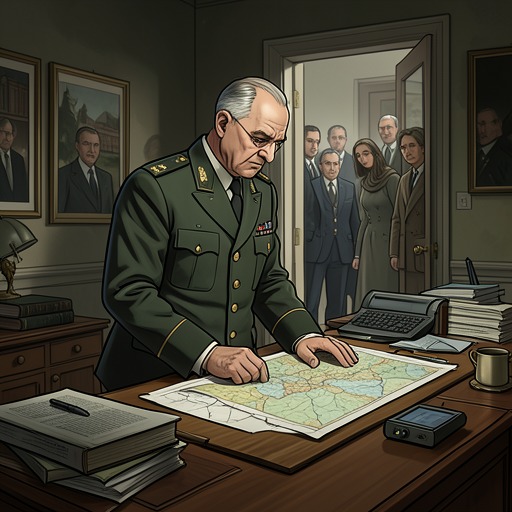
As reports of the attack arrived, Truman and his advisers treated the defense of South Korea as a test of whether the United Nations could respond to armed aggression. At a meeting on the crisis, Dean Acheson proposed sending arms and supplies as quickly as possible, evacuating American civilians under air cover, and moving the Seventh Fleet to guard the Formosa Strait. Truman insisted that no one make a public statement until he had spoken. The next evening, as the situation worsened, he authorized American air and naval support for South Korean forces and pressed for immediate United Nations backing. He also set a limit: for the moment, there would be no action north of the 38th parallel.
By the time the news reached Washington that North Korean tanks had swept into Seoul, the South Korean government had fled. President Syngman Rhee described the American assistance as too little and too late. Truman nevertheless secured broad support from congressional leaders for the measures he had taken. He relied on his authority as Commander in Chief rather than seek a congressional war resolution, explaining to Averell Harriman that doing so in the emergency could make it harder for future presidents to respond to crises. The choice tied the immediate defense of South Korea to a lasting question about executive power.
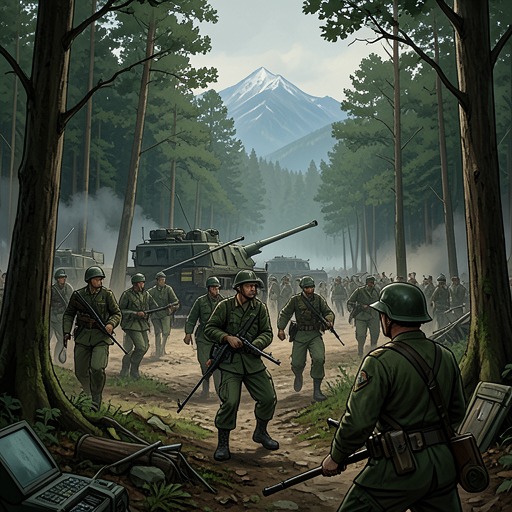
The first American ground troops entered combat near Osan, south of Seoul, on July 5. The force consisted of only 256 men, drawn from two and a half companies of the 24th Infantry Division. Airlifted from Japan, the soldiers had been rushed into action without adequate preparation. Many were inexperienced draftees; the troops were poorly equipped against a disciplined opponent advancing in large numbers with Russian T-34 tanks. South Korean forces were also being driven back. At a July 6 meeting, Omar Bradley estimated that 90,000 North Koreans were involved in the operation, against about 10,000 American troops and 25,000 South Korean troops. The disparity gave the early defense its precarious character: the forces were fighting to preserve a southern foothold while retreating toward Busan.
The Reversal at Incheon
In September, the balance changed sharply. The amphibious assault at Incheon involved 262 ships and 70,000 men of the U.S. Tenth Corps, with the 1st Marine Division leading. The landing surprised the North Korean forces and succeeded on a scale that reversed the course of the campaign. Incheon fell in little more than a day, and Seoul was retaken within eleven days. Meanwhile, General Walton Walker’s Eighth Army broke out of the Pusan Perimeter and advanced north.
By September 27, more than half of the North Korean Army had been trapped in a large pincer movement. On October 1, United Nations forces reached the 38th parallel, and South Korea was under United Nations control. The rapid reversal transformed the question facing Truman and his advisers. For months, the pressing issue had been whether the forces in South Korea could survive; now officials debated whether to cross the dividing line, destroy the northern regime, and reunify the country. The initial success made expansion seem attainable, but it also changed the stakes of the intervention: defending the south and seeking to unify the peninsula were no longer the same objective.
Retreat, Restraint, and Command
The later advance north was followed by a severe reversal. Chinese forces entered the conflict in overwhelming numbers, and the retreat continued as United Nations forces moved back toward the 38th parallel. Truman feared that abandoning South Korea would leave its people exposed after they had fought alongside the United States and received its help. He also worried about the possibility of attacks from Manchuria and the risk that the conflict could widen into a world war. His position was not simply to pursue victory at any cost: the goal of unifying Korea by force was abandoned, and the immediate aim became an armistice near the 38th parallel. In discussions with British Prime Minister Clement Attlee, Truman agreed that the war must not be widened.
The defense of South Korea also shaped Truman’s conflict with General Douglas MacArthur. Truman regarded MacArthur’s public challenge to policy as defiance of presidential orders and of the United Nations’ position. Yet even amid anger, he initially chose a restrained reprimand rather than immediate dismissal, weighing the dangers of insubordination against MacArthur’s popularity and the public’s desire for victory. The later removal of MacArthur, in Truman’s view, was necessary to keep control of the military in civilian hands. The issue was not only who commanded forces in the field, but who had authority to determine the purposes and limits of the war.
South Korea thus remains central to the book’s account even as the narrative moves among Washington, military headquarters, and international diplomacy. Its territory defined the line that Truman initially refused to cross, the retreat that threatened the republic, and the eventual boundary toward which an armistice was sought. The campaign’s reversals made South Korea the place where the promise of collective resistance, the limits of military victory, and the president’s responsibility to restrain escalation were tested together.