North Korea
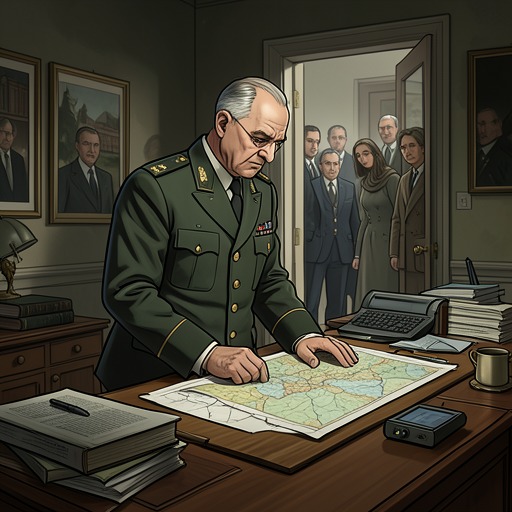
TrumanNorth Korea is the point of origin and one of the principal theaters of the Korean War in the account: its forces crossed the 38th parallel into South Korea, and the counteroffensive that followed carried United Nations forces back north into North Korean territory. The changing front made the country more than a setting for combat. It became the ground on which American leaders and commanders confronted the limits of intervention, the risks of widening the war, and the question of how far a military victory could be pursued.
The invasion and the decision to intervene
The crisis reached Harry S. Truman while he was away in Missouri. Before returning, he used the plane’s radio to ask Dean Acheson to convene an emergency meeting at Blair House. Acheson reported that the North Korean forces had crossed the 38th parallel in a heavy attack, not one of the limited patrol incursions that had occurred earlier. The distinction turned a continuing border danger into an invasion demanding an immediate decision.
During the flight, Truman considered earlier cases in which stronger powers had attacked weaker ones, including Manchuria and Ethiopia. He feared that allowing North Korea to absorb South Korea without resistance would discourage other small nations from opposing stronger Communist neighbors, and could help bring about another world war. The book presents this reasoning as a response not only to the immediate military emergency but to the wider consequences Truman believed might follow from failing to act.
The advisers at Blair House framed the strategic stakes differently but reached the same conclusion about the importance of resisting the attack. Dean Rusk argued that the United States bore a particular responsibility because it had occupied South Korea for five years, and that losing the South would expose Japan to a grave strategic threat. Omar N. Bradley, recently returned from Japan and feeling seriously ill, argued that the United States had to establish a line somewhere and that Korea could serve that purpose. He viewed Soviet actions as a test rather than evidence that Russia was ready for war. North Korea thus became the place where American leaders chose to make resistance visible, despite the considerable uncertainty about the consequences.
The early retreat and the fight to hold the South
The invasion quickly put North Korean forces in a position of apparent advantage. Headlines on June 27 reported their tanks entering Seoul, South Korea’s capital. The South Korean government had fled, and its president complained that American assistance had come too little and too late. A broadcast from Pyongyang, North Korea’s capital, announced the North Korean premier’s intention to defeat the South swiftly. These developments made the danger immediate: the crisis was no longer simply a threatened border but a rapidly advancing campaign against South Korea’s government and forces.
The first American ground troops sent into action were only 256 men, drawn from two and a half companies of the 24th Infantry Division. Airlifted from Japan, they entered the fighting south of Seoul near Osan on July 5, with little preparation and no combat experience for many of the young draftees. They and the South Korean forces were often badly outmatched by disciplined North Korean troops supported by Russian T-34 tanks. American and South Korean units could face odds of three to one, ten to one, or even twenty to one; they lacked tanks, artillery, and effective weapons against the advancing armor. American policy had previously kept South Korean forces under-equipped partly to discourage an attack by South Korea on the North, a decision that left the defenders poorly prepared for the invasion that came from the other direction.
The retreat nevertheless did not become an immediate collapse. General MacArthur, in overall command of United Nations forces, exchanged territory for time while men and supplies were brought through the port of Pusan. The account emphasizes how close the danger was: American and South Korean units endured severe setbacks but held back the North Korean advance long enough for the defense to continue. Their rearguard action prevented North Korea from overrunning South Korea at once and created the conditions for a major change in the campaign.
The reversal and the advance north
The Inchon landing reversed the direction of the war. The force comprised 262 ships and 70,000 men from the Tenth Corps, with the 1st Marine Division leading the assault. Inchon fell in little more than a day, and Seoul was retaken within eleven days. At the same time, General Walker’s Eighth Army broke out of the Pusan Perimeter and began advancing north. The account describes the result as a dramatic reversal: by September 27, more than half of the North Korean Army had been trapped in a large pincer movement; by October 1, United Nations forces had reached the 38th parallel and South Korea was under United Nations control.
That change in fortune altered the stated objective. On September 27, the decision was made to authorize MacArthur to cross the 38th parallel and pursue the destruction of the North Korean armed forces, provided that there was no sign of major Soviet or Chinese intervention in North Korea. The instructions also prohibited carrying the fighting beyond North Korea’s borders with China or the Soviet Union. Within those limits, MacArthur was given freedom to act to end the war quickly. When he later reported that he regarded all of Korea as open for military operations, his view met no objection. The boundary that had marked the initial invasion had become a conditional threshold for an expanded campaign.
North Korea and the limits of the campaign
The northward advance did not produce a stable or uncomplicated victory. Three days after MacArthur launched his offensive to end the war, he declared that the United Nations command faced an entirely new war and conditions beyond its control and strength. The Chinese intervention had transformed the military situation; the account describes Chinese forces as bent on destroying his army. North Korea, which had first been the launching ground of an attack on the South, was now the territory into which United Nations forces had advanced and where the campaign’s expansion encountered a new and formidable opponent.
The sequence gives North Korea a changing role in the narrative: invasion begins there, the counteroffensive carries the fighting back across the dividing line, and the advance into the North brings the danger of a wider conflict into sharper focus. The authorization to cross the 38th parallel had been conditional on the absence of major Chinese or Soviet intervention and explicitly restricted operations beyond North Korea’s borders. The subsequent reversal exposed the stakes of those conditions. North Korea therefore stands at the center of the book’s account of how the war’s geography, military objectives, and political risks changed together.