Missouri
TrumanMissouri is both a place of settlement and a borderland shaped by conflict in the narrative. Its western edge first appears as an unfamiliar frontier drawing migrants from Kentucky; later, the state’s position as a slave state beside Kansas makes it a center of the tensions that preceded the American Civil War. In Harry S. Truman’s lifetime, Missouri remains more than a point of origin: its towns, family homes, and people recur as a personal and political geography.
Frontier Settlement and Independence
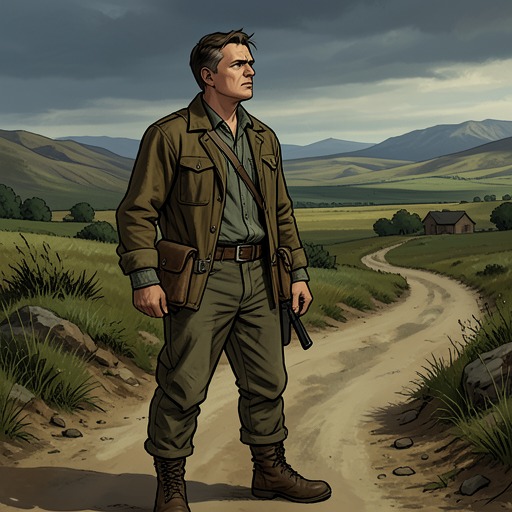
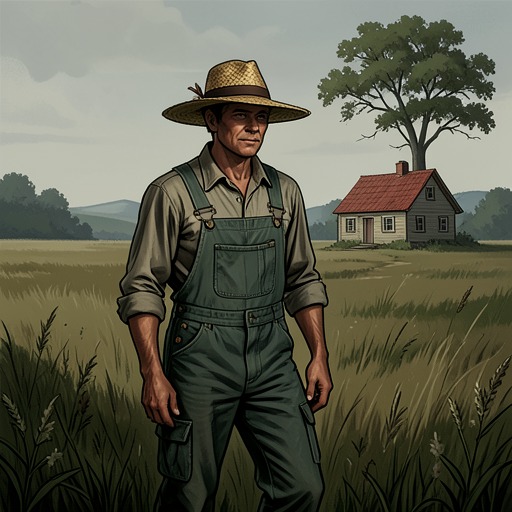
In the spring of 1841, Solomon Young, a Kentucky farmer, set out for western Missouri with his red-haired wife, Harriet Louisa Young, and their two small children. Their move belonged to a larger migration from Kentucky that had begun nearly twenty years earlier. Reports from Daniel Morgan Boone, son of Daniel Boone, described a far-western “New Eden,” while Missouri’s admission to the Union as a slave state in 1821 also drew settlers. For the Youngs, the destination was not yet familiar country but the “extreme frontier” of the United States.
The settlement around them had developed over the preceding decades. Early arrivals included the Boggs, Dailey, and Adair families, among others. By 1827, settlers had founded Independence, a courthouse town on high ground in Jackson County, in the region often called the Blue River country. Hundreds more came afterward, including families named Hickman, Holmes, Ford, Davenport, Noland, Truman, Peacock, and Wallace. This sequence places the Young family’s arrival within an expanding community rather than an isolated migration: a courthouse town and an established network of families were already taking shape in western Missouri.
A Slave State and a Contested Border
Missouri’s political position had been established through the Missouri Compromise of 1820–21. The agreement admitted Missouri as a slave state and Maine as a free state, while prohibiting slavery north of Missouri’s southern boundary at latitude 36°30′. In the narrative, that settlement later appears not as a lasting resolution but as a line whose removal transformed the border region.
For many people in western Missouri, the Civil War began in 1854 rather than with the 1861 attack on Fort Sumter. Congress’s Kansas-Nebraska Act left the question of slavery to residents of the Kansas and Nebraska territories and abolished the old Missouri Compromise line. Although intended to ease political tension, the measure had the opposite effect. Missouri’s proximity to Kansas made the change immediate in regional terms: the question of slavery was no longer contained by the earlier boundary, and the border became a site of escalating conflict.
The book also distinguishes the violence of the border from the reputation it acquired elsewhere. Atrocities were committed on both sides, and civilians suffered most, but the popular image of all western Missourians as rough, lawless bushwhackers was described as inaccurate. Most Missourians remained loyal to the Union, including slaveholders such as Solomon Young. The region’s history is therefore presented through a tension between genuine wartime horrors and an oversimplified image that obscured the varied loyalties and experiences of its inhabitants.
Missouri in Truman’s Public and Family Life
Missouri reappears in Truman’s public life as a place where national questions were addressed to local audiences. At an American Legion fair in Caruthersville, he spoke about the difficulties ahead and the atomic bomb, linking the new force to his request for civilian rather than military control of atomic energy. He also urged the crowd to apply the Golden Rule. The scene locates a major national policy debate in a Missouri gathering, where a president’s argument was delivered directly to the public.
A later flying visit brought Truman to Kansas City and nearby Liberty, where he was to receive an honorary degree from William Jewell College. He also wanted to see his mother, Vivian Truman. With the help of friends, he and Vivian had managed to buy back from the county the old family homeplace on Blue Ridge, the farm she loved. Her deteriorating health meant that she could not move back there; she and Mary Jane Truman continued living in a small yellow frame bungalow in Grandview, where they had resided since 1940. The homecoming thus joined a public occasion to a family effort to recover a beloved place, while also recording the limits imposed by his mother’s health.
Missouri mattered to Truman as a source of social and cultural affinity as well as family history. Clark Clifford later recalled that Truman felt kinship with people from the same part of the country who had been educated there and spoke as he did, though Clifford was of another generation and a markedly different style. That observation suggests how the state’s significance extended beyond particular towns or visits: it was also a shared regional manner that others recognized in Truman, even when he did not necessarily acknowledge its influence.
A Recurring Regional Frame
Across these episodes, Missouri changes in scale without losing its connection to the people who inhabit it. It is first a destination at the edge of settlement, then part of a disputed border where national policy carried immediate local consequences, and later the setting for Truman’s public appeals and private family concerns. The narrative’s return to western towns and family land keeps those scales in view together: national conflicts unfold in a region of named communities, while the state’s political and historical identity is carried through individual lives.