Blair House
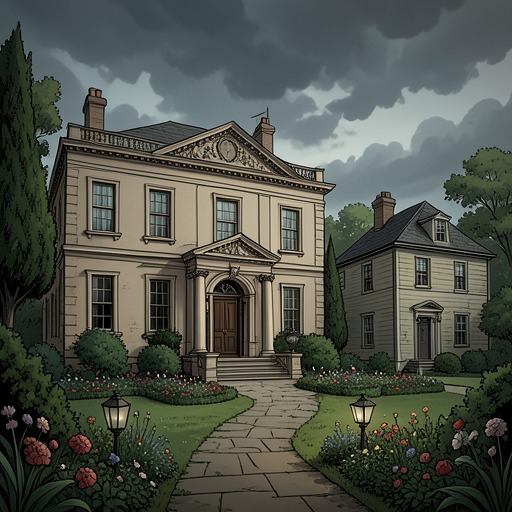
TrumanBlair House, at 1651 Pennsylvania Avenue across from the White House, was a temporary home for Harry S. Truman during major transitions and a recurring setting for private meetings. Its importance came not from grandeur—the house was described as dowdy and later troubled by noise and deterioration—but from its position between domestic life and presidential responsibility. Truman walked from its door to work, received political visitors there, and made or confronted consequential decisions while living within its guarded rooms.
A first home during the presidential transition
On the afternoon of April 16, 1945, the day Truman addressed Congress for the first time as President, he and his family moved from their apartment to Blair House. They intended to stay until Franklin D. Roosevelt’s family had time to move out of the White House. The apartment had proved impractical: Truman could not move without a large Secret Service and police presence, and other residents needed passes to enter and leave. The family left with suitcases, while their furniture remained behind and Truman continued paying the apartment rent.
The move placed the new President within sight of his workplace, but it did not make his circumstances ordinary. For several days, with the Secret Service convoy keeping pace, Truman walked briskly across Pennsylvania Avenue at about eight each morning. A taxi driver once slowed to wish him good luck, a brief public greeting that seemed to express the country’s welcome. At the same time, Truman privately described the day of his address as his greatest trial. The ovation suggested that the speech had gone well, yet he told his mother and sister that the smooth start to his presidency left him nearly as frightened as the news that had brought him to office. Blair House was thus the setting for both public reassurance and private uncertainty.
The move also made the house a family residence under unusual restrictions. Truman wrote that the family was living there until the White House could be vacated and redecorated; he expected to pay for another month if the work took that long. The arrangements were provisional, but the constraints were immediate: security altered the family’s movements, separated them from their apartment furniture, and made the simple act of living in Washington conspicuously public.
Domestic routine and guarded privacy
Blair House offered a measure of home life amid those pressures. In the evening, Truman and Bess Wallace Truman would relax with a cocktail in the so-called sitting hall. J. B. West recalled that the staff needed time to learn their preferences. The small domestic routine contrasts with the security operation outside: the house could be a place for an evening together, but it was also the guarded residence of a President whose movements affected everyone around him.
Later accounts emphasized that Blair House was not an elegant refuge. Even after quick cosmetic improvements, it was somewhat dowdy; its floors and structure creaked and groaned, and streetcars passing outside made it tremble. The dark cellar was known to be full of rats, a place Secret Service agents disliked entering. Ambulance sirens from Emergency Hospital nearby sometimes passed beneath the President’s bedroom window several times in a night. Some agents later said that, among the Presidents they had known, Truman alone would have been willing to live there. The plainness of the building did not remove the burdens of presidential residence, but it made the house a notably unceremonious counterpoint to the office across the avenue.
That domestic space could also become a place for controlled political discussion. During one evening in the dining room, Truman called a confidential meeting about what might be done regarding Senator Joseph McCarthy. The gathering included Attorney General Howard McGrath, four Democratic senators, a congressman, Solicitor General Philip B. Perlman, Democratic Party chairman William Boyle, adviser Clark Clifford, and the writer John Hersey as a witness. The room’s ordinary function as a place to eat gave way to private consultation, with Truman seeking advice rather than staging a public confrontation.
A setting for diplomacy and consequential choices
Blair House also provided temporary lodging for diplomatic visitors. Vyacheslav Molotov, the Soviet foreign minister, stayed there during his Washington visit in April 1945. After dinner, he and Truman met briefly and amicably at the house. Truman expressed admiration for the Soviet role in the war and said he would stand by the commitments made by Roosevelt. Their cordial first encounter did not settle the problems between the governments: the next day, in a separate meeting at the White House with Roosevelt’s former advisers, Truman learned that the Soviet Union was insisting on its preferred government in Poland. The contrast between the friendly conversation at Blair House and the harder diplomatic dispute that followed marks the house as a setting for an opening gesture, not a resolution.
After Thanksgiving in 1948, Truman privately offered Dean Acheson the position of Secretary of State at Blair House. George Marshall had said he wished to retire, and Truman chose Acheson as his successor for the coming term. Acheson initially said he was not qualified for the demands of the office. Truman acknowledged that he himself, or any other man, might make the same claim, and put the question instead as whether Acheson would do the job. The private offer illustrates how the house’s informality could support direct political persuasion: a major appointment was discussed away from a formal public announcement, through a personal conversation between President and prospective secretary.
Blair House was likewise a place where Truman received political figures whose intentions and loyalties mattered. On November 5, 1951, he had lunch there with Dwight D. Eisenhower and reportedly again offered full support if Eisenhower would accept the Democratic presidential nomination. Later that day, at a reception at the house, Truman was said to have discussed the offer in the presence of William O. Douglas and others; Douglas became the source through whom the story reached Arthur Krock of The New York Times. Eisenhower’s reported response stressed that he had been a Republican all his life. In January 1952, Truman met alone with Governor Adlai Stevenson at Blair House for more than an hour, after Stevenson made his way past guards who did not recognize him. The two met there again on March 4 at Stevenson’s request. The house therefore hosted both exploratory political approaches and further private conversation, even when those discussions did not immediately settle a public question.
The White House crisis and the Korean decision
Blair House became a residence for the Truman family again when the White House’s condition forced a larger relocation. After returning to Washington from the 1948 election, Truman was told that the old Executive Mansion was dangerous and might collapse. The facts were made public, the White House was closed to visitors, and Truman, Bess, and Margaret left for Key West while workers prepared Blair House. Painters and decorators worked through the night, and furniture was moved in so the family could return to Blair House by Thanksgiving. The temporary arrangement reflected a genuine structural emergency rather than a ceremonial change of residence.
In 1950, while the Korean War entered its darkest period, Truman also had to oversee the complete reconstruction of the White House within the old building’s gutted exterior walls. Blair House remained his temporary residence and a place where urgent decisions could be discussed. After meeting advisers there on two successive nights, Truman reached the decision to send American forces into Korea, which he regarded as the most difficult and important decision of his presidency. On June 27, after announcing the intervention, he was photographed heading from the White House back toward Blair House with Attorney General J. Howard McGrath and Secretary of Defense Louis Johnson. The route between the two buildings gave visible form to the split between public action and private deliberation: the announcement was made, but the residence across the avenue had been the setting for the preceding consultations.
The house was also the site of an attempted assassination on November 1, 1950, by two Puerto Rican nationalists. That attack occurred while Truman was living there during the Korean crisis and White House reconstruction. Blair House was therefore not simply a convenient substitute for an unavailable official residence. It was where the President’s domestic life, political consultations, personal security, and decisions about war repeatedly converged.