Soviet Union
TrumanThe Soviet Union enters the narrative as an indispensable wartime partner whose conduct at the approach of victory raises an increasingly urgent question: whether cooperation can survive the struggle over postwar power. The book traces how reports of Soviet control in Eastern Europe, disputes over Poland, and warnings about Soviet military capacity shape Harry S. Truman’s diplomacy. The Soviet Union is not only a place on the map of the emerging postwar order; it is the point around which Truman tests his judgment, his advisers’ competing counsel, and the limits of American power.
A wartime ally under scrutiny
By the time Truman became president, unease about Soviet policy was already widespread among American officials. The State Department’s account of the situation after the Yalta Conference described the Soviet government as uncompromising on major questions, while Poland—occupied by Soviet forces—was presented as a particularly serious breach of expectations. Soviet authorities had repeatedly failed to keep agreements, supported a rival Warsaw Provisional Government, and held liberated prisoners without an exchange. Truman’s first apparent opening came when Joseph Stalin agreed to send Vyacheslav Molotov to the San Francisco Conference, after Truman requested it. The gesture seemed like a diplomatic breakthrough, but it resolved none of the underlying disputes.
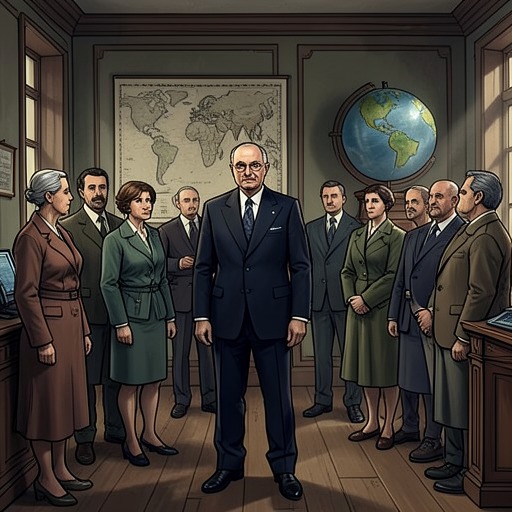
Truman took office without firsthand experience of relations with the Soviet Union or a settled foreign-policy program. When Averell Harriman outlined the problem, he described two Soviet aims operating at once: cooperation with the United States and Britain, and the extension of control over neighboring states in Eastern Europe. Harriman warned that Soviet leaders might interpret American generosity as weakness, but believed they would avoid a break because they needed postwar financial assistance. Truman answered that he would be firm but fair, and that the Soviet Union needed American support more than America needed Soviet support. He had been studying the Map Room files late into the night, so his lack of experience did not mean he was wholly uninformed.
The book places these discussions in a longer accumulation of warnings. Concerns about Soviet behavior had become the predominant theme among State Department officers by the winter of 1944–45. Churchill had warned that the Yalta agreements on Poland were breaking down, while Harriman reported that liberated American prisoners were being held in appalling conditions. A secret report prepared for Franklin Roosevelt before his death predicted that Soviet resources and manpower could make the Soviet Union the strongest power in Europe and Asia, and warned that it might seek to expand its control across both regions. These forecasts did not settle what American policy should be, but they made a simple return to wartime trust difficult to sustain.
Poland as the test of cooperation
Harriman’s account gave Truman a sharper way to understand Soviet control. In Poland and Romania, he argued, it meant more than influence over foreign policy: it could mean secret police and the suppression of freedom of speech. He described the prospect as a “barbarian invasion” of Europe, a phrase the book identifies as one Truman would remember. Harriman nevertheless argued that workable relations remained possible if both sides made concessions. Truman, in turn, accepted that complete cooperation with Joseph Stalin was unrealistic, while saying he would be satisfied with less than complete agreement.
Truman’s meeting with Molotov brought the conflict into the President’s office. At the meeting, Truman said the United States would not recognize a Polish government that failed to provide free elections. He also made clear that the United States would proceed with the United Nations despite disagreements elsewhere, and reminded Molotov that American foreign policy depended on public support and that postwar economic assistance would require congressional approval. Molotov replied that Allied governments had to treat one another as equals and defended Soviet actions by accusing the Poles of working against the Red Army. Truman interrupted him, rejected what he regarded as propaganda, and asked him to tell Stalin that the Soviet government was failing to honor its agreements. He said he wanted friendship with the Soviet Union, but insisted that the United States expected the Yalta agreements to be carried out by both sides.
The episode captures the distinction the book draws between Truman’s desire for accommodation and his resistance to yielding over principle. Poland was not a minor disagreement to him: it tested whether wartime agreements could constrain the postwar conduct of a powerful ally. At the same time, the narrative does not present Truman as having arrived at a fully developed strategy. He was trying to respond patiently and prudently to events, without becoming either belligerent or weak.
From uncertainty to containment
The conflict widened as new evidence and declarations changed the political atmosphere. In February 1946, Joseph Stalin declared that communism and capitalism were incompatible and that another war was inevitable, calling for a major increase in Soviet defense production while consumer goods waited. The declaration stunned Washington. Soon afterward came reports that Soviet troops remained in Manchuria and that a Soviet garrison was still in Iran’s Azerbaijan province, despite an agreement requiring withdrawal. News from Ottawa of a spy ring accused of trying to steal information about the atomic bomb further sharpened American fears.
Another influential warning came in George Kennan's Long Telegram, an 8,000-word message from Moscow. Kennan described the Soviet leadership as driven by insecurity and committed to conflict with the United States, and argued that Soviet power was sensitive to strength. The analysis supplied a framework for firmness, but the book shows Truman’s uncertainty persisting alongside it. He privately told Harriman that a Soviet refusal to withdraw from Iran could mean war, even while publicly disavowing the implications of Winston Churchill’s Fulton speech, which Truman had encouraged and approved in advance. His conflicting signals reflected a real tension: he wanted to preserve the possibility of cooperation without letting that hope excuse Soviet expansion.
The administration’s own report, American Relations with the Soviet Union, made the danger appear broader still. Completed in 1946 after research and interviews across the executive branch, it called relations with the Soviet Union the gravest problem facing the United States. It described Soviet dominance in Finland, Poland, Czechoslovakia, Hungary, Romania, and Bulgaria; warned of Soviet influence in China and Korea; and portrayed Soviet military expansion as a drive to extend the area under Soviet control. The report also cited the development of atomic weapons, guided missiles, biological-warfare materials, a strategic air force, and long-range submarines. Its conclusion was that the United States needed sufficient military strength to confine Soviet influence, and that preparedness could deter aggression and help preserve peace.
A continuing strategic pressure
The Soviet Union’s place in the narrative is also tied to Truman’s insistence that the war effort remain under civilian control. As military contracts expanded dramatically in 1942, he worried that generals and admirals were acquiring influence over industry and agriculture that might reshape the country after the war. He supported a single civilian head for procurement and argued that military officers should identify what they needed to fight, not direct the larger political and economic order. The book connects this conviction to the stakes of the postwar rivalry: confronting Soviet power could demand military readiness, but the decisions governing that readiness had to remain civilian decisions.
The account therefore presents the Soviet Union neither as a setting for a resolved confrontation nor as a passive backdrop to American policy. Its power, its position in Eastern Europe, and the uncertainty of Joseph Stalin’s intentions continually press upon Truman’s choices. The movement from wartime cooperation to containment develops through disputed agreements, diplomatic encounters, intelligence warnings, and competing counsel. By the time the administration’s report called for preparedness as a condition of peace, the earlier hope that goodwill alone might sustain the alliance had given way to a harder question: how to resist Soviet expansion without turning rivalry into war.