Ajihad
EragonAjihad is the leader of the Varden and the central political authority Eragon encounters after reaching Farthen Dûr. His decisive significance lies in the way he joins sanctuary to strategy: he welcomes Eragon and Saphira, acknowledges the danger surrounding them, investigates their history, and directs the Varden’s response when an Urgal army approaches through the tunnels beneath Tronjheim. Through Ajihad, the resistance appears not as an abstract rebel force but as an organized community forced to balance protection, factional pressure, military necessity, and the survival of its allies.
Identity and Authority
Ajihad is introduced in an elegant, two-story study in Tronjheim, standing behind a large walnut desk amid cedar bookshelves, lanterns, and a wrought-iron staircase. His physical presence establishes authority before he explains his position: his skin has the color of oiled ebony, his head is shaved, his black beard is closely trimmed, and his broad shoulders are emphasized by a red vest embroidered with gold over a purple shirt. His grave, intelligent eyes and commanding bearing make him appear both formidable and deliberate. He welcomes Eragon and Saphira directly and identifies himself as Ajihad, then invites them to sit.
His authority is supported by more than ceremony. The Twins stand nearby as silent attendants, while Ajihad controls the meeting and studies Eragon and Murtagh before questioning them. He is courteous, but the courtesy does not erase scrutiny. The long, unwavering gaze with which he examines the newcomers suggests that admission to the Varden brings political and personal consequences, not merely physical refuge.
Ajihad’s position also includes a second in command, Jörmundur, whom he later introduces to Eragon in the same study. This detail places Ajihad within a functioning command structure rather than presenting him as an isolated rebel chief. His decisions are communicated through officers, guards, and the movement of civilians, revealing an administration capable of acting under pressure.
Political Judgment and the Varden
The Varden are a rebel group that raids and attacks Galbatorix’s Empire, but their origins and leadership have long been obscure. They were formed sometime after Galbatorix’s rise to power more than a century earlier, survived repeated efforts to destroy them, and attracted sympathy from fugitives and enemies of the Empire. Their secrecy is therefore both a source of protection and a practical weakness: those who need the Varden must first find them. Ajihad embodies the organized face of this hidden movement, converting scattered opposition into decisions about sanctuary, intelligence, diplomacy, and war.
His leadership is not presented as uncomplicated benevolence. Ajihad tells Eragon that factions want the new Rider to serve their own interests. Once Eragon enters Farthen Dûr, those factions begin exerting pressure on him, and Ajihad admits that his own influence is part of that pressure. His brief laugh does not soften the warning; his eyes remain sharp. The admission gives his authority a guarded honesty. He does not pretend that the Varden’s protection is free of political purpose, nor that Eragon’s arrival can remain outside the struggles already dividing the community.
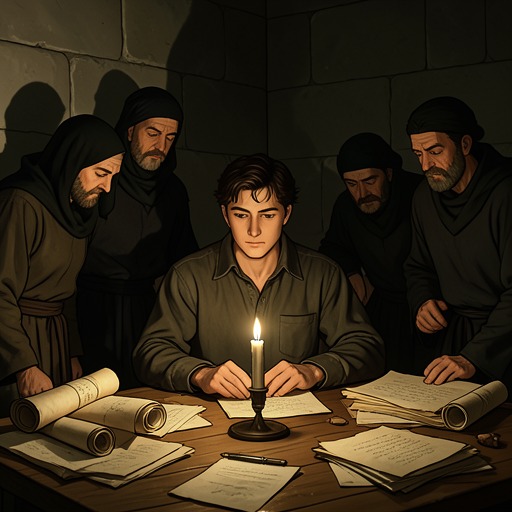
Ajihad also guards information until the proper moment. He asks Eragon to recount how he found Saphira and everything that followed, especially the circumstances of Brom’s death, even though he has already received partial reports from Brom and The Twins. His method is investigative rather than merely ceremonial: firsthand testimony matters, details matter, and the leader wants to hear the account from the person who lived it.
Protection, Disclosure, and Responsibility
Ajihad’s concern for Arya provides the first immediate test of his relationship with Eragon. When Eragon asks whether she is well, Ajihad answers that she is not, but that the healers expect her to recover. She has been treated throughout the night, and the poison has taken a dreadful toll. Ajihad explicitly credits Eragon with saving her life and gives him the Varden’s deepest thanks. The response transforms Eragon’s escape from Gil’ead from a desperate flight into an act with recognized political and human value.
His later explanation of Saphira’s egg widens the significance of Eragon’s arrival. When Brom brought the egg to the Varden, everyone became concerned with its fate because the Varden had believed the dragons exterminated. The dwarves wanted the future Rider to be an ally, although some opposed the emergence of a new Rider altogether; the elves and the Varden possessed a more personal stake. Ajihad explains that the historical pattern itself made the event politically charged: every previous Rider had been elven or human, with most Riders being elven, and no dwarf had ever become a Rider. The egg therefore represents more than a private bond between Eragon and Saphira. It unsettles established expectations among the peoples opposing Galbatorix.
Ajihad’s leadership repeatedly appears as the management of competing obligations. He must preserve the Varden’s independence while sheltering a dangerous symbol, respect the concerns of the dwarves while protecting the future of the resistance, and acknowledge Eragon’s importance without allowing every faction to claim him. His questions and disclosures make the political stakes legible to Eragon, who is still learning that his identity as a Dragon Rider has consequences beyond his own intentions.
The Crisis Beneath Tronjheim
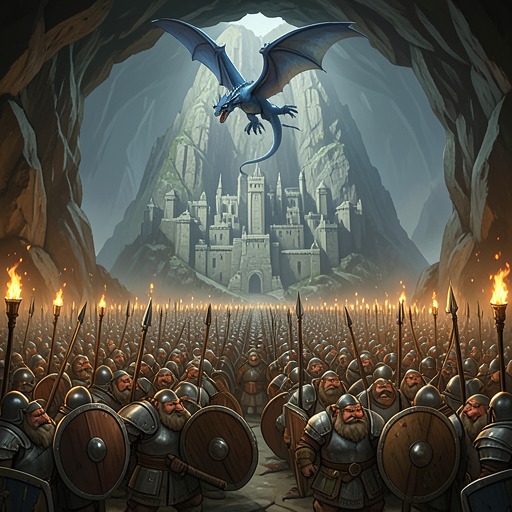
Ajihad’s most urgent action follows the report of a wounded dwarf who escapes from an abandoned tunnel beneath Tronjheim. The dwarf is nearly incoherent but manages to communicate that an army of Urgals, perhaps a day’s march away, is pursuing him. Ajihad immediately summons Eragon, Saphira, Arya, Jörmundur, and Orik to his study, where he explains that the danger is worse than an ordinary approach: the Urgals are advancing underground and will attack from below.
The discovery turns Ajihad’s study from a place of examination into a command center. The scale of the threat is conveyed through the reactions around him: shocked silence fills the room, Jörmundur swears and begins asking questions, and Orik demands information at the same time. Ajihad raises his hands and imposes order before issuing the next decisions. His authority is therefore practical and immediate, founded on the ability to convert panic into coordinated action.
He orders the evacuation of all women and children into the surrounding valleys. If the defenders lose, guides will lead the evacuees to Surda, giving the civilian population a possible route of survival. The measure is not presented as a guarantee; it is the maximum protection Ajihad can arrange under the circumstances. Nasuada is included in the evacuation despite her displeasure, demonstrating that Ajihad applies the emergency plan even when it removes an important person from the immediate center of events.
Ajihad then defines the battle in collective and historical terms. The Urgals are expected within hours, their numbers are great, and Farthen Dûr must be held. Defeat would mean the downfall of the dwarves, the death of the Varden, and the eventual defeat of Surda and the elves. His order to Jörmundur to ready the men makes the strategic conclusion unmistakable: this is not a battle that can be postponed or surrendered. The survival of several allied peoples has been concentrated into the defense of one underground stronghold.
Legitimacy and Narrative Role
Ajihad’s command differs sharply from the Empire’s rhetoric. In Carvahall, grain traders claim that only Galbatorix’s unceasing efforts protect the villagers, while the Varden are described as a rebel army allied with the Urgals. The villagers reject this imperial version because the Empire failed them during harsh years and its tax collectors were heartless. Against that background, Ajihad’s conduct supplies a competing model of rule: he protects civilians, acknowledges political pressure, investigates danger, and accepts responsibility for consequences that extend beyond his own group.
Yet the contrast is not simplistic. Ajihad openly admits that he seeks influence over Eragon, and the Varden’s need to hold Farthen Dûr places its ideals beside military coercion and strategic necessity. His legitimacy is built through action rather than innocence. He cannot eliminate factional interests, historical grievances, or the threat of invasion; he can only negotiate them while making choices whose failure would destroy the people under his protection.
As a character, Ajihad functions as a threshold figure between Eragon’s personal awakening and the wider political war. He receives the Dragon Rider, tests the account of his past, explains why Saphira’s existence matters to several peoples, and then places Eragon inside an imminent collective crisis. Ajihad thus enlarges the story’s scale. Under his direction, the discovery of one dragon becomes a question of alliances, the rescue of Arya becomes a matter of resistance, and the defense of Tronjheim becomes a battle on which the future of the Varden and its allies depends.