Jeod
EragonJeod is a Teirm merchant whose public business conceals a far more dangerous vocation: he uses trade to move supplies toward Surda and Tronjheim for the Varden. Once a scholar associated with Brom, he becomes an indispensable link between commerce and rebellion. His knowledge of shipping records, smuggling routes, warehouses, and political contacts enables Brom and Eragon to turn the search for the Ra’zac from a pursuit based on rumor into an investigation grounded in the Empire’s own trade system.
Identity and Background
Jeod is presented as a wealthy merchant but not as a man wholly defined by commerce. He tells Brom that, after the events in Gil’ead, he lost his taste for sitting in musty rooms reading scrolls and chose to help Ajihad instead. He was not a warrior, yet he could contribute through the skills he possessed: business, information, and access. His father had also been a merchant and helped him establish himself, giving Jeod a legitimate economic position from which he could operate.
That position is partly a disguise. Jeod explains that most of his business is a front for getting goods into Surda. The distinction between visible trade and hidden purpose defines his role: the same commercial identity that grants him access to records and shipping networks also conceals his support for the Varden. His participation in the resistance therefore depends less on open combat than on making ordinary economic movement serve an underground war.
Reunion with Brom
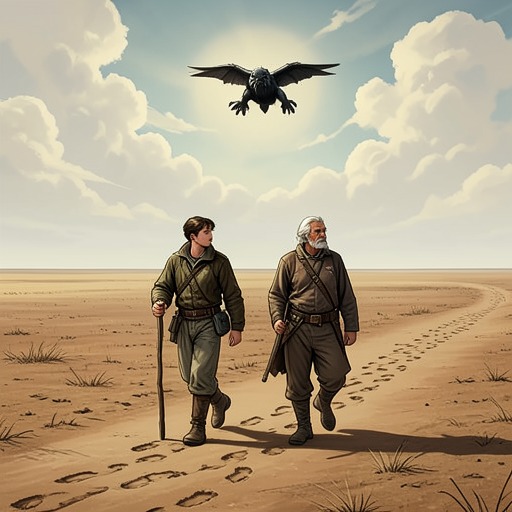
When Brom and Eragon reach Jeod’s house, Jeod emerges in expensive but rumpled clothing. His gray hair is wispy, a long scar runs from his scalp to his temple, and his mournful face changes to astonishment when he recognizes Brom. Brom immediately asks him not to use Brom’s name publicly, because knowledge that he is alive could endanger them. Their meeting reveals that the two men share a history extending back to Gil’ead and that Jeod had been deliberately kept ignorant of Brom’s later movements.
Brom recounts that, during the turmoil in Gil’ead, he found what they had been searching for and escaped with it before he could be discovered. He took it to their allies, who stored it in a vault, and then disappeared into Carvahall under an obligation to care for whoever eventually received it. Jeod had not known that Brom was alive, a secrecy that had caused him pain but protected the larger mission. The reunion consequently carries both warmth and strain: old comradeship returns, but it is immediately governed by concealment.
Jeod also becomes the first person in Teirm to hear the immediate reason for Brom and Eragon’s journey. Brom explains that Eragon’s uncle, Garrow, was brutally killed when the Ra’zac burned his home, and that Eragon needs help finding them. Jeod initially admits that he does not know where the Ra’zac are hiding, but Brom offers a material clue: a flask bearing their symbol and containing Seithr oil. The clue gives Jeod’s expertise a precise purpose.
Trade as Investigation
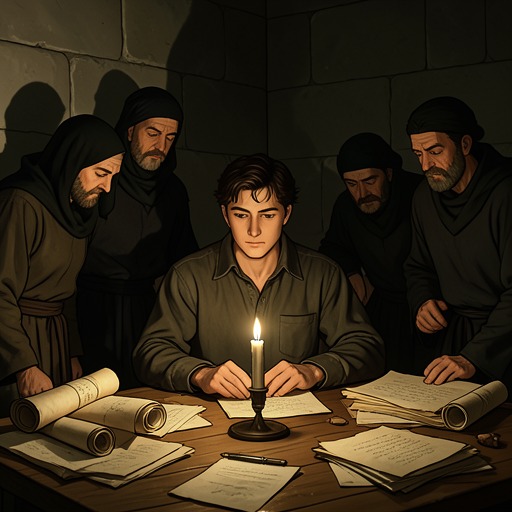
Jeod understands that the key evidence lies in Teirm’s shipping records. The Ra’zac’s possession of Seithr oil suggests that the oil was purchased through the Empire’s commercial system; tracing its movement could reveal where their lair was located. Jeod warns that the records are held in the castle and normally seen only by Brand, Risthart’s administrator of trade. Merchants are barred from handling them because officials fear that traders could falsify records and cheat the Empire of taxes. The investigation therefore confronts both bureaucratic restriction and the political danger surrounding information.
The records show that shipments of Seithr oil had reached every major city in the Empire during the preceding five years. Many orders appeared to have been placed by wealthy jewelers, leaving Brom and Jeod with a broad and initially unmanageable list of possibilities. Jeod’s evidence does not solve the mystery by itself, but it changes its scale: the oil is not an isolated purchase but part of a distribution network extending across the Empire.
Brom and Jeod then narrow the possibilities through geography and logistics. The Ra’zac must be able to travel wherever Galbatorix sends them, so their base should be at a sizeable crossroads where they could remain inconspicuous and obtain unusual provisions for their mounts without attracting attention. Teirm, Gil’ead, and Ceunon remain among the plausible northern cities; Narda is too small, while Ceunon is too isolated. Jeod’s knowledge of the coast and its trade routes makes this deduction possible, and Gil’ead emerges as the remaining likely location.
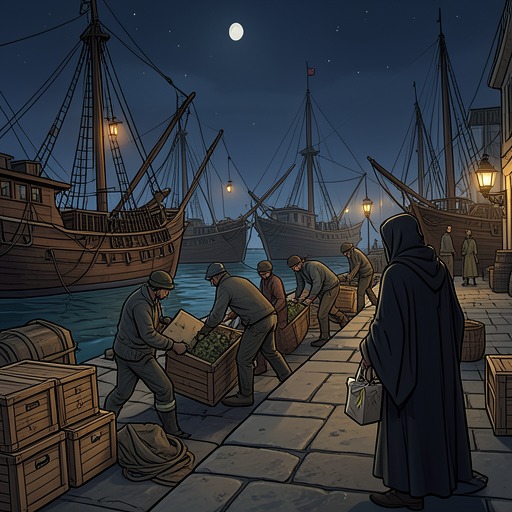
Jeod’s commercial world is itself under attack. Martin reports that someone has been destroying ships carrying the goods of selected merchants, including Jeod. The attacks are not ordinary piracy: only certain cargoes are targeted, no survivors remain, and the missing ships are never seen again. Because captains refuse to carry the threatened merchants’ goods, commerce is forced onto land routes, raising costs and causing caravans to disappear as well. The sailors’ belief that magic is responsible gives the economic crisis an ominous, unexplained dimension.
Support for the Varden
Jeod confirms that his merchant identity serves the Varden’s supply chain. His business sends goods toward Surda, but none of the shipments have recently arrived, leaving Tronjheim short of supplies. He suspects the Empire has discovered which merchants are assisting the resistance, although the absence of visible soldiers makes him consider the possibility that Galbatorix hired mercenaries instead. The uncertainty matters: Jeod can see the effects of the attack on the network but cannot yet identify the force directing it.
Later, Ajihad explains the full political consequence of this pressure. Jeod’s business has been virtually destroyed, as have the businesses of other merchants who support the Varden. Their ships vanish whenever they sail, while the dwarves cannot provide everything the resistance needs. Jeod’s losses are therefore not merely personal or commercial; they weaken the Varden’s ability to survive. Trade becomes a battlefield in which the Empire can isolate its enemies without openly confronting every supporter.
Jeod’s connection with Ajihad is also evidence of his deliberate commitment. He says that after Gil’ead he decided to help Ajihad as best he could, accepting the risks of a resistance whose survival depended on secrecy. His contribution is practical rather than heroic in the conventional martial sense, but the narrative treats access to goods, records, and routes as a form of political action. Jeod turns economic capital into resistance infrastructure.
Narrative Role and Significance
Jeod occupies the border between respectable society and rebellion. To the people of Carvahall, the Varden are a secretive rebel group that raids the Empire and accepts fugitives and enemies of Galbatorix, while imperial sympathizers describe the rebels as a threat supposedly held back only by the king’s protection. Against that public uncertainty, Jeod represents the hidden network that makes opposition possible. He demonstrates that the Varden are not sustained by battlefield courage alone but by merchants willing to risk property, reputation, and life.
His importance also lies in the way he connects apparently separate mysteries. The Ra’zac’s flask, the Seithr oil shipments, disappearing ships, interrupted caravans, the shortages at Tronjheim, and the suspected traitor within the Varden all belong to one system of information and supply. Jeod does not uncover every answer, but his records and testimony allow Brom, Eragon, and Ajihad to recognize the pattern. Through him, the Empire’s power appears not only as military force but as control over movement, taxation, commerce, and intelligence.
Jeod is consequently a rounded supporting character rather than a single-function merchant. He has abandoned scholarship without abandoning learning, replaced books with ledgers and routes, and replaced open study with covert service. His scarred appearance and guarded reunion with Brom embody a life shaped by danger, while his endangered business shows the material price of resistance. He does not end the conflict himself, but he helps make its hidden structure legible, turning trade from background scenery into one of the decisive instruments of the struggle against Galbatorix.