Arya
EragonArya is an elven warrior, spellcaster, and political agent whose ordeal and rescue become a decisive hinge in Eragon’s story. First glimpsed as the poised center of an elven escort, she later emerges as the captive who sent Saphira’s egg away, the prisoner Eragon frees from Gil’ead, and the authoritative defender who prevents the Twins from abusing his ignorance. Her suffering exposes the reach of Galbatorix’s power, while her survival and final summons toward Ellesméra make her a living bridge between the lost age of the Dragon Riders and the resistance’s uncertain future.
Identity and First Appearance
Arya first appears among three elves traveling on horseback. The two guards are armed with a bow and sword, or a spear and white dagger, while Arya rides between them with a sword at her side, a long bow and quiver on her back, and a pouch in her lap that she repeatedly checks. Her raven-black hair, deep eyes, and composed bearing distinguish her from the guards, but the scene emphasizes more than beauty: she surveys the surroundings with poise, answers one elf with obvious authority, and causes the escort to change formation when danger approaches. When the wind carries the Urgals’ stench toward them, the riders wheel around and flee, showing that Arya’s mission is already conducted under pursuit and concealment.
Her importance is enlarged by the history Brom tells of Alagaësia. The Dragon Riders once protected the land, used their powers for good, and presided over a golden age in which cities flourished and elves and dwarves were allies. Their destruction began when Galbatorix, after the death of his dragon, turned against the order, manipulated another Rider, killed an elder, and later recruited Morzan. Arya belongs to the elven world that survived the Riders’ fall, but she also carries knowledge of the forces still trying to preserve their legacy. The history therefore places her within a civilization shaped by catastrophe rather than presenting her as an isolated mysterious stranger.
The Egg, Capture, and Imprisonment
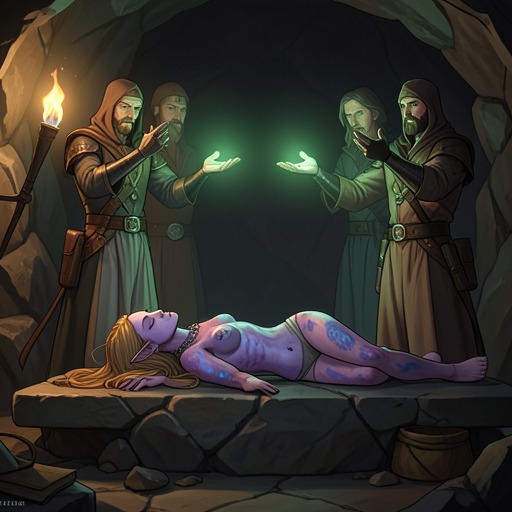
Arya’s connection to Saphira begins before Eragon knows her name. She explains that when Eragon first saw the egg, she had just been captured by Durza. Urgals ambushed her and killed her companions, Faolin and Glenwing, after somehow discovering where to wait for them. Drugged and transported to Gil’ead, Arya became a prisoner whose knowledge mattered to Galbatorix: Durza was ordered to discover where she had sent the egg and everything she knew about Ellesméra.
The captivity lasted for months. Durza’s harsh methods failed to extract the information, and when soldiers were ordered to violate her, Arya used what strength remained to influence their minds and make them incapable of carrying out the order. Her resistance is therefore neither abstract nor effortless. She survives by conserving the last resources of her battered body and mind, refusing to surrender the location of the egg or the secrets of her people. Galbatorix eventually ordered that she be taken to Urû’baen, and Arya understood that she would have stood before him within a week if Eragon had not intervened. Her imprisonment turns the dragon egg from a mysterious object into the center of a political and magical struggle between the Empire and its enemies.
Arya’s rescue also gives Eragon his first direct access to the consequences of imperial power. After escaping Gil’ead with her, he tells her through the ancient language that she is free, that her wounds have been healed, and that they have crossed the edge of the Hadarac Desert and reached the Beor Mountains during the five days in which she has remained unconscious. Arya’s weary contact with him reveals both her physical weakness and her continuing consciousness of captivity: she had believed the healing itself might be preparation for another torture. Her first exchange with Eragon is thus a movement from suspicion to recognition, not an uncomplicated expression of gratitude.
Authority and Relationships
Arya’s relationship with Eragon is founded on rescue but develops through correction and trust. She tells him the truth about her capture because he witnessed the egg’s arrival and therefore needs to understand the chain of events connecting his discovery to her suffering. Yet she does not simply become a passive recipient of his protection. When the Twins test Eragon’s abilities in Tronjheim, Arya interrupts them with immediate authority. She condemns their attempt to demand from him what only a master could do, exposes their claim that they did not know his abilities as false, and orders them to leave.
Her intervention is demonstrated through action as much as speech. When she points at the ring in Eragon’s hand and says, “Arget!”, a ghostly duplicate appears beside it, purer and white-hot in appearance. The Twins flee at once, while Orik and Fredric watch her warily and Saphira prepares for violence. Arya therefore recognizes and commands magical power at a level that unsettles trained practitioners, but the scene also shows her ethical standard: technical mastery does not justify humiliating or endangering an inexperienced person. She protects Eragon by rejecting both the Twins’ manipulation and the institutional authority that allowed it.
Arya is also connected to the Varden’s larger political crisis. The Varden are a rebel group that raids the Empire, accepts fugitives and those who hate Galbatorix, and survives despite the king’s efforts to destroy it; its leader and origins remain obscure to ordinary people. In Tronjheim, Ajihad welcomes Eragon and Saphira as the Varden’s leader, while Hrothgar must overcome opposition within the dwarf clans before granting Eragon sanctuary in Farthen Dûr. These encounters establish the political world in which Arya operates: resistance depends on secrecy, contested legitimacy, and alliances among humans, elves, dwarves, and dragons rather than on a single unquestioned authority.
Change, Survival, and Future Direction
When Arya is finally seen after her rescue, the marks of abuse are not visible on her unmarked face. Her physical presentation contrasts sharply with the history she recounts: she is taller than most men, perfectly balanced, relaxed in stance, and armed with a slender sword and bow. The contrast does not erase the ordeal. Pain crosses her face when she speaks of it, and she looks away while walking with Eragon toward Farthen Dûr. Her composure is a form of recovered agency, not proof that the captivity left no wound.
Her survival changes Eragon’s understanding of his own place in the conflict. He had thought of the egg primarily through discovery, danger, and revenge; Arya’s account reveals the cost paid by the person who tried to protect it. The egg’s passage from Du Weldenvarden to the Spine required immense energy and risk, and Arya’s capture shows that the act was not a distant magical abstraction but a decision that exposed her to pursuit, torture, and threatened delivery to Galbatorix. Through her, Eragon’s personal quest acquires a history and a network of obligations.
The impending battle at Farthen Dûr gives Arya’s survival immediate collective stakes. Ajihad announces that the Urgals will arrive within hours and that the Varden must hold the underground refuge: defeat would mean the downfall of the dwarves, the death of the Varden, and eventual defeat for Surda and the elves. Women and children are evacuated toward surrounding valleys and, if necessary, Surda, while the remaining fighters prepare. Arya is among those moving through this endangered political center, and her presence links the protection of one prisoner and one dragon egg to the fate of several peoples.
At the close of this phase, the mysterious voice that aids Eragon identifies itself as Osthato Chetowä, the Mourning Sage, and Togira Ikonoka, the Cripple Who Is Whole. The voice instructs Eragon to trust Arya and travel with her to Ellesméra, promising to meet him there and warning that delay may soon make safety impossible. Arya consequently becomes more than a rescued ally: she is named as the trustworthy route toward the next source of knowledge. Her story remains unfinished, but its direction is clear. She has carried the egg’s secret through capture, endured an attempted destruction of her will, regained command of her surroundings, and now stands at the threshold of Eragon’s further education.
Narrative Role and Significance
Arya embodies the collision between the ancient and the immediate. The Dragon Riders’ golden age survives only in fragmented memory, in relics such as Zar’roc, in the lost homeland of Vroengard and its abandoned city of Dorú Areaba, and in the continuing conflict created by Galbatorix’s betrayal. Arya, by contrast, is a living participant in that history. She moves through the present carrying an endangered egg, knowledge of Ellesméra, and the scars of a regime determined to turn memory into intelligence for imperial use.
Her function in the narrative is therefore double. She is a figure of rescue whose vulnerability makes the Empire’s violence concrete, but she is also a threshold guardian and mentor-like authority who refuses to let Eragon remain merely talented and unformed. She neither replaces his agency nor permits others to exploit his inexperience. The story’s movement toward Ellesméra depends on that distinction: Eragon must continue his own transformation, but he must do so by trusting someone whose knowledge was purchased through danger and whose authority has already survived imprisonment, interrogation, and political uncertainty.