Murtagh
EragonMurtagh enters the story as an armed stranger beside a campfire, yet he quickly becomes far more than a temporary traveling companion. Calm, watchful, and equipped for danger, he offers Eragon both practical protection and an unsettling reminder that the world beyond the farm is populated by people whose histories are as dangerous as their weapons. His decisive significance lies in the tension between his conduct and his bloodline: he acts as an ally while carrying the name of Morzan, first and last of the Forsworn.
Identity and Introduction
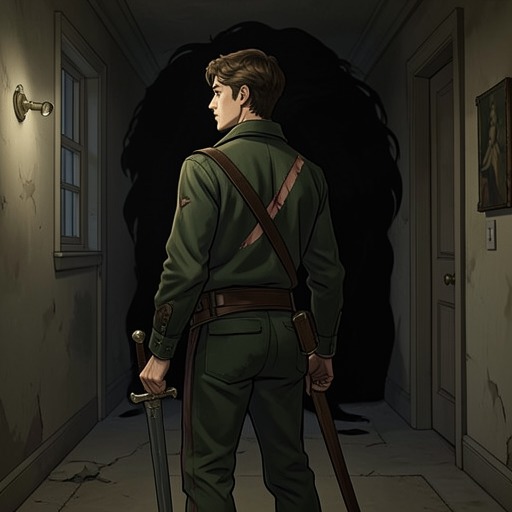
Murtagh is introduced as a young man in battered clothes whose composure contrasts with the uncertainty surrounding him. He carries a bow, a long hand-and-a-half sword, and a dagger hidden in his boot; a white horn bound with silver fittings rests in his lap, and a gray war-horse waits behind him. His serious face, fierce eyes, and wary attention toward Saphira mark him as capable but not openly hostile. When Eragon asks who he is, he answers simply, “Murtagh.” His voice is low and controlled, though it carries an emotion that suggests the name is not offered lightly.
The equipment surrounding him establishes Murtagh as a practiced traveler and fighter rather than an ordinary fugitive. He is not introduced through an explanation of his past but through objects, posture, and restraint. The bow remains ready, his hands tighten around it when questioned, and his attention stays fixed on the dragon. This entrance gives him the quality of a threshold figure: he appears at a moment when Eragon is vulnerable, offers a route forward, and simultaneously makes the road more uncertain.
Alliance with Eragon
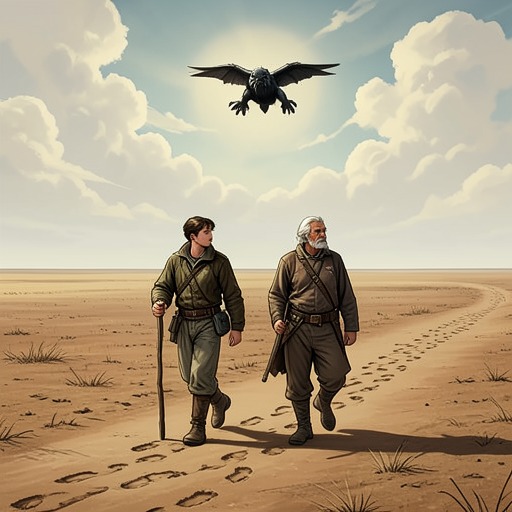
Murtagh chooses to accompany Eragon after recognizing that the young Rider has nowhere nearby to rest safely. His offer is practical rather than sentimental. He says he has no better place to be and hopes that traveling with Eragon will give him another opportunity to attack the Ra’zac. The presence of a Rider, he observes, is likely to draw danger and unexpected events. Murtagh therefore joins the journey because Eragon’s pursuit overlaps with his own, not because trust has already been established.
Eragon hesitates because Murtagh is a complete stranger, but weakness and immediate danger limit the choice. He accepts on the understanding that Saphira could drive Murtagh away if necessary. Murtagh mounts his gray war-horse, Eragon takes Snowfire’s reins, and the two leave the camp under an oxbow moon that may make them easier for the Ra’zac to track. The alliance thus begins under pursuit: companionship is not a refuge from danger but a means of moving through it.
Murtagh’s usefulness becomes concrete during the escape from Gil’ead. He returns carrying Zar’roc, a strange bow, and an elegant unsheathed sword, having found the weapons in the guardroom. He gives Zar’roc back to Eragon and identifies the other weapons as likely belonging to Arya because of their unfamiliar design. His contribution is not merely martial. He searches, retrieves what the fugitives need, and helps preserve the practical conditions of their escape while soldiers continue to move through the room.
Lineage and Hidden History
Murtagh’s identity changes sharply when Eragon insists that he must know how the Varden will react to him. Under pressure, Murtagh reveals that he is the son of Morzan, the first and last of the Forsworn. The confession is delivered in a tortured voice, after a period in which his breathing becomes hard and fast like that of a cornered wolf. His reaction shows that the disclosure is both feared and unavoidable: his ancestry is not an abstract genealogical fact but a danger capable of deciding whether he can enter the Varden at all.
He later begins to explain his history beside Eragon and Saphira. At first his speech is halting, but it gains strength and confidence as he continues. Murtagh claims to be the only child of the Thirteen Servants, though he admits that other children might have existed and been concealed. His uncertainty is itself part of the story he inherits: the Forsworn possessed the skill to hide what they wanted, leaving their family histories obscured by secrecy.
Murtagh’s mother met Morzan in an unidentified village while Morzan traveled on Galbatorix’s business. Morzan’s apparent kindness drew her confidence, and she fell deeply in love with him. He exploited that devotion, using her as a servant and as a tool for torment. After returning to Galbatorix’s court, he relied on her to carry secret messages, taught her rudimentary magic so she could avoid discovery and sometimes obtain information, and protected her from the other Forsworn because they might have used her against him. This history presents Murtagh’s birth within a system of coercion, political violence, and calculated manipulation rather than within a stable family.
Inheritance of the Riders’ Fall
Murtagh’s lineage is inseparable from the history Brom tells of the Dragon Riders. The Riders were formed before the age of the grandfathers’ fathers to protect and guard the land. For thousands of years they kept peace, allied with the elves and befriended the dwarves; their power helped cities and towers rise from living stone, and their era became remembered as a golden age. Their collapse began not because an outside enemy defeated them, but because Galbatorix learned to turn grievance, ambition, and betrayal against the order itself.
Galbatorix became a Rider after being tested at ten and found to possess great power. When his first dragon died, his grief and madness hardened into blame. He manipulated a sympathetic Rider, used dark secrets learned from a Shade, and lured an elder to death before slaughtering his accomplice. Later he found Morzan, described as physically strong but mentally weak, and persuaded him to leave a gate unbolted at Ilirea, now called Urû’baen. Through that opening Galbatorix stole a dragon hatchling, and Morzan became his disciple in forbidden magic. Once Shruikan had grown, Galbatorix and Morzan revealed themselves, killed Riders, and gathered twelve additional defectors into the Thirteen Forsworn.
Murtagh therefore inherits the name of a man who helped make the Riders’ destruction possible. The historical account gives that inheritance a double force. Morzan is not only Murtagh’s father; he is one of the principal instruments through which a protective order became a source of tyranny. At the same time, Murtagh’s own behavior does not reproduce the pattern of Morzan’s betrayal. His actions beside Eragon create a living contrast between descent and choice, suggesting that blood can transmit danger without determining allegiance.
Relationships, Change, and Narrative Role
Murtagh’s relationship with Eragon is founded on mutual necessity and tested by withheld truth. He offers protection, knowledge of weapons, and a shared objective against the Ra’zac, while Eragon offers the possibility of movement toward the Varden. Yet Murtagh cannot remain only the helpful stranger. Once his parentage is revealed, every act of assistance acquires a second meaning: it may be read as loyalty freely chosen, as self-protection, or as the complicated attempt of a son to escape the legacy of a father whose name still commands fear.
His position also connects him to the larger conflict among Riders, Galbatorix, and the Varden. The history of the Riders makes clear why Murtagh’s arrival at the Varden would be politically explosive. He is both an ally of Eragon and the child of one of the order’s most notorious enemies. The narrative places him at the boundary between inherited history and present action, where the past is not dead but remains capable of determining who may be trusted.
Murtagh’s role is further enlarged by the story’s pattern of revelation. Eragon learns the history of the Riders, receives Zar’roc, studies the map of Alagaësia, and then encounters Murtagh as another fragment of the fallen order’s legacy. The map leads toward Vroengard, the ancestral home of the Riders, now a looted and empty shell, while Murtagh embodies a different kind of ruin: not an abandoned place, but a living person forced to carry the consequences of the Riders’ fall. When a mysterious voice later identifies itself as Osthato Chetowä, the Mourning Sage, and Togira Ikonoka, the Cripple Who Is Whole, and instructs Eragon to trust Arya and go to Ellesméra, Murtagh remains part of the unresolved human danger surrounding that journey. His ending in the supplied material is therefore not a completed redemption or condemnation. It is an open moral trial, suspended between the conduct he has shown, the name he bears, and the choices still required to prove that he is not another Morzan.