Durza
EragonDurza is the Shade who confronts Eragon beneath Tronjheim and whose defeat becomes a decisive reversal in the battle at Farthen Dûr. He embodies concentrated power, cruelty, and the terrifying instability of a being whose apparent human form conceals something wholly other. Yet the brief revelation of his former identity, Carsaib, complicates that image: beneath the monster is the memory of an abandoned child, even though the story does not excuse the violence into which that history has been transformed.
Identity and Appearance
Durza enters the narrative at the moment when the Varden’s position is in immediate danger. An explosion tears open the chamber floor, sending a slab of stone thirty feet into the air and allowing Urgals to climb from the breach. While Eragon considers whether to flee, seal the tunnel, or reach one of Tronjheim’s gates, a tall man in black armor emerges and looks directly at him. The revelation is stark: it is Durza.
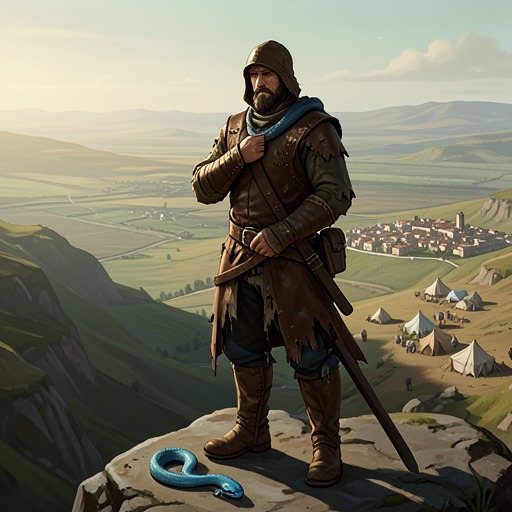
His appearance presents authority and menace at once. He carries a pale blade marked by the scratch Ajihad gave him, a black round shield bearing a crimson ensign, and a richly decorated helmet like that of a general. A long snakeskin cloak moves behind him, while madness burns in his maroon eyes. The military grandeur of the armor is therefore inseparable from his delight in power: Durza is not merely an agent of violence but an antagonist who has found himself in a position where violence can be exercised without restraint.
The Confrontation Beneath Tronjheim
Eragon immediately warns Saphira, although he knows that she cannot reach him in time. Durza’s presence forces him to apply what Brom taught him about fighting another magic user, and the prospects are discouraging. The encounter is dangerous on two levels from its beginning: Durza is physically faster and stronger, while his status as a Shade makes him a magical opponent who cannot be defeated by ordinary force alone.
Durza’s blade catches Eragon in the ribs, piercing his mail and driving the breath from him. The mail shifts just enough for the sword to miss his side by the width of a wire, but that narrow escape only creates the opening Durza needs. He breaks through Eragon’s mental defenses and begins trying to take control of his mind.
Eragon resists by attacking rather than retreating. He throws himself at Durza, grapples with the sword arm, and protects his hand from a cut with a mail-backed glove. Durza knocks him to the floor with his shield, leaving Eragon tasting blood and feeling the pain in his neck, but Eragon continues the struggle. He throws his own shield; although Durza is faster, it clips him on the hip. When the Shade stumbles, Eragon cuts his upper arm with Zar’roc, producing a line of blood and weakening the apparent invulnerability of the enemy.
The Mind Behind the Shade
The physical wound gives Eragon the opening for the decisive counterattack. He thrusts into Durza’s mind and breaks through the Shade’s weakened defenses, but the victory does not produce a simple glimpse of an inhuman consciousness. Instead, Eragon is engulfed by a flood of memories. Durza appears as a young boy living as a nomad with his parents on empty plains. His tribe abandons the family and calls his father an “oathbreaker.” The child’s name is not yet Durza but Carsaib, the name his mother sings while combing his hair.
This revelation creates a sharp division between the identity Durza displays and the life that preceded it. The general-like armor, the maroon-eyed madness, and the enjoyment of power belong to the Shade Eragon faces; the remembered name Carsaib belongs to a child whose family has been rejected and left exposed. The memories do not turn Durza into an innocent figure, nor do they explain every act attributed to him. They instead make the confrontation psychologically unstable: Eragon is fighting a monster, but the monster’s mind contains the abandoned human history that its outward form has buried.
Durza reels in pain as the memories overwhelm him, and Eragon cannot fully control the torrent passing through his own consciousness. The mental assault thus works in both directions. Eragon penetrates the Shade’s defenses, but the discovery also exposes him to the force of Durza’s past. The scene makes Durza’s power inseparable from the darkness of his interior life, while refusing to reduce that darkness to a merely tactical obstacle.
Death and Transformation
Durza’s defeat depends on the specific vulnerability Eragon has been told about: a Shade can be destroyed only by a thrust through the heart. After forcing his way through the Shade’s defenses, Eragon stabs Durza in the heart with Zar’roc. Durza looks down in shock at the blade protruding from his breast; his sword falls from his nerveless fingers, and he grips Zar’roc as though he might pull it free, but the weapon is firmly lodged in him.
The death reveals that Durza’s body has never been what it appeared to be. His skin becomes transparent, and beneath it there is neither flesh nor bone, only swirling patterns of darkness. The darkness pulses, splits his skin, and tears him apart from head to toe. With his final cry, the substance of the Shade separates into three entities that fly through Tronjheim’s walls and out of Farthen Dûr. Durza is therefore not left as an ordinary corpse: his destruction is a release, a violent unmaking of the form that contained the darkness.
The aftermath links Durza’s death to the larger battle rather than treating it as an isolated duel. As Eragon loses his strength, Saphira and Arya are nearly at the floor with the deadly remains of Isidar Mithrim. Eragon’s sight fades, and Saphira, Arya, and the countless fragments seem to stop in midair. Durza’s removal coincides with this suspension, turning his defeat into the threshold of another crisis and leaving the consequences of the shattered gemstone immediately unresolved.
Narrative Role and Significance
Durza functions as both a direct physical threat and a threshold guardian at the point where the conflict enters its most dangerous space. His emergence from the breached floor converts Eragon’s uncertainty about how to defend Tronjheim into a personal confrontation. The choices Eragon considers—flight, sealing the tunnel, or opening a gate for the Varden—collapse when Durza appears, and the larger military problem becomes an intimate test of survival, magical discipline, and courage.
His characterization also joins spectacle to buried history. The Shade’s armor, weapons, and supernatural body establish an antagonist of overwhelming force, while the memory of Carsaib interrupts the clean division between human and monster. Durza’s past is not presented as redemption; it is a fracture in the image of evil, showing that the terrifying figure in black armor once possessed a family name and a childhood bond. His final transformation then makes that fracture literal: the human-looking exterior breaks apart, exposing the darkness that has governed the character all along.
Durza’s death marks a decisive reversal because Eragon defeats an enemy who has breached both the city and his mind. The victory demonstrates that Eragon can survive a magical duel despite physical injury and overwhelming fear, but it also leaves him nearly unconscious and surrounded by a new catastrophe. Durza is gone, yet the darkness released from him escapes into the world, making his ending less a quiet conclusion than a violent passage from one stage of the conflict to the next.