Roran
EragonRoran is Eragon’s two-years-older cousin and one of the most important figures in Eragon’s home life. Muscular, sturdy, and careful in his movements, he is described as so close to Eragon that the two could not have been closer even if they had been biological brothers. His significance lies in the ordinary human future he represents: family, work, marriage, and a home built by personal effort rather than by inherited power or heroic destiny.
Identity and Family
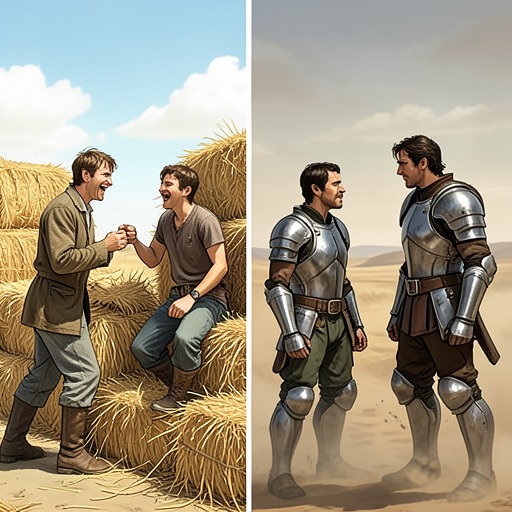
Roran belongs to the household formed by Garrow, Eragon, and himself. When Eragon returns from his journey, Roran is already eating chicken with Garrow and greets him with a grin, immediately restoring the warmth of family life after Eragon’s absence. His physical strength is matched by a controlled manner; he is sturdy but careful, suggesting reliability rather than recklessness. The closeness between the cousins gives Eragon an emotional bond that is both familial and fraternal, even though Eragon’s uncertainty about his own father leaves his heritage unresolved.
Roran’s relationship with Eragon is therefore grounded in chosen and lived kinship. Eragon wishes to know the name of his father and understand his ancestry, but the household’s daily affection supplies a more immediate form of belonging. Roran’s welcome, like Garrow’s care, makes family something experienced through loyalty and shared life rather than something guaranteed by bloodline alone.
Marriage and the Hope of a Home
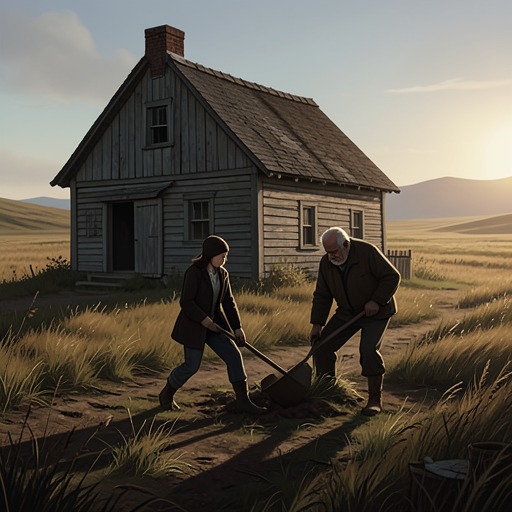
Roran’s clearest personal objective is his intention to marry Katrina. He tells Eragon that the money he seeks is for himself, then explains that he wants to marry. Although Eragon has already seen Roran and Katrina kissing during the traders’ visit, the declaration of marriage transforms a private romance into a practical plan. Roran has not yet asked Katrina formally, but he expects to do so in the spring, when he can raise a house.
The proposed house is more than a construction project. It expresses Roran’s desire to establish an independent household and enter adulthood through work, commitment, and responsibility. His plan depends on seasonal timing and available labor, not on adventure or supernatural inheritance. In this respect, Roran provides a deliberate contrast to Eragon: while Eragon is drawn toward the hidden history of the Dragon Riders, Roran is preparing to build a future in the visible world of fields, family, and marriage.
Garrow’s Approval and the Threat to Ordinary Life
Roran expects that the news of Katrina may create conflict, saying that there will be blood between them when her father finds out about their relationship. The statement places his marriage plan within a social conflict that could become violent. His hope for domestic stability is already shadowed by the possibility that another man’s opposition will turn courtship into a blood feud.
Garrow, however, does not oppose the match. After Roran explains his intention, Garrow says that he had hoped Roran would marry soon and that it would be good to see the family growing again. He also welcomes Katrina into the family, calling her lucky to have Roran. Roran’s astonishment gives way to a relieved grin, showing how much the approval of his guardian matters to him. Garrow’s response briefly confirms the possibility of the future Roran imagines: a marriage accepted by the household and a family renewed through its next generation.
That future is immediately made fragile by circumstance. Roran leaves with Dempton to obtain the sockets for the mill, traveling to Therinsford while Eragon remains at home. When the Ra’zac attack the farm, Eragon realizes with a sinking heart that Roran does not know what has happened and may be exposed because he is away. The attack thus separates the two cousins at the moment their family bond is most urgently needed. Roran’s absence is not a sign of indifference; it is the consequence of pursuing the work that was meant to support his marriage and household.
Connection to the Larger History
Roran’s life unfolds beside Eragon’s discovery of a much older and more dangerous history. At the village performance, Brom recounts the formation of the Dragon Riders, their mission to protect and guard, their unmatched prowess, and the golden age in which their power helped cities rise and the land prosper. Brom also explains that the Riders’ downfall came from within, beginning with Galbatorix, whose exceptional power led to his acceptance among them.
Roran is not the focus of Brom’s historical recital, yet his place in the narrative is sharpened by the contrast. The Dragon Riders represent a vast inherited past of magic, war, and political power; Roran represents the family member who wants only to work, marry, and build. The danger entering his life is therefore especially disruptive because it does not arise from an ambition he has chosen. It reaches him through Eragon, the stone, the Ra’zac, and the violent history that Brom has begun to uncover.
Narrative Role
Roran anchors Eragon’s extraordinary story in recognizable human attachments. His body, labor, courtship, and plans for a house give concrete value to the peaceful life that the larger conflict threatens to destroy. The narrative’s expanding system of knowledge is also set against this domestic world: Brom preserves history through oral performance, rare books preserve suppressed accounts of Alagaësia, and Eragon must first confront the fact that he cannot read before he can enter those written traditions.
Within that structure, Roran’s importance is relational rather than supernatural. He is the older cousin who welcomes Eragon home, the near-brother whose absence becomes alarming when violence strikes, and the young man whose marriage plans embody continuity. His projected future with Katrina makes the consequences of the Ra’zac’s attack more than a private family disaster: it threatens the possibility of a stable life that Roran had begun to imagine and prepare with his own hands.