Garrow
EragonGarrow is Eragon’s uncle, guardian, and central domestic authority before the story’s world of magic and war overtakes him. A farmer living outside Carvahall near the Anora River, he represents a hard-won ordinary life: poor, suspicious of danger, exacting about work, yet bound to Eragon and Roran by responsibility. His murder in the Ra’zac attack is therefore not merely an early plot incident. It breaks the household that formed Eragon, turns the farm into a site of memory and violence, and gives Eragon a personal reason to pursue the forces threatening Alagaësia.
Identity and Household
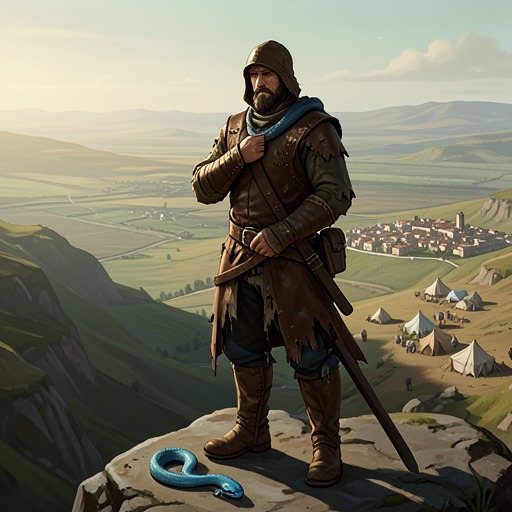
Garrow is introduced at the door of the family home after Eragon returns from hunting. He is visibly worn down: his clothes hang from a gaunt frame, his face is lean and hungry, and his graying hair and intense eyes make him appear prematurely aged. The house around him is equally plain and labor-worn. Its old table, homemade nails, cooking utensils, and floorboards polished by years of footsteps establish a household sustained by endurance rather than comfort. Roran is sleeping inside, while Garrow remains the adult who receives Eragon and questions him.
The farm’s animals and equipment reinforce Garrow’s precarious circumstances. Two horses, Birka and Brugh, share a dull-colored barn with chickens and a cow; a pig, once present, has become unaffordable that year. A wagon is wedged between the stalls, and trees mark the edge of the fields along the Anora River. These details make Garrow’s life materially specific: his authority comes not from wealth or status but from maintaining a small, vulnerable rural economy.
Practical Authority and Fear of Magic
Garrow’s first response to Eragon’s strange stone is practical suspicion. When Eragon brings home meat purchased by Horst after his dispute with Sloan, Garrow sharply demands to know where the money came from. His concern is not abstract morality alone; every unexplained exchange threatens to draw trouble toward the farm. He listens to Eragon’s account of Sloan’s anger and explains that Sloan’s wife, Ismira, went over Igualda Falls a year earlier, after which Sloan avoided the Spine and refused any connection with it. Garrow sees Sloan’s hostility as spiteful rather than a reason for Eragon to reject payment.
His advice about the stone defines his attitude toward the supernatural. After hearing that the weather has turned cold, Garrow tells Eragon to help Roran complete the barley harvest and gather the squash before frost damages them. He then advises selling the stone when traders arrive, because the less the family becomes involved with magic, the safer they will be. This is a distinctly rural form of prudence: harvest, weather, money, and family obligations matter more to him than mystery. Yet the very caution that seems sensible in the farm’s ordinary world cannot protect him from dangers already moving toward the household.
The Ra’zac Attack and Garrow’s Wounding
The destruction of Garrow’s home marks the violent end of his role as protector. Eragon finds a hand beneath the collapsed roof and tears through the wreckage, trying to reach his uncle despite splintered wood and a beam too heavy for him to move. He calls for Saphira, who comes immediately and braces herself against the beam. Her strength lifts it long enough for Eragon to drag Garrow from the ruins.
Garrow’s condition shows the attack as bodily devastation rather than distant tragedy. His skin is gray, lifeless, and dry; his lip is split, his cheekbone scraped, and deep ragged burns cover most of his body. The burns are chalky white and ooze clear liquid, while the smell surrounding him recalls rotting fruit. His breath comes in short jerks that sound like a death rattle. Saphira identifies the attackers as murderers, but Eragon refuses to surrender hope and insists that Garrow may still be saved. He wants to take him to Gertrude, yet acknowledges that he cannot carry him to Carvahall alone. Garrow’s helplessness reverses the household’s former order: the uncle who had directed work and guarded the family must now be carried and treated as a wounded body, while Eragon assumes the desperate responsibility of saving him.
Death and Grief
Garrow survives the initial attack only briefly. Before dawn, Eragon wakes from a terrible premonition and discovers people gathered in his uncle’s room. Garrow lies peacefully on the bed in clean clothes, his hair combed back and his face calm. The silver amulet around his neck and the sprig of dried hemlock on his chest identify him as dead and show that the living have prepared him according to local custom.
Katrina stands beside the bed with her face pale and her eyes lowered. She whispers that she had hoped to call Garrow Father one day, a statement that exposes the emotional place he held beyond formal kinship. Eragon answers her inwardly with bitterness: even that name is a right he does not possess. His grief is intensified by cumulative loss. He feels emptied of vitality, sees Garrow’s face as the only solid thing in an otherwise insubstantial world, and recognizes that he has lost his mother, aunt, and uncle. Garrow’s death thus completes the destruction of Eragon’s original family structure and leaves him with mourning that cannot be separated from his developing identity as a Dragon Rider.
Afterlife in Eragon’s Moral World
Although Garrow does not participate in the later battles, his influence remains visible in Eragon’s responses to violence. When Murtagh executes the defenseless slaver Torkenbrand, Eragon reacts with fury, arguing that killing a powerless captive is wanton violence and demanding empathy. Murtagh answers that survival and the protection of what one cherishes may require lethal action. The disagreement gives form to a moral tension that Garrow’s death has made personal for Eragon: violence is no longer an abstraction because the destruction of his home has shown him its cost, yet he must still decide what kinds of violence he can accept.
That tension develops further during the battle beneath Farthen Dûr. Eragon fights beside Saphira and the dwarves, using magic when Zar’roc cannot serve him and taking no mercy on the Urgals attacking them. A spear dents his shield and bruises his shoulder; he then kills an Urgal, while Hrothgar and the dwarf guards perform acts of overwhelming battlefield strength. Eragon’s conduct is no longer the helpless rescue attempt at the ruined farm, but neither is it morally weightless. The memory of Garrow’s murder stands behind the transformation from a farmer’s nephew defending a household to a combatant defending allies.
At the crisis of the battle, Eragon believes that the Varden and dwarves have been destroyed and that Saphira will surrender herself for his sake while Arya is recaptured or killed. His despair repeats the emotional structure of Garrow’s death: a world of family and allies appears to vanish at once, leaving him to ask what justice can mean when everything ends in loss. Garrow’s decisive narrative function lies in this continuity. He is the figure who makes Eragon’s departure necessary, whose death gives the wider conflict an intimate wound, and whose memory remains embedded in Eragon’s struggle to preserve what he cherishes without becoming indistinguishable from the violence he opposes.