Hrothgar
EragonHrothgar is the forty-second king of the Dwarves and the guardian of an eight-thousand-year political tradition beneath Farthen Dûr. His significance lies not only in his royal power but in the choice he makes when Eragon arrives: despite opposition within the clans, Hrothgar secures sanctuary for the Rider and thereby places ancient dwarf authority behind the resistance to Galbatorix.
Identity and Royal Presence
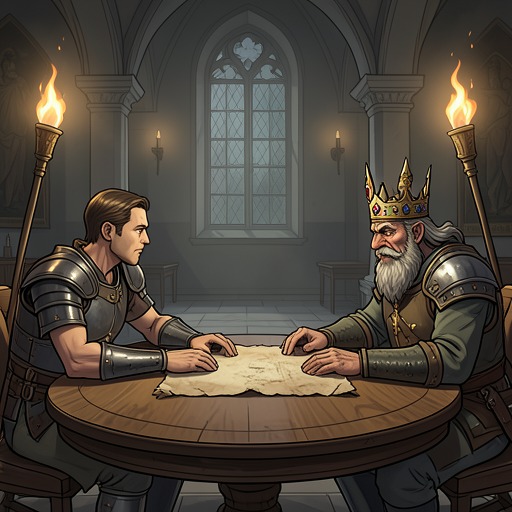
Hrothgar first appears at the end of a solemn hall lined with more than forty statues of dead dwarf monarchs. He sits upon a raised throne carved from a single piece of black marble, wearing a gold helm set with rubies and diamonds rather than a crown. His face is grim and weathered, his eyes deep-set and piercing, and his white beard is tucked beneath his belt. A war hammer bearing the emblem of Orik’s clan rests in his lap. The image joins bodily age, military readiness, and dynastic memory: Hrothgar is presented as a ruler who seems almost continuous with the stone and monuments around him.
His authority is rooted in more than ceremony. He tells Eragon that forty-one predecessors occupy the carved thrones and that his own statue will join them when he dies. He identifies Korgan as the first of those ancestors and credits him with forging Volund. For eight millennia, he says, the Dwarves have ruled beneath Farthen Dûr, older than both the elves and the dragons. Hrothgar therefore speaks as the living representative of a civilization that understands sovereignty through endurance, ancestry, and possession of the land.
Sanctuary for Eragon
Hrothgar’s first political importance is revealed when he explains why he could not meet Eragon as quickly as Ajihad did. Enemies within the clans demanded that he deny Eragon sanctuary and expel him from Farthen Dûr. Hrothgar spent considerable effort persuading them to accept the Rider instead. His decision is consequently neither automatic hospitality nor a private favor. It is a contested act of statecraft, achieved against internal resistance and exposing the political risk attached to Eragon’s presence.
When Eragon thanks him, Hrothgar responds with the dwarf maxim Âz knurl deimi lanok, rendered as “Beware, the rock changes.” He immediately connects the old saying to the present, observing that the rock is changing very quickly. The maxim functions as both warning and self-description. Hrothgar belongs to an ancient order, yet he understands that the arrival of a new Dragon Rider, the war against Galbatorix, and conflict among the clans are forcing that order to adapt.
Hrothgar also rejects the idea that Eragon should become a king merely because he is a Rider. When Eragon says that he does not seek the throne in Urû’baen unless no other capable person is willing to take it, Hrothgar warns that no race should be ruled by a leader who does not age or leave the throne. He declares that the time of the Riders has passed and would not return even if Galbatorix’s remaining eggs hatched. His judgment places limits on heroic succession: power and longevity do not by themselves create legitimate government.
Suspicion, Zar’roc, and Political Memory
Hrothgar’s welcome remains guarded. He has been told that Eragon carries an enemy’s sword and travels with a son of the Forsworn, and the knowledge displeases him. His attention turns specifically to Zar’roc, whose history links Eragon to the violence and betrayal of the old Rider order. Hrothgar asks to inspect the blade, tests its point against his palm, and acknowledges its exceptional craftsmanship while calling it ill-fated.
The exchange makes Hrothgar a keeper of historical memory rather than a passive ally. He can recognize the excellence of an elven-forged Rider’s sword and still distrust the legacy it carries. His response to Zar’roc is measured rather than absolutist: he does not confiscate it, but permits Eragon to carry it, suggesting that its luck may have changed. That qualified acceptance mirrors his treatment of Eragon himself. Hrothgar does not erase the past, yet he allows present actions to challenge inherited judgment.
The wider history surrounding Hrothgar intensifies this role. Brom’s account describes the Dragon Riders as protectors whose powers enabled cities and towers to rise from living stone, ushering in a golden age in which elves were allies, Dwarves were friends, and human prosperity flourished. It also recounts how Galbatorix’s betrayal, Morzan’s collaboration, and the Thirteen Forsworn destroyed that order. Hrothgar’s suspicion of Zar’roc and of the son of a Forsworn is therefore grounded in a collective catastrophe, not personal prejudice alone.
War and Material Support
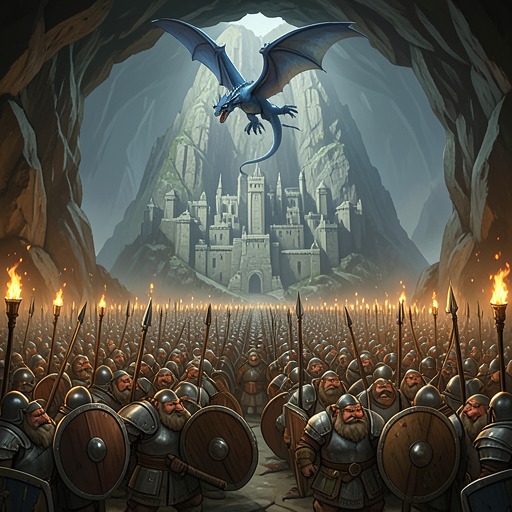
Hrothgar’s support becomes concrete when the coming battle threatens Farthen Dûr. Ajihad announces that the Urgals will arrive within hours and that the city-mountain must be held. Defeat would mean the downfall of the Dwarves, the death of the Varden, and eventual defeat for Surda and the elves. Hrothgar’s earlier decision to grant sanctuary thus acquires immediate military consequences: the question of whether Eragon belongs within Farthen Dûr is inseparable from the question of how its defenders will face the invasion.
Before the battle, Hrothgar gives Saphira a complete set of dragon armor forged before the fall of the Riders. The armor is extremely heavy, intricately engraved, and decorated with gold filigree; some parts are an inch thick. It had lain forgotten among the dwarven treasures because complete sets were rare, requiring immense time to make and repeated adjustment as dragons grew. Since Saphira is still relatively small, the armor should fit her reasonably well. The gift transforms Hrothgar’s historical wealth into practical protection for the new Rider and dragon, making the past materially useful in the present conflict.
Narrative Role and Significance
Hrothgar occupies the threshold between tradition and transformation. His throne, ancestors, hammer, and stone kingdom express continuity, while his acceptance of Eragon acknowledges a future that cannot simply restore the old Riders. He neither embraces change without reservation nor retreats into isolation. Instead, he negotiates with hostile clans, scrutinizes the symbols of a ruined age, and equips Saphira for a battle whose outcome affects several peoples.
As a ruler, Hrothgar also provides a political counterpoint to Galbatorix. The Empire’s agents claim that only the king’s unceasing efforts protect ordinary people, even as the Varden are described as a rebel group resisting imperial rule. Hrothgar’s authority is presented differently: it is argued through ancestral legitimacy, communal defense, negotiation with internal opponents, and tangible aid. His rule is not free from conflict, but it is responsive to the survival of the people under his protection.
Hrothgar’s decisive contribution is therefore an act of judgment. He recognizes the danger represented by Eragon’s weapon and lineage, yet he chooses sanctuary, cooperation, and preparation over exclusion. In a story shaped by the fall of the Dragon Riders and the rise of Galbatorix, Hrothgar shows that preserving a civilization does not mean leaving it unchanged. The ancient king’s strength is measured by his ability to let a new alliance enter the old stone without surrendering the memory that gives that stone meaning.