Saphira
EragonSaphira is the dragon who hatches for Eragon and becomes his bonded partner, guide, and ally. Her decisive significance lies in the way her existence joins personal awakening to the recovery of a nearly lost order: through her, Eragon inherits the Dragon Rider’s power and responsibilities, while Saphira herself becomes a living continuation of the dragons and Riders whose golden age Brom remembers and whose destruction was brought about by Galbatorix and the Thirteen Forsworn.
Identity and Awakening
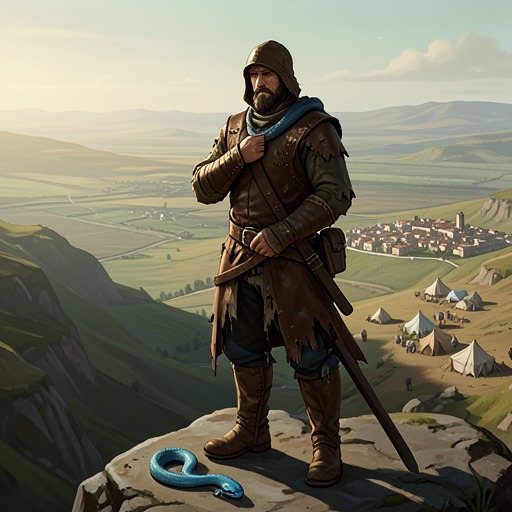
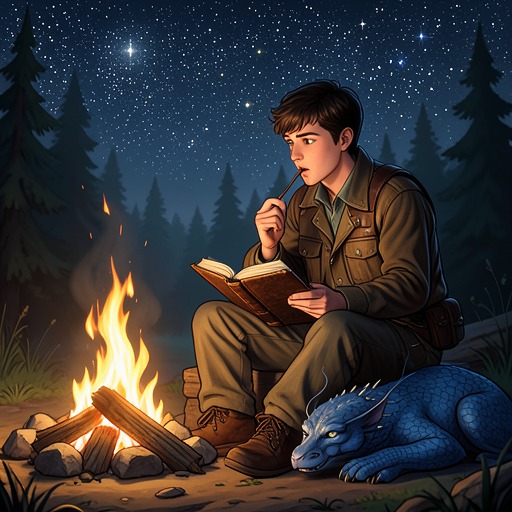
Saphira first appears not as a known creature but as the secret within a blue stone. After Eragon brings the object home and tries to conceal it, the stone cracks open. A small, dark-headed creature emerges, and Eragon discovers that he is looking at a dragon. She is no longer than his forearm, with deep sapphire-blue scales matching the apparent stone, oversized wings, white fangs and claws, and a line of spines extending from her head to the tip of her tail. Her physical form is young, but the description already gives her dignity and nobility, distinguishing her from an ordinary animal.
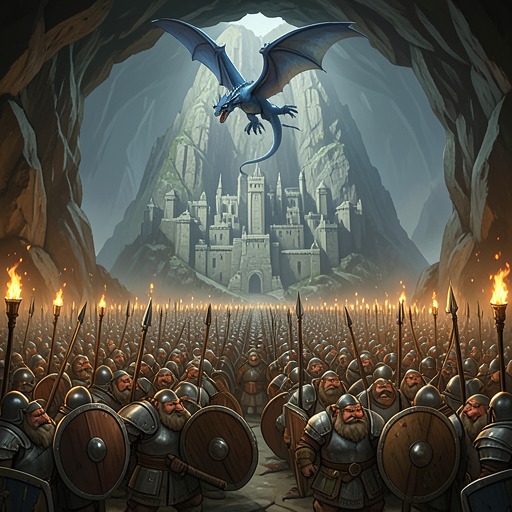
Her hatching changes the meaning of Eragon’s discovery. The object is revealed to be an egg, and Saphira is not merely a rare creature found by chance: her emergence places Eragon within the history of the Dragon Riders. Brom’s account explains that the Riders were formed to protect and guard the land, that their strength was extraordinary, and that their service helped create a prosperous golden age in which elves were allies and dwarves were friends. That order collapsed when Galbatorix’s grief, madness, manipulation, and hunger for power turned against the Riders. Saphira’s birth therefore carries both promise and historical burden: she is a new beginning arising from the ruins of an older world.
Eragon searches for a name that will suit her, considering and rejecting several possibilities before recalling a name Brom had mentioned. When he asks whether she is Saphira, she answers through their emerging mental connection, and he feels her satisfaction. The moment establishes that naming is reciprocal rather than simply imposed. Eragon proposes the name, but Saphira accepts it, and her humming confirms the bond between identity and recognition.
Bond with Eragon
Saphira’s relationship with Eragon is founded on mental contact rather than ownership. When Eragon calls to her after returning to the farm, she replies faintly that she is coming, and he senses alarm in her response. She arrives through the forest on beating wings and lands amid smoke. Once Eragon tells her that strangers have appeared, Saphira reacts with immediate fear and violence, rearing, roaring, and striking the snow with her tail. Her thoughts convey bloodlust, fear, fire, enemies, death, and murderers, while an iron barrier shuts Eragon out of the rest of her mind. The connection gives him access to her emotions, but it does not erase her privacy or autonomy.
That autonomy remains central even as the bond deepens. During flight, Saphira draws Eragon’s mind away from his body and lets him see through her eyes. Colors appear altered, with blue intensified and other colors subdued; he cannot control her body and experiences himself as a ghost outside it. He nevertheless feels her physical effort as she climbs, uses updrafts, steers with her tail, and rejoices in the freedom of the sky. Their connection grows until the distinction between their identities nearly disappears. When they clasp wings and dive, Eragon experiences no terror because Saphira’s exhilaration overwhelms it. The scene presents the Dragon Rider bond as a shared sensory and emotional existence, not simply a means of communication.
The bond also makes danger mutual. Saphira’s alarm at the strangers is not an isolated animal response but an instinctive recognition of lethal threat, and Eragon’s need to understand her becomes inseparable from his need to protect Garrow and confront the forces pursuing them. Her thoughts and reactions repeatedly widen Eragon’s awareness beyond ordinary human perception, while his presence gives her a human partner through whom the lost Rider tradition can re-enter the world.
History and the Lost Riders
Saphira belongs to a species whose history is intertwined with the rise and fall of civilization. Brom recounts that the conflict between elves and dragons began when an elven youth hunted and killed a dragon as though it were a stag. The dragons retaliated against the elves, and the resulting war lasted five years before an elf named Eragon found a dragon egg and created the first bridge toward peace. Saphira’s existence thus recalls an ancient reconciliation between peoples as well as the later destruction caused by Galbatorix.
The catastrophe that ended the Riders’ golden age began with Galbatorix, who was accepted by the Riders as a gifted child. After his first dragon died, he blamed the Riders for the loss, manipulated a sympathetic Rider, and helped lure and kill an elder before murdering his accomplice. Years later he persuaded Morzan to leave a gate unbolted at Ilirea, stole a dragon hatchling, and eventually emerged with his black dragon, Shruikan. Twelve Riders joined him, forming the Thirteen Forsworn, and the Riders fell beneath their attack. Saphira’s hatching occurs against the far side of this history: where Galbatorix used a dragon to consolidate tyranny, Saphira’s bond with Eragon offers the possibility that human and dragon power can again serve resistance and protection.
The geography associated with the Riders reinforces that sense of loss. Vroengard, their ancestral home, is described as a looted and empty shell haunted by strange beasts, with the abandoned city of Dorú Areaba at its center. Saphira is the opposite of that abandoned inheritance. She is not a relic displayed in a ruined place but a living dragon capable of choosing, feeling, communicating, and entering history anew.
Relational and Narrative Role
Saphira is Eragon’s closest counterpart, but the narrative does not reduce her to an extension of his personality. She possesses her own alarm, satisfaction, curiosity, and joy, and her reactions can interrupt or redirect Eragon’s intentions. Her mental barrier during the crisis at the farm demonstrates that intimacy does not mean total transparency. Likewise, her delight in flight is specifically hers, even when Eragon shares it through the bond.
Her role also parallels the book’s larger movement from inheritance to transformation. Brom’s story looks backward toward the Riders’ formation, their alliance with elves and dwarves, their prosperity, and their destruction through betrayal. Saphira looks forward: her body carries the recognizable signs of an ancient species, but her life begins in a world where the Rider order has been broken. Eragon’s possession of Zar’roc, a Rider’s blade presented to him by Brom, gives the past a weapon; Saphira gives it a living future. The sword can be inherited, but the bond must be formed.
Saphira’s presence further challenges a purely human measure of agency. She is physically young yet intellectually responsive; she communicates without ordinary speech, shares perception across species, and participates in decisions through emotion and thought. The Rider identity is therefore relational from its origin. Eragon cannot become what he is alone, and Saphira cannot be understood merely as a mount or weapon. Their shared consciousness makes each the condition through which the other’s new identity becomes possible.
Change and Continuing Significance
Saphira’s first major change is from concealed egg to named dragon, but the more important transformation is relational. At hatching, she is a small creature newly separated from the egg; after Eragon names her, she becomes a conscious partner; during flight, the bond develops into a near-unified experience of body and mind. Each stage expands the consequences of her existence, from private wonder to public danger and historical significance.
Her future importance is foreshadowed by the authority of the voice that later identifies itself as Osthato Chetowä, the Mourning Sage, and Togira Ikonoka, the Cripple Who Is Whole. That voice tells Eragon to trust Arya, go with her to Ellesméra, and seek the speaker there, while praising what he has accomplished in ridding the land of a great evil. Although the message is addressed to Eragon, its implications extend to Saphira: the two are treated as a joined force whose emergence has already altered the balance of the struggle against Galbatorix.
Saphira’s significance therefore rests in several linked functions. She is the immediate cause of Eragon’s passage beyond ordinary village life, the embodied survival of the dragons and Riders, a partner whose independent mind prevents the bond from becoming simple possession, and a counter-image to the corrupted dragon-rider relationship represented by Galbatorix and Shruikan. Her sapphire body carries the memory of a destroyed order, but her shared flight with Eragon turns memory into movement. Through Saphira, the past is not merely mourned; it begins again.