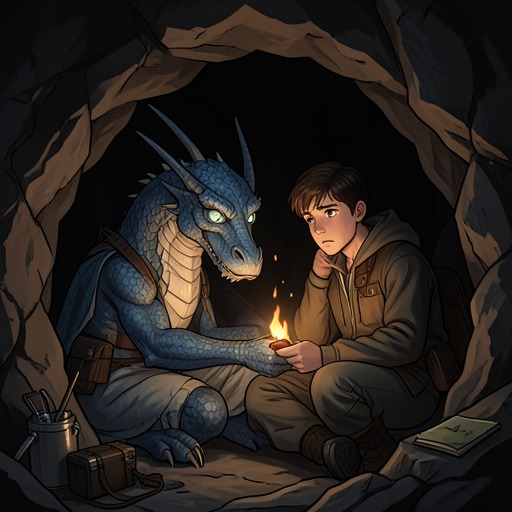
Solembum
EragonSolembum is a werecat who appears first as an uncanny cat in Angela’s shop and becomes one of the book’s most enigmatic sources of knowledge. His refusal to fit Eragon’s assumptions about animals, his insistence on possessing a proper name that remains undisclosed, and his two cryptic instructions give him a distinctive narrative function: he guards knowledge rather than distributing it freely, and he turns a brief encounter into a promise of future revelation.
Identity and Introduction
Solembum is initially seen in darkness as a large, fierce cat with a lean body, powerful shoulders, oversized paws, a shaggy mane, black-tufted ears, and white fangs curving over his jaw. His red, slanted eyes and angular face make him unlike any cat Eragon has encountered. He studies Eragon with shrewd attention, then dismisses him with a flick of the tail, establishing independence before he speaks or explains himself.
Eragon reaches toward the creature’s consciousness with his mind, intending to communicate as a friend, but Solembum immediately makes clear that such an effort is unnecessary. When Eragon treats him as an ordinary cat, the werecat challenges the assumption directly. He identifies himself as a member of a people of whom few remain, and his sharp correction exposes Eragon’s neglected education. The exchange changes the encounter from a magical animal sighting into a meeting with an intelligent, self-defining being.
Nature and Temperament
Solembum describes himself as a werecat rather than a cat, and the distinction governs his entire presentation. He is capable of speech, mental communication, and deliberate judgment, yet he retains the physical habits of a feline creature: he cleans a paw, stretches, curls his paws beneath his breast, purrs, naps, and moves with silent or abruptly forceful grace. His animal form is therefore not a disguise that disappears once his intelligence is revealed. It is part of the identity he insists Eragon recognize.
He is also presented as rare and elusive. Eragon recalls that werecats appear at the edges of stories, keep to themselves, and sometimes offer advice; legends attribute magical powers, long lives, and concealed knowledge to them. Solembum confirms neither the legends nor their full scope. Instead, he answers Eragon’s fascination with a distinction between knowledge and existence: a person’s ignorance does not make that person unreal. His response rebukes human certainty and places the limits of Eragon’s education at the center of the scene.
Solembum’s manner combines irritation, amusement, and control. He resents being awakened, uses his claws to enforce the lesson when Eragon persists, and declines to provide his proper name. He says that he goes by many names but allows Eragon to call him Solembum. Even this apparent concession preserves his privacy: Eragon receives a usable name, not complete access to the person behind it.
Relationship with Eragon and Angela
Solembum’s connection with Eragon begins through mental contact, but it does not become a simple bond of friendship or obedience. Eragon approaches him cautiously and with fascination, while Solembum decides when communication will occur and what it will contain. Their relationship is structured by asymmetry: Eragon wants explanations, whereas Solembum supplies fragments, corrections, and warnings on his own terms.
Angela’s reaction emphasizes the unusual nature of the encounter. When she returns to the shop and learns that Eragon has spoken with Solembum, she is startled. Later, when Solembum moves between them, Angela tells Eragon that she does not know what the werecat said and does not want to know, because he spoke only to Eragon. She specifically instructs Eragon not to repeat the message. Her response acknowledges a boundary around Solembum’s speech: his words are private, recipient-specific knowledge rather than ordinary information available to everyone present.
Prophecy and the Two Instructions
Solembum’s most consequential act is the delivery of two instructions. He tells Eragon that when the time comes and a weapon is needed, Eragon should look beneath the roots of the Menoa tree. He then adds that when everything seems lost and Eragon’s power is insufficient, Eragon should go to the rock of Kuthian and speak his name to open the Vault of Souls.
The statements are precise in their objects but opaque in their circumstances. Solembum does not explain the Menoa tree, the weapon, the rock of Kuthian, the meaning of speaking one’s name, or the nature of the Vault of Souls. The advice therefore functions less as immediate assistance than as a delayed mechanism of plot and memory. It gives Eragon knowledge that cannot yet be used, while attaching future survival to the recollection of a nearly inexplicable conversation.
Eragon is shaken before he leaves, and that reaction marks the instructions as more than picturesque prophecy. Solembum’s words widen the world beyond the problems Eragon currently understands. They suggest that the crises ahead will demand both an external weapon and a deeper act of self-disclosure, linking material power with identity.
Return at Farthen Dûr
Solembum reappears in Farthen Dûr after Eragon has found warmth, food, sleep, and a temporary sense of security. The setting gives the reunion a different charge from the first meeting. Eragon’s tension has begun to loosen, yet his concern for Murtagh prevents that comfort from becoming complete. In this moment of uneasy refuge, he looks toward the dragonhold and sees a large cat licking a paw on the edge of the cave.
The flash of slanted red eyes allows Eragon to recognize him before any explanation is given. When Eragon asks whether the cat is Solembum, the werecat answers with characteristic bluntness, treating recognition as obvious. He shakes his mane, yawns to display his long fangs, stretches, and leaps from the cave onto Isidar Mithrim twenty feet below before inviting Eragon to follow. The scene preserves his feline physicality and his control of movement while renewing the unresolved connection between them.
Solembum’s return confirms that the earlier encounter was not an isolated curiosity. He can appear across the changing stages of Eragon’s journey, remaining independent of the human institutions and immediate conflicts surrounding the Varden. His presence carries forward the private knowledge of the Menoa tree, Kuthian, and the Vault of Souls, even while he offers no clarification.
Narrative Role and Significance
Solembum occupies the space between animal and person, secrecy and revelation, comic strangeness and grave prophecy. He is not merely a talking creature included to make the magical world more colorful. His first appearance challenges Eragon’s anthropocentric assumptions, and his later warning makes him a guardian of knowledge whose value depends on timing. He demonstrates that intelligence does not have to resemble human behavior, and that access to truth may be conditional rather than universally shareable.
His concealment of a proper name also resonates with the story’s broader concern with identity and power. Solembum gives Eragon a name by which to address him but withholds the deeper name Eragon seeks. That refusal preserves autonomy and prevents familiarity from becoming possession. In contrast, his instructions about speaking Eragon’s own name point toward a future in which self-knowledge or self-identification will open a sealed store of power.
As a character, Solembum is deliberately resistant to full explanation. He appears, corrects, warns, and departs; even his return ends in another leap away rather than in resolution. His mystery is not a gap that the narrative rushes to close but a continuing pressure on Eragon’s understanding. Through Solembum, the book makes knowledge feel alive: selective, mobile, embodied, and capable of waiting until the moment when its meaning can finally be grasped.