Brom
EragonBrom is introduced as an elderly storyteller whose rough village persona conceals extraordinary knowledge and a life bound to the history of the Dragon Riders. He becomes Eragon’s first sustained mentor: he teaches him how to read, explains the political and magical past of Alagaësia, trains him for danger, and places a Rider’s sword in his hands. Only at the end of his life does Brom reveal that he was himself a Rider, once bonded to a dragon named Saphira. His death is therefore both a personal bereavement and the transfer of an unfinished cause from one generation to the next.
Identity and Background
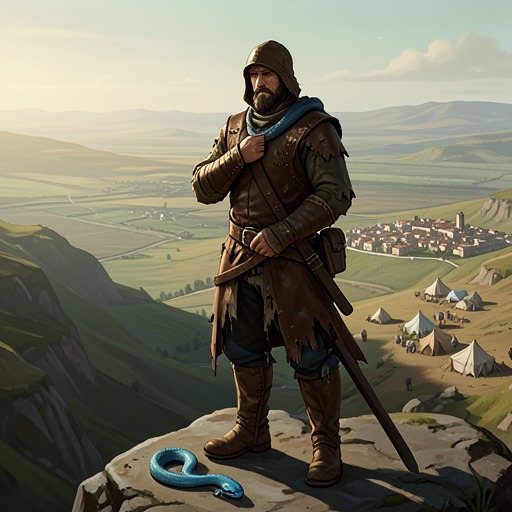
Brom lives quietly in Carvahall, where Garrow knows only that the old man bought a house nearly fifteen years earlier and has remained there in relative obscurity. His public appearance encourages that impression of an eccentric provincial: he wears a brown hooded robe like a friar, leans on a twisted staff carved with strange designs, carries a pouch on a worn leather belt, and has a hooked eagle nose above his white beard. His deep-set eyes and gnarled brow give him an intimidating aspect, while his irascibility makes his hospitality easy to mistake for mere cantankerousness. Brom’s house is dark, acrid, and cluttered with objects whose importance Eragon cannot yet recognize. A gold ring set with a sapphire bears a strange symbol, and Brom’s apparent dependence on a staff does not exhaust the implications of his past. When Eragon asks where he came from, Brom deflects the question with a joke about having come from a village like Carvahall. The answer is evasive rather than informative, preserving the boundary between the storyteller’s adopted village identity and the history he has deliberately concealed.
Keeper of History and Oral Tradition
Brom’s authority first appears through narration. At a village gathering, troubadours perform comic plays before the older storyteller steps forward in a black cape, his white beard rippling over his chest and his hands extended like talons. He frames his tale as a damaged remnant of the past: time cannot be stopped, but memory can preserve what has been lost. He warns that the account is imperfect and fragmented, yet insists that it becomes meaningful through the people who receive it. The performance thus presents history not as inert information but as a living exchange between teller, audience, and memory. His account of the Dragon Riders describes them as guardians whose battle prowess was unmatched, whose powers were used for good, and whose rule allowed cities, towers, trade, and prosperity to flourish. The age is remembered as a golden time in which elves were allies, dwarves were friends, and peace enabled the land to flourish. Brom immediately sets that ideal against its collapse: the Riders could defeat external enemies but could not protect themselves from internal betrayal. Brom identifies Galbatorix as the agent through whom that collapse becomes catastrophe. He recounts Galbatorix’s early acceptance by the Riders, the death of his dragon, his resentment toward the council, and his descent into revenge. Galbatorix manipulates a sympathetic Rider, helps murder an elder, kills his accomplice, then later recruits Morzan by persuading him to leave a gate unbolted at Ilirea, now called Urû’baen. He steals a dragon hatchling, learns forbidden magic, returns with the black dragon Shruikan, and builds the Thirteen Forsworn from Riders drawn by power and grievance. Brom’s history makes the Fall of the Riders a cautionary pattern: institutions fail not only when attacked, but when ambition converts injury into ideology. In a second account, Brom explains that dragons have no known beginning apart from the creation of Alagaësia and that they, the dwarves, and a few other beings were the land’s earliest inhabitants. He describes the war between elves and dragons as the result of a fatal misunderstanding: an elf hunted a dragon as if it were an ordinary animal, and the dragons retaliated against the elven nation. The conflict lasted five years and might have continued much longer had an elf named Eragon not found a dragon egg. Brom’s telling unexpectedly reveals why Eragon bears the name of an ancient elf, joining the young protagonist’s personal identity to a much older attempt to end violence between peoples.
Mentor, Teacher, and Armorer
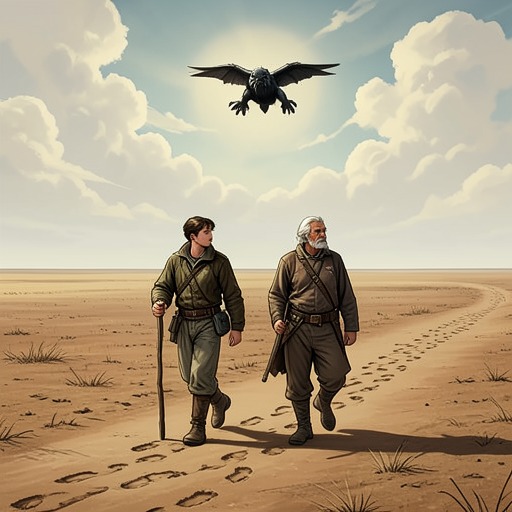
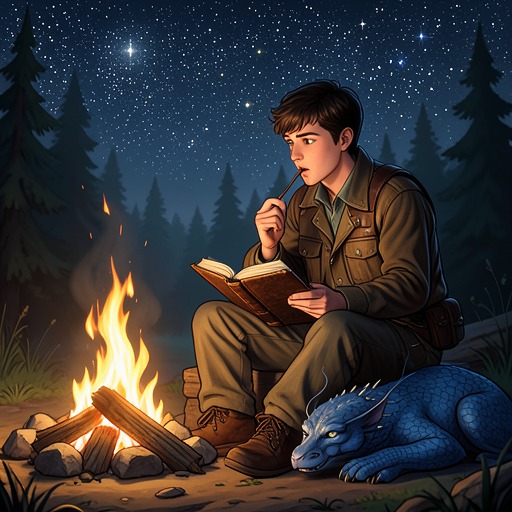
Brom’s relationship with Eragon begins in curiosity and instruction. He tolerates the boy’s repeated questions, even while grumbling that the history of the Riders is too vast to recount in full. Before explaining their origins, reputation, and the nature of dragons, he lights his pipe and establishes the limits of the lesson, turning an immense subject into something Eragon can absorb. His teaching is informal, embodied in tea, tobacco, household objects, maps, stories, and patient correction rather than in an official school. That education includes literacy, a decisive gift because Eragon cannot read. His inability is exposed when he is expected to help with work involving written materials, and Brom reacts with disbelief that Garrow never taught him. Later, Brom teaches him to read, a skill Eragon remembers after Brom’s death when he enters the great library in Tronjheim. The memory shows that Brom’s instruction survives in practical form: it allows Eragon to approach written knowledge and inherit histories that would otherwise remain closed to him. Brom also teaches Eragon how to distinguish historical record from legend. He explains that the Dragon Riders’ history spans countless years and that, at their height, they held sway over twice the Empire’s lands, while warning that many popular stories exaggerate their powers. He introduces Eragon to The Domia abr Wyrda, a rare history of Alagaësia written by Heslant the Monk, whose work the Empire condemned as blasphemy and whose author it burned. Brom identifies the ancient-language lettering in the book and explains its passage about the elven king Ceranthor riding into battle. Through this lesson, books, poetry, oral performance, imperial censorship, and collective remembrance become competing means of preserving the past. Brom’s instruction eventually becomes physical preparation. He unwraps a heavy sword from cloth and reveals Zar’roc, a Rider’s blade with a gold pommel, a ruby, silver-wrapped hilt, wine-red sheath, and a black symbol repeated on the blade. He explains that the elves traditionally presented such swords to Riders after their training, that their forging methods remain secret, and that the blade’s color usually matched its Rider’s dragon. Zar’roc feels to Eragon like an extension of his arm, possessing both lethal purpose and terrible beauty. Brom therefore gives Eragon more than a weapon: he places a material emblem of the lost Rider order into the hands of its newest independent successor.
The Hidden Rider
Brom’s concealment breaks when Eragon washes his right hand with wine and a brown dye comes away from the palm, revealing the gedwëy ignasia. The mark identifies Brom as a Rider, overturning the village storyteller’s apparent identity. Brom explains that he was chosen when young, trained by the Riders, and befriended another apprentice, Morzan, before Morzan became one of the Forsworn. Their shared past gives Brom’s history of betrayal personal weight: he is not merely repeating an account of Galbatorix’s rebellion but remembering the destruction of a world in which he once belonged. Brom’s own dragon was killed during the fighting at Dorú Areaba, the city on Vroengard, the ancestral home of the Riders. The dragon’s name was Saphira, which creates a striking link between Brom’s lost bond and the living Saphira who accompanies Eragon. The connection does not make Brom a substitute for Eragon’s dragon or erase the earlier loss; instead, it places the present Rider within a lineage marked by repeated attachment, bereavement, and renewal. Brom’s concealed identity also clarifies why his knowledge, reflexes, possessions, and determination exceed what his village role would explain. Brom later describes himself bluntly as a storyteller who believes Eragon will make a fine story because he is the first Rider outside the king’s control in more than a hundred years. He imagines several possible outcomes for Eragon, including martyrdom, joining the Varden, or killing Galbatorix, and intends to witness what follows. The remark reveals both his professional instinct and his commitment to recording a new historical turning point. Brom does not merely train Eragon to survive; he recognizes him as the beginning of a story that may determine whether the Riders’ legacy remains a memory or becomes a renewed force.
Death and Legacy
Brom’s final revelation comes when he is dying from the Ra’zac’s wound. He orders Eragon to wash his hand and allows the hidden mark to be uncovered, but he has no time for questions. The revelation arrives under pressure, as though his past can be disclosed only when ordinary concealment is no longer possible. His bodily weakness contrasts with the authority that had previously animated his voice and movement, while the recovered mark restores the identity he had hidden for years. Brom dies in the evening, with Eragon holding his hand and Murtagh unable to save him. His face settles into contentment before his final breath escapes, and the narrative closes the life of Brom the storyteller. Eragon shuts his eyes; Saphira raises her head and roars mournfully; and Eragon, overcome by loss, insists that Brom must be buried. The scene makes grief communal even though Brom’s history had been private. His death leaves Eragon without the teacher who interpreted the world, but not without the tools that teacher supplied. Brom’s legacy persists through Eragon’s literacy, historical knowledge, combat training, Zar’roc, and understanding of the Rider tradition. It also persists through the larger pattern of memory Brom embodies: the old order survives in fragments, stories, artifacts, marks on the body, and the actions of those who inherit its unfinished responsibilities. When Osthato Chetowä, the Mourning Sage, later tells Eragon that he has done a deed no one else could and urges him to trust Arya and go to Ellesméra, Brom’s earlier role as the first interpreter of Eragon’s significance gains retrospective force. Brom has died, but the narrative he began continues through the pupil he prepared to carry it.