Galbatorix
EragonGalbatorix is the fallen Dragon Rider whose ascent from gifted child to self-appointed king defines the political catastrophe behind Eragon’s world. Once admitted to the Riders for his exceptional power, he becomes consumed by the death of his first dragon, embraces dark instruction, destroys the order that trained him, and rules Alagaësia through the Empire. Even when he remains physically distant from the principal action, his policies, armies, propaganda, and control of the remaining dragon eggs determine the dangers facing Eragon and Saphira.
Identity and Rise
Before Galbatorix became king, he was a boy from the province of Inzilbêth, a place that no longer exists. At the age of ten he was tested according to Rider custom and discovered to possess extraordinary power. The Dragon Riders accepted him, and his training confirmed the promise of his talent: he surpassed others in skill through a combination of a sharp mind and a strong body. Some Riders recognized that his rapid rise might be dangerous, but the order had grown confident, even arrogant, in its own power and disregarded their warnings.
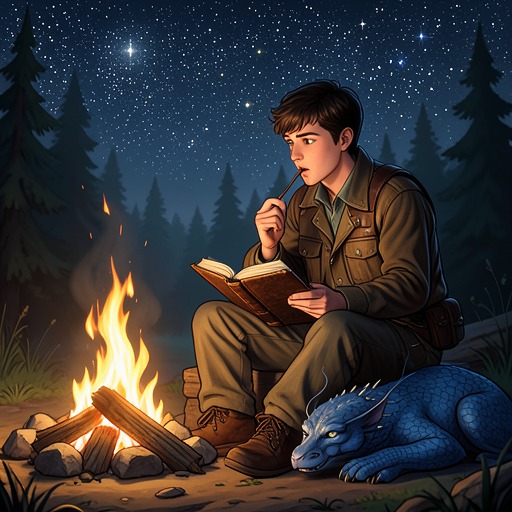
His first decisive break with the Riders came after a reckless expedition into the remaining territory of the Urgals. Galbatorix and two companions flew north for days, trusting their new abilities to protect them. The group was ambushed while sleeping on a sheet of ice that had remained unmelted even in summer. Galbatorix survived the slaughter and killed the attackers, but a stray arrow pierced his dragon’s heart. He had no means of saving her and watched her die in his arms. The loss planted the seeds of the madness that would govern his later choices.
The Riders recovered Galbatorix and healed his body after he was found unconscious. He slept for four days, and when he awoke he gave no outward sign of a fevered mind. Before the council assembled to judge him, however, he demanded another dragon. The desperation of that request exposed the depth of his disturbance. When the council refused, he redirected his grief into blame, coming to believe that the Riders themselves were responsible for his dragon’s death. His mourning therefore became not a private wound but the foundation of a plan for revenge.
Destruction of the Riders
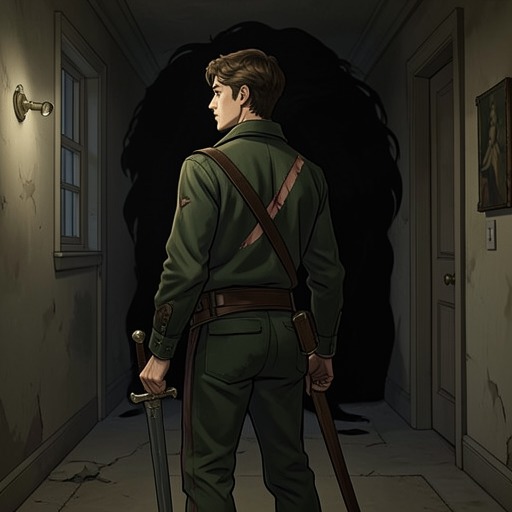
Galbatorix’s revenge began through persuasion before it became open war. He found a sympathetic Rider and used persistent reasoning, together with dark secrets learned from a Shade, to turn that Rider against the elders. The two lured and killed an elder, but Galbatorix immediately betrayed his accomplice and slaughtered him. When the Riders found him with blood dripping from his hands, he fled into the night. His cunning allowed him to evade years of pursuit while he hid in wastelands like a hunted animal.
Time weakened the search but did not erase the atrocity. Galbatorix eventually encountered the young Rider Morzan, who was strong in body but weak in mind. He persuaded Morzan to leave a gate unbolted in the Riders’ citadel of Ilirea, later called Urû’baen. Through that opening Galbatorix entered and stole a dragon hatchling, acquiring the means to rebuild his power and giving Morzan a role in the catastrophe that followed.
Galbatorix and Morzan concealed themselves in a place where the Riders would not dare pursue them. There Morzan underwent a dark apprenticeship, learning forbidden magic and secrets that should never have been revealed. When the instruction ended and Galbatorix’s black dragon, Shruikan, had reached full growth, Galbatorix returned openly with Morzan beside him. They attacked every Rider they encountered, and each victory increased their strength.
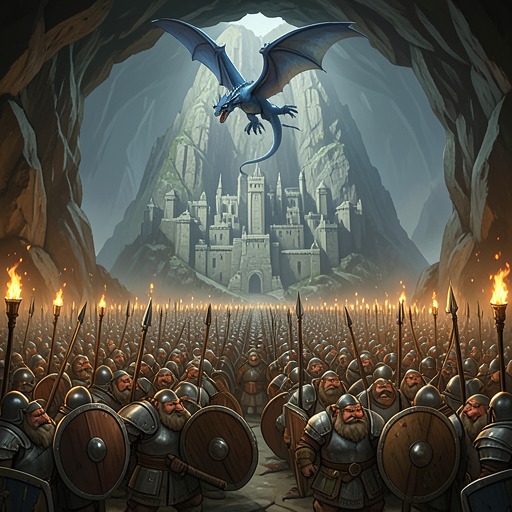
Twelve Riders joined Galbatorix, driven by power and by resentment over grievances they believed the order had inflicted upon them. Together with Morzan, they became the Thirteen Forsworn. The Riders were unprepared for the assault and fell beneath it. The elves fought bitterly as well, but Galbatorix defeated them and forced them to retreat into secret places from which they no longer emerged. The defeat ended the alliance and political order that had allowed elves, dwarves, humans, and Dragons to flourish together.
Kingship and Imperial Power
Only Vrael, leader of the Riders, could resist Galbatorix and the Forsworn. In the last battle, before the gates of Dorú Areaba, Vrael defeated Galbatorix but hesitated before delivering the final blow. Galbatorix used that hesitation to strike Vrael in the side. The wounded leader fled to Utgard Mountain to recover and gather strength, but Galbatorix found him there. During their final fight, Galbatorix gained dominance through an underhanded kick, then removed Vrael’s head with a blazing sword. Power surged through him after the victory, and he anointed himself king over all Alagaësia.
His rule is remembered as the continuation of the Riders’ destruction rather than as a legitimate succession. In Carvahall, the Empire’s failure to help during harsh years and the cruelty of its tax collectors have produced a hatred of Galbatorix’s government that feels almost hereditary. The grain buyers’ defense of the king exposes the machinery of imperial legitimacy: they claim that only Galbatorix’s unceasing protection allows villagers to argue in safety, while Morn and the villagers hear the claim as a lie. The disagreement shows that his power is maintained not only through force but also through competing stories about protection, order, and obligation.
The Varden remain the Empire’s most persistent political threat. They are a rebel group that raids and attacks the Empire, yet their origins and leadership are obscure. Their ability to survive Galbatorix’s attempts to destroy them has won them sympathy, particularly from fugitives and people who hate the Empire. The difficulty is not their purpose but their secrecy: those who need them must first discover where they are. The Empire’s conflict with the Varden is therefore both military and ideological, a contest over whether Galbatorix’s rule represents safety or oppression.
Dragons and the Next Generation
Galbatorix’s power depends on more than the conquest of territory. The struggle between the Empire and the Varden is ultimately focused on the future Dragon Riders. Although the old Riders have been destroyed, Galbatorix possesses three remaining dragon eggs, salvaged during his final great battle with the Riders. After Saphira hatches, only two eggs remain in his possession. Their possible hatchlings would create new Riders loyal to the king, while the Varden race to kill the candidates chosen for those eggs or steal the eggs themselves.
This makes Eragon and Saphira politically decisive before Eragon can understand why. Their existence is not merely a personal wonder or a revival of an ancient tradition; it is the reason both sides are willing to risk lives and resources. Whoever controls the next generation of Riders will become the undisputed master of Alagaësia. Galbatorix therefore treats dragon selection as a strategic monopoly, while the Varden regard every surviving egg and every possible Rider as an opportunity to break that monopoly.
The wider history of Dragons and Riders gives this struggle its mythic scale. A long and bloody war between elves and Dragons ended only when an elf named Eragon found a dragon egg and created a path toward reconciliation. From that settlement arose the Riders’ mission to protect and guard. Their later golden age brought peace, flourishing lands, living-stone cities, wealth, and prosperity, with elves as allies and dwarves as friends. Galbatorix’s rise reverses that pattern: the institution created to preserve peace becomes the target of an insider who turns its own power against it.
Relationships, Image, and Narrative Function
Galbatorix’s relationship with Morzan illustrates his method of rule at its most intimate. He first manipulates Morzan into opening the gate at Ilirea, then makes him a disciple through forbidden instruction, and finally places him beside himself in the public campaign against the Riders. The partnership is built on asymmetry: Galbatorix recognizes and exploits Morzan’s weakness, using loyalty as an instrument of expansion rather than as a bond between equals.
His relationship with Murtagh, as later remembered by Murtagh, reveals a different weapon: seductive political vision. At Murtagh’s eighteenth birthday, Galbatorix summoned him to a private dinner. During the meal the king watched him without speaking, as though searching his face for something hidden. When Galbatorix finally spoke, his voice carried a power Murtagh found entrancing and frightening. He described an Empire filled with beautiful cities, great warriors, artisans, musicians, and philosophers; the eradication of the Urgals; expansion across all Alagaësia; peace and prosperity; and the restoration of the Riders to govern his domains.
The vision worked because it joined genuine longing to imperial domination. Murtagh knew the history connecting Galbatorix and his father, yet the promise of a restored order proved too compelling to resist. When Murtagh asked how the Riders could return despite the accepted belief that no dragon eggs remained, Galbatorix answered the question not with an explanation but with an invitation to serve him. The king’s authority thus operates through temptation as well as coercion: he offers an imagined paradise, conceals its cost, and recruits obedience by making service appear to be participation in renewal.
Galbatorix’s public image is consequently unstable. Imperial supporters present him as a protector whose efforts make local safety and even dissent possible, while the Varden and communities such as Carvahall understand his government through raids, taxes, repression, and fear. His most important achievement is not simply that he occupies the center of the Empire at Urû’baen with Shruikan, but that he has made every political question return to the legacy of his rule: the destruction of the Riders, the imprisonment of the eggs, and the approaching battle between the Varden and the Empire.
Lasting Significance
Within the supplied narrative, Galbatorix’s personal ending is not shown; his rule remains active, and the imminent battle at Farthen Dûr is explicitly framed as a struggle whose defeat would eventually bring down Surda and the elves as well as the Varden. His absence from the immediate scenes makes him more, rather than less, structurally important. He is the distant source of the armies, the political lies, the hunt for dragon eggs, and the inherited fear surrounding the return of the Riders.
He also embodies the corrupted version of the heroic pattern that Eragon is beginning to enter. Both are linked to Dragons, Rider swords, ancient history, and powers larger than ordinary human life, but Galbatorix turns initiation into possession and guardianship into dominion. Zar’roc, a former Rider’s blade with a red blade and a strange black symbol, materializes the violent inheritance Eragon receives; the remaining eggs represent the future that Galbatorix seeks to control. Against that inheritance stands the promise that Eragon may become a different kind of Rider—one who restores connection rather than converting ancient power into personal rule.
The story of Galbatorix therefore functions as a warning about grief that refuses limitation, talent freed from moral restraint, and political order sustained by manufactured consent. His kingdom began with the collapse of a golden age, but its deeper danger lies in his attempt to monopolize the future. By controlling the eggs and promising selected heirs a place in his imagined paradise, he seeks to ensure that even the next generation of Riders will reproduce his power. The Varden’s resistance and Eragon’s emergence challenge not only a king’s army but the historical logic by which one wounded man has made an entire land inherit his vengeance.