Eragon
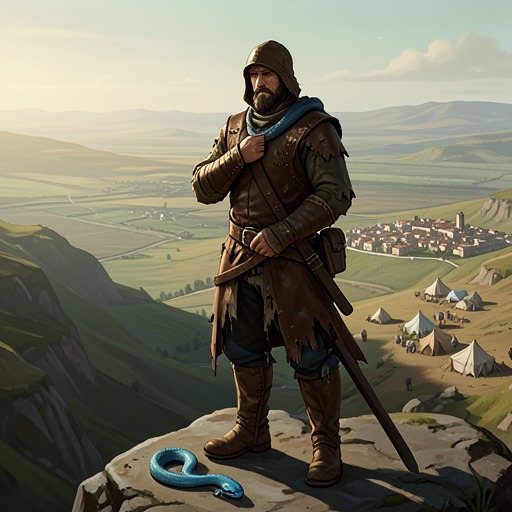
EragonEragon is introduced as a fifteen-year-old hunter still less than a year from manhood, rooted in the work and landscape of Palancar Valley. He reads the tracks of a wounded doe with practiced precision, carries a bone-handled hunting knife, a yew bow protected in a buckskin tube, and a wood-frame pack, and moves through a mountain meadow beneath the Harvest Moon. This ordinary competence is the first measure of the person he is before history claims him: observant, self-reliant, physically accustomed to hardship, and defined by a home whose limits he has not yet consciously chosen to exceed.
Identity and Inheritance
Eragon’s identity is bound to a name whose significance he initially does not know. Brom tells him that, during the ancient War Between Elves and Dragons, an elf called Eragon found a dragon egg and thereby helped bring an end to a war that had lasted five years. The revelation places the young hunter inside a history older than his own life and gives his name an inherited resonance. He is not merely repeating an ancestor’s identity, but the recurrence makes his later discovery of a dragon feel like an echo that has returned in a changed age.
That larger history is dominated by the rise and fall of the Dragon Riders. Brom describes them as guardians who protected the land for thousands of years, possessed strength beyond ordinary men, and helped create a golden age in which elves were allies, dwarves were friends, cities flourished, and men prospered. Their destruction began when Galbatorix, after losing his dragon and blaming the Riders, turned to treachery, dark knowledge, and revenge. He manipulated another Rider, killed an elder and then his accomplice, stole a dragon hatchling through Morzan’s aid, and eventually led the Thirteen Forsworn against the Riders. Eragon’s emergence therefore occurs against the background of a broken order: the Rider tradition is not a living institution awaiting his application, but a fallen inheritance whose ideals have survived its practitioners.
Discovery and Awakening
Eragon’s decisive transformation begins when the object he has found proves not to be a stone but a dragon egg. After the egg cracks, a small sapphire-blue dragon emerges, its wings awkwardly larger than its body, its white claws and fangs sharp, and a row of spines running from its neck to its tail. Eragon recoils in shock at the sight of the dragon, but the shock is also an awakening: an ancient power and relationship have entered the narrow world of the farm boy.
The discovery changes the meaning of both Eragon and the wider political landscape. The Dragon Riders once maintained peace through their bond with dragons; Galbatorix later used a black dragon, Shruikan, as an instrument of conquest. Eragon’s connection to Saphira thus carries both a promise and a warning. The bond can restore a protective tradition, but the history Brom recounts shows that extraordinary power is never safe merely because its possessor claims a good purpose.
Brom’s instruction further connects Eragon to the material culture of the Riders. He gives Eragon Zar’roc, a former Rider’s sword with a gold pommel enclosing a ruby, a silver-wrapped hilt, a wine-red sheath, and a blade that is iridescent red, eternally sharp, and resistant to staining. The weapon fits Eragon’s hand as though made for him and feels unlike the crude tools of farm labor, yet its beauty is inseparable from its purpose: it was forged for battle and to end human lives. Zar’roc makes Eragon’s new status tangible while also placing violence at the center of the inheritance he receives.
Revenge and the Heroic Turn
Eragon’s first great objective is not an abstract defense of the land but revenge. After the strangers who destroyed his home and killed Garrow, his anger hardens into a single purpose. Saphira’s arguments remain in his mind while he struggles with doubt, but he finally converts grief and pain into resolve, embracing the principle that “The doing is the thing.” He declares that he will act, cuts off contact with Saphira, and rises despite the physical pain that had recently made walking difficult.
This decision marks both courage and danger. Eragon understands himself as an enemy with nothing to lose, and his will allows him to ignore the signals of his injured body. The movement is therefore not a simple passage from weakness to strength. His determination is forged from bereavement, and the same force that enables him to pursue the killers threatens to narrow his moral horizon to retaliation. Saphira’s presence prevents the revenge quest from being entirely solitary, but Eragon still chooses it as an act of personal will rather than because he begins with a fully formed political ambition.
His limited ambitions matter. When the possibilities of becoming a leader or martyr are raised, Eragon cannot imagine himself pursuing them; he wants vengeance and little else. That resistance keeps his early heroism grounded in reluctance and incompleteness. He does not begin as a chosen champion who understands the cause awaiting him. He begins as a young man trying to answer an intimate wound, and the larger meaning of his actions emerges only as his path intersects the fallen history of the Riders and the resistance to Galbatorix.
Bonds, Conflict, and Recognition
Eragon’s most consequential relationship is with Saphira, whose existence changes his inner and outer life. Their communication gives him counsel when doubt threatens to immobilize him, and her presence turns his revenge from an isolated impulse into a shared undertaking. The bond also makes Eragon a participant in a nonhuman lineage that the old Rider order was built around. He cannot become the same kind of figure as an ordinary human warrior because his identity is now inseparable from a dragon.
His relationship with Brom is equally formative but more deliberately mediated. Brom teaches him the history of the Riders, explains the ancient conflict between elves and dragons, and reveals the significance of the sword placed in his hands. Through Brom, Eragon receives knowledge, warning, and an ethical problem: the past offers both a golden model of guardianship and a record of catastrophic betrayal. Brom does not simply hand Eragon power; he gives him a history in which power has already failed.
Eragon’s public recognition comes after the defeat of Durza. Arya calls him Eragon Shadeslayer and identifies the price he has paid for his deed, while Murtagh harshly observes that Eragon is now marked in a way that makes him like Murtagh himself. The title Shadeslayer records the destruction of a great evil, but it does not erase the bodily cost of accomplishing it. Recognition and disfigurement arrive together, binding honor to damage rather than allowing victory to remain pristine.
Change, Scar, and Destiny
The consequence of Eragon’s confrontation with Durza is a massive scar left by the Shade’s blow, stretching from his right shoulder to the opposite hip. Angela heals his back in a day and a half through herbs and potions, yet her healing cannot restore the body to its former condition. Eragon finds the skin smooth and warm before discovering the hard, ropy mark beneath it; the moment turns apparent recovery into a renewed confrontation with what the battle has done to him.
His response reveals an important change in self-perception. He is dismayed to be disfigured, but the memory of a mysterious figure who aided him while he was unconscious redirects his attention toward the deed itself. That figure identifies himself as Osthato Chetowä, the Mourning Sage, and Togira Ikonoka, the Cripple Who Is Whole. He tells Eragon to find him, assures him that he has rid the land of a great evil, and directs him to trust Arya and travel with her to Ellesméra, where he will be waiting. Eragon’s achievement is therefore acknowledged by an intelligence that sees beyond the scar, but the promise of answers also opens a new stage rather than closing his story.
Eragon’s place in the world expands again when he studies a map of Alagaësia. He recognizes Vroengard as the ancestral home of the Riders, now a looted and empty shell haunted by strange beasts, with the abandoned city of Dorú Areaba at its center. He also sees Urû’baen, where Galbatorix rules beside Shruikan, and suspects that the Ra’zac maintain a hiding place there. The map converts personal pursuit into geographical and political understanding: the enemies connected to his home belong to an empire centered in the same ruined world whose Rider history Eragon is beginning to inherit.
Narrative Role and Significance
Eragon functions as the point where several broken continuities meet. His name recalls the elf who found the egg that ended the War Between Elves and Dragons; his discovery of Saphira renews the dragon-human bond; Zar’roc links his hand to the vanished Riders; and the scar from Durza records the cost of confronting the forces that replaced them. Each inheritance is double-edged. The ancient order protected the land but collapsed through internal betrayal, the sword is beautiful but made to kill, and victory brings a title together with permanent bodily damage.
His arc is consequently a movement from local knowledge to historical responsibility. The hunter who reads a doe’s tracks becomes a young Rider whose choices implicate Alagaësia, yet he retains the vulnerability of the boy who wants vengeance without initially desiring leadership. The figure named Shadeslayer is celebrated for having destroyed a great evil, but the narrative keeps his triumph unsettled through pain, disfigurement, and the unanswered summons of Togira Ikonoka. Eragon’s significance lies not in becoming an untouched legendary hero, but in showing how a damaged, reluctant successor can carry a fallen tradition forward while being forced to question what that tradition demands.