The Gun
GunsoulThe Gun is the book’s central supernatural antagonist and its most paradoxical force: not merely a weapon, a spirit-machine, or an evil god, but death by firearms given a recurring body. It raises the dead into Gunsouls, feeds on the revenge that follows their murders, and ultimately seeks to pass itself from one bearer to the next. Yuan Guang’s final victory does not annihilate firearms or erase the Gun’s existence. Instead, he kills the active incarnation, takes its power into himself, and changes the relationship between weapon and wielder. The Gun remains part of the world, but it no longer rules him.
Identity and Metaphysical Nature
The Gun is described by Revolver as the spirit of vengeance and firearms, the demigod of ultraviolence and the apostle of gunplay. Its origin is deliberately uncertain. It may once have been a weapon that killed so many people that it became a spirit-machine of immense power; it may once have been a man; or it may be an ancient murder demon that adopted a modern form. The uncertainty is not resolved into a single biography because the Gun’s significance lies less in an original person than in the violence firearms continue to produce. It exists wherever the weapon’s capacity for revenge, murder, and escalation acquires supernatural force.
The decisive revelation is that the Gun is not an individual. It is a title, and a curse passed from Gunsoul to Gunsoul. This explains why different victims can encounter what appears to be the same enemy and why the Gun’s body, voice, and presence can be inherited without its identity remaining fixed. The curse has a succession mechanism: those who die by firearms may be raised by the Gun, and a Gunsoul who survives long enough may eventually become entangled with the same power that created him. The Gun therefore resembles a role imposed upon the dead rather than a stable creature with one unchanging body.
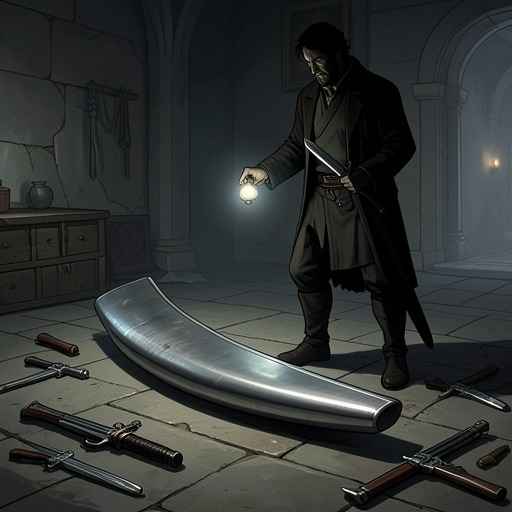
Its relationship to other demigods clarifies its peculiarity. Those beings possess dedicated Paths, but their children do not necessarily follow those Paths in the same manner, and their reincarnation patterns differ. The Gun is exceptional because it passes directly from Gunsoul to Gunsoul, while the Blade is said to prefer possessing swords rather than people. The Gun’s curse is thus both personal and systemic: it enters individual bodies, yet its true continuity is maintained through a repeating pattern of firearm violence.
The Curse and the Reincarnation Cycle
The Gun’s first visible function is resurrection. Yuan Guang begins as a man born without the potential for a qi core, one of the Scraps who labor beneath the cultivators’ hierarchy. After two decades of struggle, he is murdered and buried in a ditch, where his killer gives him and his team the last rites sutras. The Gun answers that death by returning him as a Gunsoul. Its intervention does not restore an ordinary human life. Yuan receives a half-life, a temporary existence tied to firearms, vengeance, and the Gun Path.
Revolver explains that the Gun rewards dedication to vengeance and firearms with such a half-life, while warning that it grants no second one. The transformation therefore appears at first as both miracle and sentence. Yuan, who had accepted his exclusion from cultivation, receives the power that the social order denied him; but the source of that power is inseparable from the violence that killed him. The Gun turns an exploited outsider into a supernatural gunfighter while binding his continued existence to the same destructive system that created his grievance.
The cycle feeds on retaliation. Arc explains that the Gun encourages the murdered to kill those responsible, after which one of the slain enemies—or a loved one seeking payback—rises with a bullet for a heart. That successor then attacks people connected to the previous victim, and the pattern repeats. The Gun plays both sides of the conflict, ensuring that revenge generates fresh murder and fresh Gunsouls. Yuan later recognizes that his own desire for payback fueled his resurrection. His anger is not simply a private emotion; it is the energy by which the Gun sustains itself.
This mechanism also makes the Gun a trap for those who believe violence can conclude violence. Yuan considers arming the sects fighting over Fleshmarket so that they might slaughter one another, even if the casualties were enormous. The plan reveals how close his thinking has come to the Gun’s logic: convert grievance into ammunition, let retaliation multiply, and treat the resulting deaths as an acceptable means to an end. Arc’s warning is categorical: so long as anyone kills another person with a firearm, the Gun will never die. The supernatural cycle is therefore anchored in an ongoing human practice rather than in the survival of a single monster.
Signs, Worship, and First Encounters
The Gun’s presence is announced through ritual language as well as violence. Its followers and associated figures invoke it as the Gunfire Father or Gun Father, proclaiming that there are no gods or kings, only the Gun. At a death, Bucket performs a gesture shaped like a gun and blesses the dead with the hope that the Gun will welcome them into Bullet Hell, where they will fight forever. When Yuan appears, Bucket celebrates the arrival of a Gunsoul as though a holy messenger has come from the Gun. These responses show how the Gun’s violence has become a theology: resurrection is interpreted as election, ammunition as sacrament, and endless combat as an afterlife.
The Gun itself initially speaks through threat. Its challenge to Yuan is blunt: “Kill me,” it says, “If you can.” Yet the challenge is not merely a monster’s invitation to battle. It establishes the Gun’s recurring demand that a Gunsoul confront the power responsible for his resurrection, even while the same power has shaped his desires. Revolver tells Yuan that every Gunsoul is fated either to kill the Gun or to be killed by it. The prophecy offers a choice that may be real only within a closed system, since both outcomes appear to serve the curse’s continuation.
The Gun’s most important early contradiction is that it craves death while encouraging others to flee rather than fight. Arc tries to prevent either Gunsoul from killing it without inflicting lethal damage, and Gatling Man calls the Gun a curse from which he must free himself. These opposing reactions make sense only once the Gun is understood as a transferable title. It wants a successor, but it also needs resistance strong enough to make the succession meaningful. Every Gunsoul is simultaneously victim, candidate, opponent, and possible vessel.
The horror intensifies when the unseen principle acquires a physical form. The Gun announces its approach with a rain of bullets, then towers over the Gunsouls as a walking fortress more than three times Asa-Zakura’s height. Its body combines charred bones, burned flesh, oily metal, shoulder-mounted artillery, gun-barrel hands, a rifle for a face, and an ammunition-belt tail; its maw displays rows of lead shells as teeth, while gunsmoke and death seem to breathe from its entire frame. The grotesque body externalizes the Gun’s accumulated history. It is not a clean icon of technology but a fusion of weapon, corpse, battlefield, and industrial ruin, a humanoid shell large enough to make individual fighters appear insignificant.
Even this body is unstable. When Yuan later confronts it, the visible face is Revolver’s, but something savage moves behind the steel, trying to shed the humanoid shell and reveal a greater form. The familiar face makes the threat more intimate: the Gun does not merely wear armor, it appropriates the appearance of a fellow Gunsoul. Its identity is therefore shown as predatory substitution, using the dead and the resurrected as surfaces through which the inherited curse can become visible.
The Gun’s Logic of Violence
The Gun’s metaphysics become most dangerous when they enter the mind of a Gunsoul. Yuan Guang discovers that his bullet-core can influence his judgment, clouding his thoughts with a murderous urge to kill Slash even when he had intended to remain cautious, gather information, and act strategically. Arc had warned him that the Gun fed on revenge, but the Gun’s ability to remove a Gunsoul’s inner safety and accelerate a confrontation reveals a more intimate form of control. The curse does not merely wait for violence to occur; it presses upon grievance until retaliation feels like instinct. Yuan’s anger becomes evidence that the Gun is not only a patron granting power, but an active pressure inside the person it has raised.
The Gun’s logic also governs the timing of its confrontations. Kaguya explains that a Gunsoul’s defining quest is not merely a personal mission but the condition of continued existence: once the resurrected fighter has fulfilled the purpose for which the Gun raised him, the Gun comes to challenge him. Its arrival after the death of Revolver’s murderer therefore follows the cycle rather than representing a random attack. The Gun converts revenge into a delayed summons, allowing the victim to complete the first movement of violence before presenting itself as the final opponent. What appears to be justice reaching its conclusion is instead the mechanism by which the curse renews itself.
The same structure makes the Gun’s destruction seem impossible by ordinary means. Arc insists that even killing the Gun will not kill the Gun, because firearms will continue to produce the deaths from which it arises. Kaguya confirms that the Perfect Shot is the only known escape from the curse, yet Yuan’s Path cannot use it; every demigod of ultraviolence carries the seed of its own destruction, and a weapon-bound power remains vulnerable to the weapon that defines it. Yuan understands the implication before the final battle: only a gun can defeat the Gun. His task is not to destroy violence as an abstraction, but to find the act of firearm violence capable of severing the curse’s succession rather than feeding it.
That possibility is complicated by Yuan’s growing resemblance to the entity he opposes. Arc tells him that he is closer to the Gun than most Gunsouls, while Yuan’s own transformations bring him nearer to its form and power. When he first adopts Gun Demon Incarnation, the state demands qi and confines his soul within a human-shaped safety vessel. The Gun remains a presence that must be contained, not mastered. Yuan’s progression is consequently measured not only by greater destructive capacity but by whether he can distinguish deliberate action from the bloodlust the bullet-core places within him. The recurring image of a safety being removed turns cultivation into a struggle over agency: the Gun wants the trigger pulled before thought can intervene, whereas Yuan seeks to retain responsibility for the shot.
Final Confrontation and Transformation
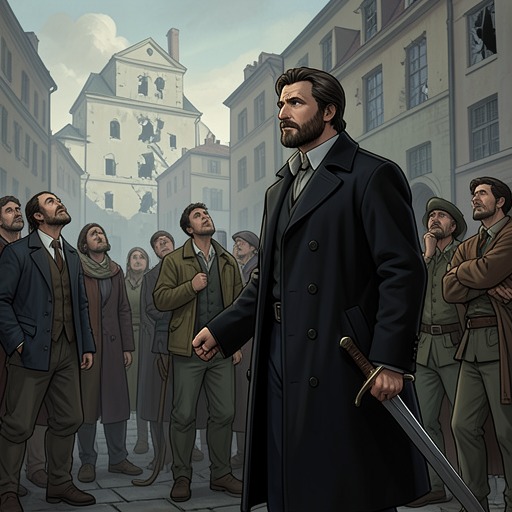
The Gun’s last appearance gathers its earlier contradictions into a single nightmare. It descends from the heavens as a colossal figure forged from steel and malice, while the face it shows Yuan is Revolver’s. Beneath that familiar surface lies the Gun’s savage presence, delighted by battle and murder and straining to abandon the humanoid shell for its true form. Yuan refuses to treat the apparition as merely an enemy to be destroyed. He resolves to drag Revolver’s soul out of it, separating the friend whose face has been appropriated from the curse that has consumed him.
The battle reaches its decisive reversal when the Gun’s wail carries fear rather than hunger or triumph. Its terror signals that the cycle built from human suffering is approaching completion. Yuan fires his own bullet-core at the Gun and shoots it dead, sacrificing the core that former Scraps had killed to preserve and using the source of his power against the power itself. The shot is neither a conventional victory nor a simple act of annihilation. It fulfills the Gun’s demand for a Gunsoul capable of killing it, but it does so in the name of protecting others rather than extending revenge.
The aftermath proves that the Gun has been mastered rather than erased. A gunshot echoes in Yuan’s soul, and the Gunman returns to life. His Gun Demon Incarnation no longer consumes his qi, because his soul has transcended the need for a human-shaped safety vessel. Revolver senses the Gun’s presence within Yuan but finds it quelled, as though the safety has been engaged. Yuan therefore becomes the Gunman: not a servant carrying an external curse, but a wielder who has incorporated the power without surrendering control of himself.
Kaguya identifies the achievement as the end of a demigod of ultraviolence, while Revolver initially describes it as having killed the Gun. Yuan corrects that interpretation by distinguishing mastery from death. The Gun will continue to exist as long as firearms continue to kill, but it has become a part of his Path rather than the force directing it. Its power is reduced to a tool for the Gunman to wield. The final transformation preserves the Gun’s immortality while overturning its authority: the inherited curse survives, but its newest bearer refuses to let the curse determine what the weapon must mean.
The Gun’s final significance lies in the distinction between persistence and rule. It cannot be annihilated while firearms continue to produce death, and Yuan Guang does not pretend otherwise. His achievement is instead an act of succession interrupted: by firing his own bullet-core into the entity, he prevents the Gun from possessing the victory it has always sought through revenge. The shot fulfills the condition that only a gun can defeat the Gun, yet refuses the cycle’s usual reward of renewed bloodshed. Yuan’s sacrifice converts the weapon’s inherited violence into chosen responsibility.
That conversion is dramatized through the Gunman’s return. A gunshot echoes within Yuan’s soul, and he rises again in Gun Demon Incarnation without the former demand for qi or the need to shelter his soul in a human-shaped vessel. Revolver can still feel the Gun inside him, but its presence is quieted, as though its safety has been engaged. The image reverses the Gun’s earlier influence: where the curse once removed a Gunsoul’s inner safety and drove grievance toward murder, Yuan now possesses the power while retaining the capacity to decide when and why it will be used.
Kaguya recognizes the act as the destruction of a demigod of ultraviolence, while Revolver first describes it as killing the Gun. Yuan’s correction is the essential conclusion of the arc. The Gun will never truly die so long as firearms kill, but it has ceased to be Yuan’s master. It has become part of his Path, a tool for the Gunman to wield. The curse therefore survives in altered form: its metaphysical force remains in the world, yet its authority has been transferred from an automatic cycle of vengeance to a bearer who can oppose its logic. The Gun’s defeat is consequently not extinction but containment, mastery, and the reclamation of agency from a power that once made violence appear inevitable.