Mel
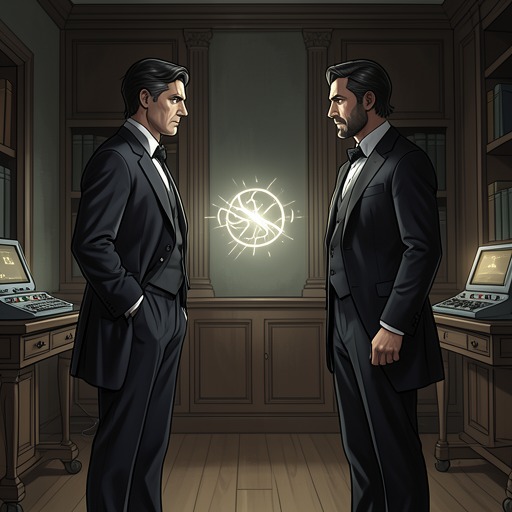
GunsoulMel is the older half of the Dyad Sect’s racing twins, distinguished from his taller brother Hardy by a red scarf. He first appears as a grizzled man in his forties with short dark hair, black eyes, a three-day beard, a leather jacket, and racer bracers. The visual pairing with Hardy is deliberate: they share almost every outward feature, while the different scarf colors and heights provide the small distinctions by which Yuan Guang tells them apart. Mel’s identity is therefore inseparable from both individuality and partnership; he is recognizable as a person, but his abilities and social position are built around the fact that he does not act alone.
Identity and Introduction
Mel approaches Yuan Guang in a racing establishment with Hardy at his side, each carrying a beer while they inspect the competition. Mel takes the initiative in conversation, asking whether Yuan is scouting the racers and then offering his gloved hand. He identifies himself by name and explains that he is older than Hardy by one minute, while Hardy is taller. The exchange gives Mel a relaxed, lightly teasing manner, but it also establishes him as the more outwardly initiating twin: he speaks first, extends the hand, and supplies the introduction that makes the pair legible to Yuan.
Yuan initially associates the brothers with the Dyad Sect and suspects that their representation of it means they work for the Yinyang Khan. Mel rejects that assumption immediately. He and Hardy follow the same Path as the Khan, but they insist that their sect is not defined by his aggression or authority. Mel describes their commitment as brotherhood and complementarity rather than competition, making a moral distinction between the Dyad Path itself and the conduct of one of its most powerful adherents. Their identity is thus partly oppositional: they belong to a tradition associated with the Khan while refusing to let his reputation define them.
The Dyad Path and Fraternal Bond
Mel explains that the Dyad Path requires two cultivators to walk it together. The partners may be foes, rivals, or allies, but their connection is structural rather than incidental. His and Hardy’s cores are intertwined, allowing them to fuel each other’s qi and combine their techniques. Mel’s account presents duality as a system of relations—yin and yang, reflections, eternal rivals, and even master and student—rather than as a simple division between two identical fighters.
That interdependence also shapes the brothers’ decisions. When Yuan proposes a deeper commitment, Mel refuses to risk the safety of their cores by swearing to a future service. He will swear only that he is telling the truth at that moment. The distinction is cautious rather than evasive: Mel accepts an Unspeakable Vow that he and Hardy are not allies of or employed by the Yinyang Khan, but he will not bind their options before the race has determined what survival requires. Yuan accepts the logic, and the vow becomes the first formal basis for trust among them.
Mel’s loyalty to Hardy is most visibly expressed through coordinated combat. During the pursuit of the Chemzard vehicle, he shapes a fireball and throws it toward his brother rather than at the truck. Hardy punches it back, and the two transform the attack into a rapid exchange, passing the projectile between them like a game while racing. The scene makes their combat method look playful without making it harmless: their intimacy is itself a weapon, and the ease of their coordination is something outsiders can scarcely reproduce.
The History Road Conflict
The brothers’ cooperation becomes more dangerous when the History Road competition turns into a field of traps and executions. After a laser targets Coyote, Mel and Hardy use the confusion to catch Duckman. Their energy chain slices through Duckman’s torso and splits him in half. Mel is not separately credited with the blow, because the brothers function as a single tactical unit, but the event clarifies the lethal edge beneath their earlier claims of avoiding unnecessary fights. Their refusal to resemble the Yinyang Khan does not make them pacifists; in a competition governed by speed, sect techniques, and sudden violence, they are prepared to kill.
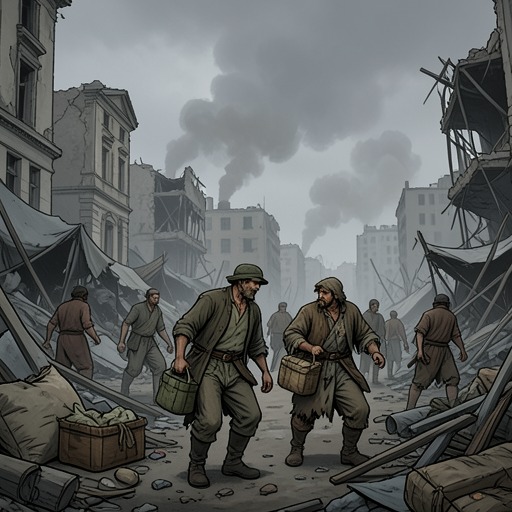
The racers later gather amid the devastation associated with Manhattan. Mel and Hardy leave their vehicles while Yuan Guang cancels Gun Demon Incarnation to conserve qi; the immediate threat is so overwhelming that no one treats the other racers as a more urgent enemy. When the confrontation with Manhattan resumes, Mel enters the fight openly. A fireball strikes the nuclear cultivator, and Mel taunts him before announcing that the battle will not be one-on-one. Hardy follows by defining the numerical advantage as three against one, placing the twins beside Yuan rather than leaving him to face Manhattan alone.
Their intervention matters tactically and symbolically. Manhattan’s core is cracked, and his death would prevent his return from Nowhere, while Yuan holds the Cube of Natho and prepares to continue the fight. Mel’s decision to join him converts the brothers from competitors into temporary comrades. The Dyad bond, which they had earlier described in terms of mutual balance, now becomes a practical alliance: two brothers use their shared Path to widen Yuan’s chances against a foe whose power exceeds that of an ordinary racer.
Survival, Fellowship, and Departure
The violence of the competition does not end with the apparent deaths of the racers. After Duckman is bisected, Mel and Hardy are found in Orient’s hospital wagons, so badly bandaged that Yuan Guang must identify them through their qi signatures. Their survival parallels Duckman’s improbable recovery and emphasizes the brutal resilience of the racers, but it also shows the cost of the twins’ participation. The brothers who had moved with effortless precision on the road are now nearly unrecognizable beneath medical treatment and bandages.
Mel’s later farewell reveals a quieter dimension of his relationship with Yuan. He tells Yuan that it has been a pleasure riding with him and, together with Hardy, prepares to drive their cars away and find their own route home. The departure is not framed as betrayal or defeat. It closes a temporary alliance formed through suspicion, tested by vows and violence, and preserved through mutual assistance. Yuan had repaired and helped move their vehicles, while Orient had made room for them despite limited capacity; Mel’s farewell and Hardy’s thanks acknowledge that practical care as part of the bond created among the travelers.
Character Function and Significance
Mel gives the Dyad Path a human scale. The Path could otherwise remain an abstract doctrine of duality, but Mel and Hardy demonstrate it through speech, shared cores, coordinated techniques, disagreement with the Yinyang Khan, and an almost game-like rhythm in battle. Mel’s red scarf marks him as distinct without separating him from his brother, reinforcing the book’s recurring tension between individual identity and transformation through connection.
His place beside Yuan Guang also provides a contrast to Yuan’s solitary evolution along the Gun Path. Yuan begins from the social stigma of the Scrap, later becomes a First Coil cultivator, and ultimately declares himself the Gunman; his body changes toward mechanical weaponry as his power grows. Mel, by contrast, is defined less by solitary metamorphosis than by a relationship that multiplies capacity. Yet the comparison is not simple: both characters resist imposed identities. Yuan rejects the assumption that birth without a qi core fixes his destiny, while Mel rejects the assumption that belonging to the Dyad Sect makes him a servant of the Yinyang Khan.
Mel therefore occupies a middle position between rival and ally. He approaches Yuan as a competitor, tests the basis of trust through an Unspeakable Vow, fights beside him when Manhattan becomes the greater danger, survives the race’s catastrophic violence, and finally departs without claiming permanent allegiance. His narrative importance lies in showing that partnership need not erase difference and that an inherited Path or sect affiliation need not dictate a person’s ethics. In a world where bodies, cores, and social labels are repeatedly treated as fixed destinies, Mel’s chosen brotherhood becomes both a fighting method and a form of self-definition.