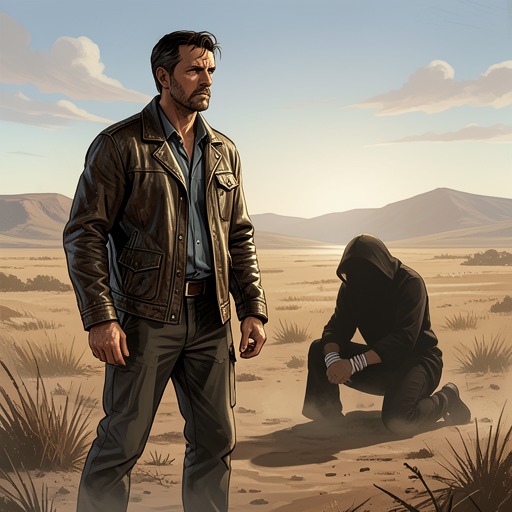
Elder Polio
GunsoulElder Polio is a Flesh Mansion Sect elder and master of fleshcrafting whose authority rests on remaking bodies and treating people as usable material. He is Gayak’s master, the architect behind Gayak’s constructed body, and the cultivator who ordered Revolver’s public execution. Through Yuan Guang’s encounters and Revolver’s recovered history, Polio emerges not merely as a formidable opponent but as an agent of the system that brands some people disposable and turns their resistance into another resource to control.
Position and Fleshcrafting
Polio’s role in the Flesh Mansion Sect is indicated by the weight attached to his name: Gayak is identified as his personal apprentice, and Yuan Guang hears Polio named repeatedly when asking who leads the sect. The account does not establish that Polio alone rules it, but his rank and influence are unmistakable. Gayak’s recruitment offer carries weight precisely because it comes from Polio’s apprentice, even as Yuan Guang doubts that the sect would let Holster leave unharmed.
Polio’s craft makes the sect’s bodily exploitation literal. Gayak is not simply a cultivator whom Polio trained: Yuan Guang realizes that his master assembled him from the bodies of unwilling subjects. The implication is reinforced by Polio’s language of design. When he finds Gayak’s mangled remains, he says he had been proud of the work, as though discussing a crafted object rather than a person. Gayak’s damaged body can still be treated as an unfinished project, and the prospect of a newly available Third Coil donor makes that project more grotesque still.
The clinic run by Jared LaChair offers a contrast to Polio’s methods and influence. LaChair had been sent to Polio to study fleshcrafting, but says he tried to provide medical assistance rather than take part in the slave trade. Polio pressed him to harvest organs before enslaved people died and to repair others so that they could return to work. LaChair eventually left rather than submit to the ultimatum he expected. His account shows that Polio’s exploitation was not confined to spectacular body-horror or combat: it extended into a working practice in which medical skill could be made to prolong enslavement.
Power and the Restoration of Gayak
When Yuan Guang encounters him amid the ruins of Fleshmarket, Polio arrives as a physical horror as well as a powerful cultivator. A flower of blood and pulsing muscle opens from the debris to reveal a lanky, hooded figure leaning on a gnarled bone staff. A long white beard is infested with maggots; beneath the rags, his torso is an amalgam of flesh and twisted organs, with tormented faces stitched into the mass. His many eyes and oppressive aura make Yuan Guang recognize a level of power comparable to Revolver’s.
Polio’s first concern is the damaged apprentice. He stomps the ground, and detached hands of rotting flesh emerge to gather Gayak’s scattered parts. While Polio performs mudras, Yuan Guang covertly uses Item Materialization to make bullets and reload his revolver, hoping that Polio’s disdain for him might create a chance to escape. Yuan Guang is already struggling to cycle through the Third Coil, however, and the pressure of his bullet-core makes the elder’s presence more dangerous still.
Polio completes his sequence and traces a circle around Gayak’s remains. Virulent Qi fills the space; after a brief silence, the pieces reassemble into quivering flesh. Gayak is alive again, though his body remains a misshapen mass of meat and organs, and his limbs can scarcely carry him. Polio presents this resurrection as evidence of his method: rather than wait for a naturally occurring prodigy, he can create one. The boast exposes the logic beneath his power. Restoration is not mercy or healing; it is the continuation of an experiment whose materials are unwilling people.
Revolver and the Sect’s Violence
Polio’s connection to Revolver predates Yuan Guang’s arrival at Fleshmarket. Jared LaChair was present when Polio had Revolver shot. According to LaChair, Polio’s hunters raided Revolver’s village, enslaved him, and put a collar around his neck. Revolver repeatedly tried to escape and encouraged other slaves to do the same. After he stole a Scrap guard’s gun and killed two First Coil students, Polio chose public execution over the proposed alternative of lobotomizing him. The execution was meant to serve as an example to the enslaved people who might follow him.
Polio’s stated justification was that a true cultivator should not waste a technique on a Scrap. He had Revolver shot in the back of the head and his body thrown into the desert. That contempt gives the execution a double force: Polio uses violence to punish revolt, while insisting that the victim is beneath the effort of a cultivator’s own hand. The bullet nevertheless fails to end Revolver’s story. Polio’s poor shot leaves the bullet-core intact, a crucial detail in the later struggle over the Gun’s hold on Revolver.
When Polio confronts Revolver again in Fleshmarket, he invokes the earlier execution as a lesson and calls him a weak slave unfit to be a graft. Revolver answers that Polio has no thrall to shoot him in the back this time. The exchange makes the old crime present in the new fight: Revolver is no longer simply the captive Polio ordered killed, but the Gunsoul who has returned to oppose him. Yuan Guang, who has also been treated as a Scrap, recognizes the pattern between their histories. The public execution meant to erase Revolver instead becomes part of the explanation for his return.
Conflict and Narrative Significance
Polio’s return to the Fleshmarket confrontation expands the danger beyond Gayak. After Yuan Guang has damaged the apprentice, Polio appears from a monstrous bloom of flesh and begins collecting the remains. Later, when Revolver attacks, an enormous wall of muscle ruptures; Revolver’s Qi-charged shot strikes an empty shell, and Polio emerges from a different flower of flesh several meters away. His concealment and decoys make his bodycraft a combat method as well as a means of remaking others.
The conflict also exposes the limits of Yuan Guang’s position. He knows he could not defeat Polio at his best, much less while weakened, and quietly prepares bullets in the hope of escape. Revolver’s arrival gives him an ally, but Polio remains dangerous enough to force them to defend themselves when the Gun’s rain of bullets descends on Fleshmarket. Yuan Guang and Revolver raise layered Barriers against the bombardment. The account establishes Polio’s presence in the battle and his immense threat, but does not confirm his fate afterward.
Polio’s broader significance lies in the way his power reproduces the violence it claims to master. He treats Gayak as a design to be repaired, enslaved people as sources of organs and labor, and Revolver’s attempted escape as an example to suppress. Yet Revolver survives the execution and later resists becoming nothing but an instrument of killing. Yuan Guang’s response to Revolver’s suffering is also shaped by the debt he feels toward the Gunsoul who saved him. Against Polio’s logic of bodies as material, the narrative sets relationships formed through protection, memory, and the refusal to abandon an ally. Polio’s cruelty thus helps explain both the creation of the violence he seeks to control and the resolve to break its cycle.