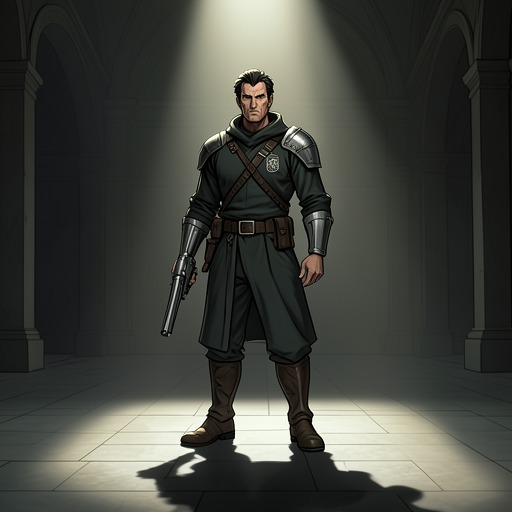
Reactor Al
GunsoulReactor Al is a nuclear cultivator whose brief, secondhand appearance nevertheless alters Yuan Guang’s understanding of destiny, power, and moral choice. His significance lies in the contradiction at the center of his existence: the Nuke resurrected him to disseminate the poison that had killed him, yet he resisted that command and transformed the same destructive force into electricity for an entire settlement. Mordiggian presents him not as an abstract exception, but as a living challenge to the belief that a person’s Path determines the harm they must cause.
Identity and Origin
Reactor Al was originally known simply as Al, a nuclear cultivator whom Mordiggian had encountered before the conversation with Yuan Guang. Like others of his kind, Al died from radiation poisoning and was then raised from the dead by the will of the Nuke. His resurrection came with an explicit function: he was meant to spread the radiation that had destroyed him. The cycle joined death, revival, and renewed contamination, making Al appear less like an autonomous person than an instrument of nuclear power.
That intended purpose is crucial to his identity. Al was not merely someone who happened to possess a dangerous ability; he had been brought back specifically to inflict upon others the same poison that had ended his own life. Mordiggian’s account therefore places him within the broader conflict between a cultivator and the nature imposed by a higher power. Al’s existence begins under the sign of repetition: the Nuke turns his death into the source of further deaths. His importance comes from the fact that he refuses to let that repetition define him.
Refusal of the Nuclear Path’s Curse
Al did not wish to kill his fellow humans, and he attempted to oppose the Nuke’s purpose. His resistance, however, did not make his power harmless. Nuclear cultivation carried a passive consequence: Al’s very presence befouled the surrounding land with radiation. Even without choosing violence, he remained a source of contamination. This limitation makes his moral struggle more severe than a simple decision to stop attacking. The danger was built into his body and Path, so good intentions alone could not protect the people around him.
For many years, Al wandered through the wastes as a hermit. The isolation reflected both the danger of his aura and the difficulty of finding a constructive place for someone whose power naturally poisoned the world. His wandering ended when he discovered an ancient power plant, one of the Lost Age installations that had once generated electricity from fuel before humanity learned to use qi. There, his destructive condition encountered an abandoned piece of infrastructure capable of giving it another function.
Reactor Al and the Settlement
Scrap scavengers lived inside the old facility, but they could not make the plant work. Al recognized that the central reactor could contain his radioactive aura. Rather than allowing his radiation to leak across the surrounding land, he offered to fuel the plant for the scavengers. The reactor became a vessel that redirected and confined the danger within his cultivation, while the settlement received usable electrical power in return.
When Mordiggian last visited, the people of the facility called him Reactor Al, and the plant supplied electricity to a settlement of one thousand inhabitants. The name records a transformation rather than merely a location. Al was no longer defined solely by the poison radiating from him; he had become associated with the machine that made his power beneficial to others. His contribution also reverses the expected outcome of nuclear cultivation. Instead of irradiating the area or exploding, he maintained a source of power that supported a settled community.
The arrangement does not erase the danger of Al’s nature. It gives that danger a structure, a boundary, and a social purpose. Reactor Al’s achievement is therefore practical as well as ethical: he finds a material form capable of containing the destructive aspect of his Path. The settlement’s survival depends on a cooperation between a resurrected cultivator and Lost Age technology, making his redemption inseparable from the infrastructure that can hold his power safely.
Influence on Yuan Guang and Arc
Mordiggian tells Yuan Guang about Reactor Al while addressing Yuan’s fear that the Gunsoul Path must always lead back to the Gun. Yuan insists that the Gun is both the beginning and the end for Gunsouls, but Mordiggian challenges the second half of that belief by recalling a nuclear cultivator who found another end for his power. Reactor Al becomes the example that makes the argument concrete: a Path may begin in violence or compulsion without determining the final form of a life.
The story deeply unsettles Yuan. He has difficulty with words, yet he tries to listen to advice and learn from the wisdom of others, and Mordiggian’s tale remains with him because it conflicts with an earlier instruction from Arc. Arc had made Yuan swear never to befriend a nuclear cultivator, believing that none of them could become good after Yuan had nearly died fighting one. Reactor Al does not resolve that conflict for Yuan, because his existence is reported rather than witnessed and Arc does not accept it without resistance. Instead, he exposes a fracture between Arc’s hard-earned certainty and the possibility that a supposedly cursed nature can be redirected.
When Yuan later recounts what Mordiggian and Kaguya told him, the mention of Reactor Al draws a snicker of disbelief from Arc. She listens to the rest in grim silence, already troubled by the prospect of her patron demigod escaping its prison after her near-fatal encounter with a nuclear cultivator. Her reaction preserves the story’s uncertainty while confirming its immediate effect: Reactor Al has become a contested piece of knowledge, a possible counterexample to Arc’s doctrine and a source of unease rather than easy hope.
Thematic Significance
Reactor Al embodies the distinction between origin and outcome. The Nuke creates him for ruin, radiation kills him, and resurrection returns him to the same destructive purpose. Yet he refuses to treat that sequence as an unbreakable destiny. His solution is not to deny what he is, nor to pretend that nuclear power has become harmless. He accepts the danger, finds its material limit, and turns it toward sustaining human life.
His story also develops the book’s recurring contrast between curse and use. A power can be destructive in isolation while becoming beneficial when placed within a relationship, a machine, and a community. The reactor does not purify Al; it contains him. The settlement does not abolish the violence embedded in his Path; it receives energy through a disciplined arrangement that prevents that violence from becoming indiscriminate ruin. This makes Reactor Al less a conventional redeemed hero than evidence that identity can be negotiated through action and circumstance.
For Yuan Guang, that evidence matters because it challenges fatalism at the precise moment he fears that his own Path has only one destination. Reactor Al’s life offers no promise that every nuclear cultivator can change, and Arc’s disbelief prevents the example from becoming settled doctrine. Its force lies instead in the question Mordiggian places before Yuan: if someone made to bring ruin can become a positive force, then inherited nature cannot by itself excuse surrender. Reactor Al is remembered as the possibility that a weaponized existence can still choose what its power will serve.