Hardy
GunsoulHardy is one half of the Dyad Sect’s twin-racer partnership and the taller brother distinguished by his green scarf. Alongside Mel, he brings a cooperative form of power and loyalty into a world organized by sect rivalries, authoritarian alliances, and the violent competition surrounding the History Road race. His decisive significance lies in the contrast he offers to the Yinyang Khan’s corrupted version of duality: Hardy and Mel share a Path, but they define that shared power through brotherhood, complementarity, and mutual protection rather than domination.
Identity and Introduction
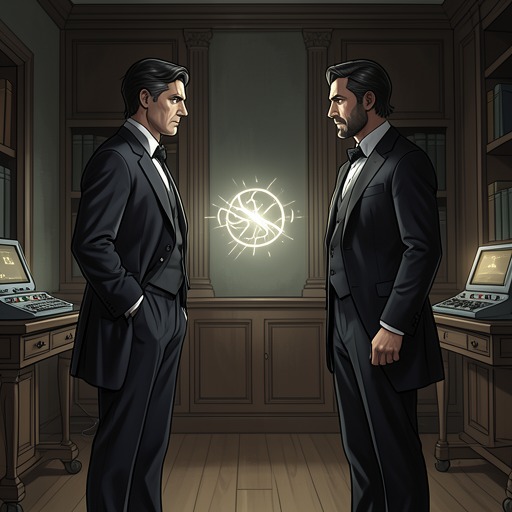
Hardy is introduced as a grizzled man in his forties with short dark hair, black eyes, a three-day beard, and a leather jacket marked by racer bracers. He and Mel are nearly indistinguishable at first glance; their height and scarf colors provide the practical distinction, with Hardy standing taller and wearing green while Mel is shorter and wears red. The visual pairing makes Hardy legible as part of a unit before he is fully established as an individual, an appropriate presentation for a character whose abilities and narrative identity depend on his brother’s presence.
When the twins approach Yuan at a bar before the History Road competition, Hardy is already recognizable from their earlier appearance as one of the sibling racers. Mel offers the introduction, explaining that he is older by one minute while Hardy is taller, and Hardy answers the teasing with easy humor. His response establishes a relaxed intimacy between the brothers rather than a hierarchy based on seniority. That familiarity also shapes his dealings with Yuan: Hardy is direct, suspicious of false affiliations, and willing to speak plainly when the political implications of the race become clear.
The Dyad Path and Brotherhood
Hardy and Mel represent the Dyad Sect, but Hardy sharply rejects any assumption that this places them in the Yinyang Khan’s camp. He objects to being grouped with the Khan, insisting that the brothers have chosen brotherhood and complementarity rather than competition. Their shared Path does not erase their individual agency; they acknowledge the sect they represent while separating its principles from the Khan’s conduct and reputation. Hardy therefore functions as a corrective to the idea that a common cultivation discipline necessarily produces common allegiance.
The brothers confirm their independence through an Unspeakable Vow. Hardy swears alongside Mel that neither brother is allied with or employed by the Yinyang Khan and his forces, and the vow’s pressure briefly touches their bullet-cores before releasing them. The scene turns their verbal claim into a binding demonstration of trustworthiness, while also showing that Hardy’s loyalty is not merely emotional. It has legal and metaphysical force within the cultivation system.
Hardy explains the practical basis of their power when Yuan asks why part of Slash’s qi seemed to exist elsewhere. The Dyad Path requires two cultivators to walk it together, whether as foes, rivals, or allies. Hardy’s core and Mel’s are intertwined, allowing them to fuel one another’s qi at will and combine their techniques. Their method embodies duality through dependence: strength comes not from one brother absorbing or subordinating the other, but from an active circulation between two linked practitioners. The Path’s images include yin and yang, reflections, eternal rivals, and master and student, yet Hardy and Mel select brotherhood as their governing interpretation.
Alliance with Yuan and the Race
Hardy and Mel approach Yuan because he has challenged the Yinyang Khan’s right-hand, and they believe the three parties can help one another by pooling information. The arrangement remains practical rather than absolute. Yuan understands that an alliance may become counterproductive once the race reaches its final stage, but cooperation can prevent the racers from becoming enemies prematurely. Hardy’s intervention consequently broadens Yuan’s network at a moment when the contest is entangled with the Khan’s power and factional politics.
Their partnership is defined by initiative rather than ceremony. The brothers ask questions, test Yuan’s loyalties, and offer information about the Dyad Path while preserving their own independence. Hardy’s bluntness is balanced by an evident refusal to provoke unnecessary conflict: he says that the brothers do not go around picking fights, distinguishing their competitive profession from the Khan’s use of authority and violence. Their chosen identity is not passivity; it is disciplined cooperation directed toward surviving a hostile field without becoming another instrument of tyranny.
During the race, Hardy’s ability becomes a visual performance of reciprocal force. Mel forms a fireball and throws it not at an enemy vehicle but at Hardy. Hardy punches the projectile back to his twin, and the brothers begin batting it between themselves like a rapidly escalating game. The fireball grows faster and larger with every exchange. What might appear to be an attack becomes a demonstration of trust, timing, and shared technique, turning combat power into coordinated play. The scene gives Hardy an individuality that does not require separating him from Mel: his character emerges through the precision of his response and the confidence that his brother will return the force.
Battletown and Survival
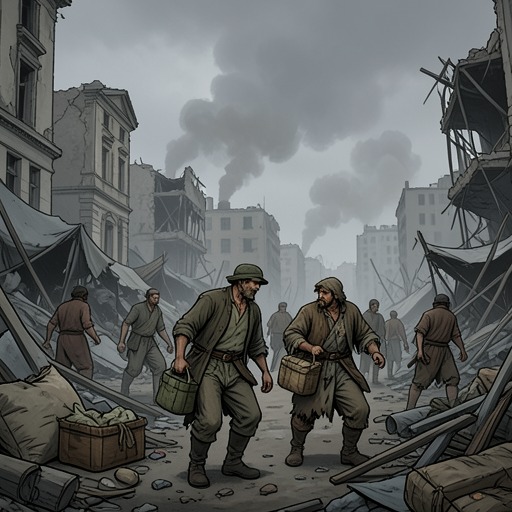
Hardy is among the racers who witness the destruction of Battletown. He and Mel leave their vehicles and stand with Holster, Bucket, and other passengers from Orient’s spirit-train while Yuan cancels Gun Demon Incarnation to conserve qi. The immediate contest loses its meaning beneath the nuclear cloud moving through the ruins. Hardy’s first response is stunned disbelief as he asks whether the Yinyang Khan has destroyed his own city; Mel follows by questioning whether the Khan has lost control of his power. Their exchange records the collapse of ordinary political assumptions. The disaster is not simply a battlefield accident but the manifestation of a nuclear cultivator’s Authority.
The twins then re-enter the conflict when Manhattan is surrounded. Hardy joins Mel in reinforcing Yuan, explicitly rejecting the idea that Manhattan should receive the advantage of a one-on-one fight. Their intervention changes the encounter from an isolated duel into a three-against-one confrontation, with Yuan holding the Cube of Natho while Manhattan’s core is already cracked. Hardy’s contribution is therefore both tactical and ethical: he strengthens Yuan’s immediate chance of survival and refuses to let overwhelming power dictate the terms of combat.
The nuclear blast leaves Hardy and Mel critically injured. Orient reports that they are alive for the moment but have suffered extensive injuries and require surgery, with no guarantee that either will survive. Unlike Yuan, they cannot regenerate from a single bullet’s worth of qi, so their survival is presented as uncertain and bodily costly rather than conveniently assured. Later, in the hospital wagons, Yuan identifies them only through their qi signatures because both are covered in bandages. Their condition gives physical consequence to their decision to stand at the center of the catastrophe and reinforce Yuan.
Departure and Narrative Role
Hardy survives long enough to resume the journey with Mel. After their vehicles are dragged out and repaired, the brothers take the wheels and prepare to find their way home. Hardy thanks Orient for repairing the cars despite her limited space, a small but revealing gesture after the scale of the preceding destruction. His farewell is not framed as triumph; it is a continuation of movement after injury, uncertainty, and collective disaster.
Hardy’s character remains closely paired with Mel, but that pairing is not a lack of development. The novel uses him to make interdependence visible in a setting where power usually isolates, ranks, and consumes. The Dyad brothers’ intertwined cores, synchronized fireball exchange, vow of nonalignment with the Yinyang Khan, intervention beside Yuan, and survival after the nuclear blast form a consistent pattern: Hardy’s strength is relational without being servile. Against the Gun’s indiscriminate violence and the Khan’s destructive authority, his brotherhood offers a different model of force—shared, responsive, and capable of becoming solidarity in action.