Mom
GunsoulMom is the living locomotive of Train-Town and the physical center of its communal life. She carries a mobile town across the spirit-tracks, shelters displaced people in her wagons, and embodies the book’s transformation of a weapon-haunted wasteland into a fragile but functioning home. Her decisive significance lies in that union of movement and refuge: Mom survives by continuing onward, yet her purpose is not merely to travel, but to give souls somewhere to return to.
Identity and Place in Train-Town
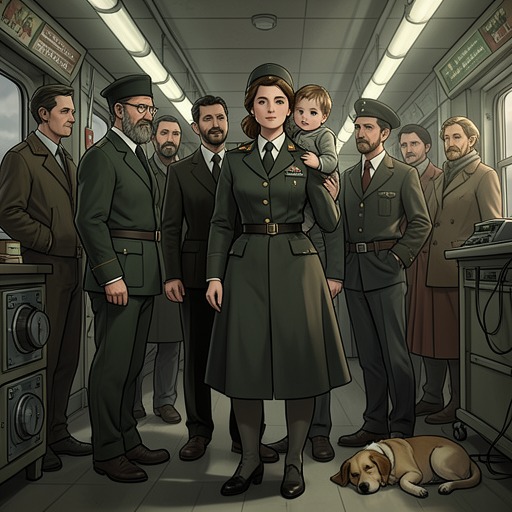
Mom is described as both the locomotive and the home of Train-Town, a moving settlement protected by a vengeful god who commands the Gunsouls. Rumors of that train had reached Kenta, who initially dismissed the idea that any god would care about Scraps; the rumor’s later reality reveals Mom and her community as a power capable of intervening in the slave market’s violence. When the train appeared, the market’s operation collapsed, and its captives became the objects of rescue rather than merchandise. Mom therefore belongs to the same legendary horizon as the Gunsouls, but her function is distinct: she is the place where protection becomes ongoing care.
Her social identity is also shaped by the people who live with her. Bucket’s shrine for Lady Arc placed Yuan Guang within his improvised “universal train theology,” and the nickname “the Gunman’s Little Angel” that he coined for Holster became accepted among Train-Town’s citizens. Mom’s world thus includes ritual, humor, kinship, and shared language, not only engines and defenses. The community’s warmth is measured by its ability to turn a private joke into a name that brings smiles to many faces.
Growth from Shelter into a Town
Mom’s growth is rendered in bodily terms. She has become longer with every passing year, accumulating nearly a hundred wagons since she took in Holster and Yuan Guang. By the time Holster returns, Mom houses more than three thousand souls, and the train has become so immense that Holster sometimes cannot see its end across the horizon. The image makes population and responsibility inseparable from physical expansion: every additional wagon represents both another portion of the town and another burden carried by its living infrastructure.
Her wagons support a structured community rather than a temporary camp. Cultivators among the residents perform maintenance and engine duties, sharing the work required to keep the settlement moving. Mom has nevertheless begun to reach her limits. She discusses with Yuan Guang the possibility of “building more trains,” although she becomes embarrassed and hesitant when Holster presses her for details. That response preserves a sense of personality beneath the vast mechanism: Mom is not an impersonal city or an infinitely reliable machine, but a living host whose capacity can be exhausted.
Protection, Rescue, and Care
Mom’s protective role becomes clearest during the aftermath of the Human Pillar farm. While Train-Town’s citizens guide rescued children into cars and provide first-aid treatment, those with surviving families are reunited with their parents, while the others are offered the possibility of a new home inside Mom’s wagons. Her protection is therefore practical and relational. It does not end with the defeat of an oppressor; it continues through triage, treatment, family reunification, and adoption into the moving community.
Holster’s response to the farm shows why Mom’s refuge matters. Holster recognizes that she remains “one of them on the inside,” a Human Pillar, because the Flesh Mansion Sect once bound her core and shipped her away as merchandise. The rescued children consequently confront not an abstract atrocity but a recurrence of Holster’s own history. Mom’s wagons provide the setting in which that history can be answered differently: children who would otherwise remain objects of ownership can be restored to families or received as members of a new home.
Mom’s protection also operates through her guardians. Yuan Guang watches Holster from high above the locomotive, his thrusters trailing smoke, prepared to descend at the first sign of danger. His vigilance is an extension of the train’s shelter, while Mom supplies the enduring place to which that protection brings Holster back. The community’s safety is distributed across living train, cultivators, Gunsouls, and family bonds rather than assigned to a single wall or fortress.
Relationships and Domestic Meaning
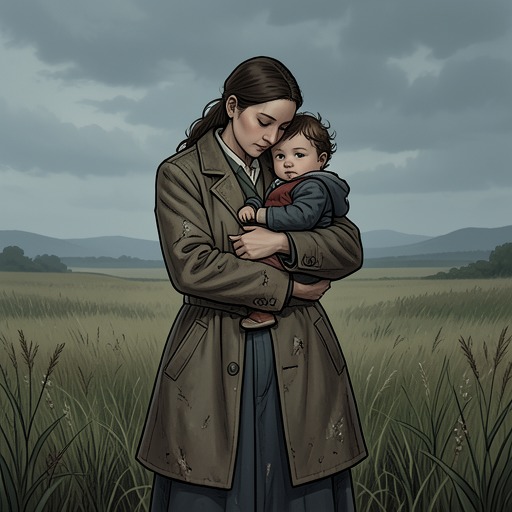
Mom’s relationship with Holster is presented through the language of motherhood. Holster refers to the locomotive as Mom, and the train has housed her since taking in Holster and Yuan Guang years earlier. This relationship is not merely symbolic: Mom’s wagons are the spaces where Holster can recover, grow, practice the Gun Path, and return after danger. The train’s expansion parallels the daughter’s maturation, so that Mom becomes both the witness to Holster’s life and the material environment that makes that life possible.
Mom also shares a domestic partnership with Yuan Guang. The two discuss the future of Train-Town and the need to build more trains, suggesting that the settlement’s survival depends on joint planning rather than on Mom’s endurance alone. Yuan Guang’s imposing barrel-faced and demonic body frightens newcomers, but those who look beyond appearances recognize the brightness within him; Mom’s community likewise teaches that frightening forms can contain care. Her home makes that recognition habitual by placing powerful, strange, and wounded beings within a shared household.
Her bond with Revolver appears indirectly through the family’s everyday speech. Revolver calls Holster the Gunman’s Little Angel and reminds her that her father will be worried if they do not return home soon. Mom is the destination implied by that concern: the place where “home” is not a fixed building but a moving body capable of receiving them. When Holster and Revolver cross the dunes and reach the settlement, Mom is waiting along the endless spirit-tracks under the fading sun.
Ending and Narrative Significance
Mom’s ending is an image of continuity rather than closure. After the rescue and the return across the wastes, Train-Town rests along the spirit-tracks, its locomotive body stretched across the horizon and filled with more than three thousand souls. Its scale suggests achievement, but the discussion of further trains prevents that achievement from becoming static. Mom has built a refuge large enough to shelter a population, yet the need for expansion remains, because protection generates new obligations whenever another vulnerable person is brought aboard.
The final domestic exchange gives Mom her strongest emotional definition without making her speak. Yuan Guang descends from the sky to greet Holster and Revolver, and he says, “Welcome home.” Holster smiles, and the narration concludes that all is right in the Unmade World. The words belong to Yuan Guang, but Mom makes them true: she is the home being entered, the accumulated wagons and shared labor behind the greeting, and the living vessel in which survival has become belonging. Against the book’s recurring images of slavery, ruined farms, wandering violence, and weaponized power, Mom offers a counter-image of growth through shelter. She keeps moving, but she carries home with her.