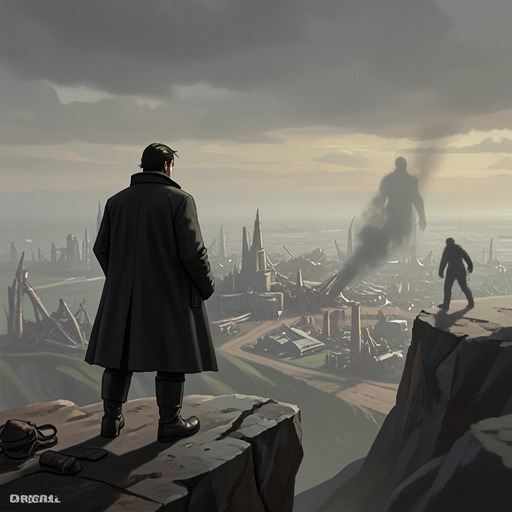
The Bow
GunsoulThe Bow is a weapon-demigod whose significance is established chiefly through the later account of Yuan Guang’s campaign against the supernatural instruments of violence. The available narrative does not describe The Bow’s appearance, personality, origin, powers, or individual confrontation with the protagonists. What it does establish is the place The Bow occupies in the book’s expanding conflict: one of the hostile demigods that remain after the central struggle with the Gun has been transformed into a broader mission of containment and destruction.
Identity and Place in the Weapon Cycle
The Bow belongs to the same larger category of weapon-linked demigods as the Gun, the Blade, the Nuke, the Biohazard, the Arson, and the Truck. The story’s weapon mythology treats these figures not as ordinary tools but as forces capable of feeding on human suffering and reproducing violence through the world. Arc names this constellation when she condemns the Nuke, the Gun, and the Blade as powers that feed on pain. The Bow is therefore significant less as an isolated personality in the surviving evidence than as part of the recurring pattern by which an instrument becomes an autonomous source of catastrophe.
That pattern contrasts sharply with Yuan Guang’s own development. Yuan begins as a Scrap, one of the many people born without the potential for a qi core, and is dismissed by the cultivator order as too old and too limited to advance. Even after he becomes a cultivator at the First Coil, the label remains a source of social humiliation; other people continue to define worth through talent, cores, and sect status. The Bow’s place in the weapon cycle reverses that hierarchy from another direction: an object associated with a weapon becomes an active power over human lives, while Yuan Guang must learn to master the Gun without allowing the Gun’s violence to master him.
Defeat and the Later Hunt
The clearest confirmed fact about The Bow is that Yuan Guang and his allies eventually put it down. In Holster’s later recollection, she states that they had already defeated the Gun and The Bow. This places The Bow’s defeat after Yuan Guang’s mastery of the Gun Path and after the Gun’s destructive cycle has been brought under control. The wording also makes The Bow one completed objective in a continuing hunt rather than the endpoint of the story.
The campaign continues toward the Truck, described as a demigod of cars and vehicular manslaughter. The Truck is unusually difficult to pursue because it can teleport across vast distances and attacks isolated targets unpredictably. Its elusive nature gives the hunt a scattered, investigative quality: Yuan Guang’s family is searching for clues about it when they encounter a local slavers’ guild and decide to destroy that organization. The Bow, by contrast, is mentioned as an already resolved threat, a name in the record of prior victories that demonstrates the hunters’ growing reach.
Connection to Yuan Guang’s Moral Arc
The Bow’s defeat gains additional weight from Yuan Guang’s crisis over the destruction of Fleshmarket. He had deliberately supplied ammunition to sects fighting over the settlement, hoping that they would annihilate one another despite the casualties. When The Gun later announced its arrival with millions upon millions of qi-charged bullets, Yuan feared that his own scheme might have helped lure the catastrophe there. His responsibility is not presented as simple villainy or innocence: he intended to manipulate violence for a strategic purpose, then had to confront the scale of the suffering that followed.
That guilt shapes his response to Revolver’s corruption. After Revolver becomes an instrument of indiscriminate killing, Yuan refuses to abandon him, because Revolver had twice saved his life and shown him unconditional kindness. Yuan’s decision to seek a way to free Revolver from the Gun’s curse turns his campaign away from revenge alone and toward responsibility, rescue, and prevention. The later defeat of The Bow belongs to this same altered ethic. The weapon-demigods are targets, but the struggle is no longer merely a contest of power; it is an attempt to stop instruments of violence from continuing to consume Scraps and cultivators alike.
Narrative Significance
The Bow’s narrative function is cumulative rather than scene-driven in the supplied material. Revolver describes how, after becoming the Gun, he follows murderous impulses to their source and kills without distinguishing between the old and young, rich and poor, Scraps and cultivators. Against that indiscriminate logic, the later statement that The Bow has been put down marks a concrete limit placed on the weapon cycle. The demigods are not invulnerable abstractions. They can be pursued, confronted, and defeated.
The Bow also helps widen the ending beyond Yuan Guang’s personal transformation. Yuan ultimately declares that the Gun is part of him but that he is greater now: the Gunman, having mastered the Gun Path rather than being consumed by it. The subsequent hunt shows what that mastery makes possible. The story does not end with Yuan Guang merely surviving the Gun’s curse; it positions him and his companions as protectors who continue confronting the remaining weapon-demigods. The Bow’s defeat is thus a quiet but important milestone in the conversion of a survivor’s trauma and guilt into an ongoing protective mission.