Slash
GunsoulSlash is the marauder leader whose attack begins Yuan Guang’s central revenge pursuit. He is not merely an anonymous killer encountered at the edge of the story: he is the first face of the violent order that treats unempowered people as disposable, and his later position within Battletown reveals that the massacre was connected to a much larger political structure. Through Slash, the narrative links personal humiliation, institutional power, and the struggle to escape the identity of a Scrap.
Identity and Introduction
Slash first appears among the marauders who seize the small black cube Yuan Guang’s team had been paid to transport. The object is a strange cube with closed eyes on every facet, and Yuan does not know either its purpose or its method of activation; his team had been hired to deliver cargo rather than inspect it. Slash is the marauder holding the package and examining it closely, placing him at the immediate intersection of the raid’s material objective and its human cost.
His appearance makes him instantly recognizable. He is a shirtless, barefoot brute wearing only black pants, a fanged demon mask crowned with horns, and a necklace of crimson malas. From behind the mask, two golden eyes regard Yuan with cold remorselessness. The mask is not simply a disguise: it gives his violence a ritualized, inhuman aspect while making his body itself a deliberately visible sign of menace. His mocking response upon finding a survivor establishes the social distance he maintains between himself and the people he kills.
Slash’s brutality is sharpened by his willingness to turn murder into sport. After taking the cube, he trades it for one of his soldiers’ revolvers and offers Yuan a supposedly fair contest with the same weapon, explicitly excluding fists and techniques. The gesture presents him as a duelist obeying rules, yet the circumstances make the fairness hollow: Yuan is a Scrap facing the raider responsible for destroying his team. Slash’s later reaction to being hit, when he admits that Yuan’s shot reached him and then announces his turn, confirms that the contest is also a demonstration of dominance.
The Marauder Leader and the Battletown Hierarchy
Yuan identifies the attackers as a warband of thirty equipped with humvees and led by a man named Slash. Revolver cannot identify him from the name alone, but recognizes the scale of the force: a warband that large is unlikely to belong to an ordinary thug. Revolver infers that Slash is probably a sect troubleshooter or a warlord’s employee, with Yinyang Khan the likeliest patron. The inference changes Slash’s meaning in the plot. He is dangerous in his own right, but his real importance lies in the network of authority behind him.
That network becomes explicit when Slash later appears in Battletown. He acts as Yinyang Khan’s majordomo and right-hand man, manages the city’s largest events, oversees the recruitment of competitors, and serves as Battletown’s chief of police. These responsibilities make him a bridge between spectacle, administration, and coercion. The man who once stalked a delivery convoy now helps organize the public machinery of a city ruled by a warlord. His violence is therefore not an isolated aberration; it is compatible with civic office and useful to the governing order.
Information about Slash’s actual capabilities remains limited. He rarely gets his hands dirty, and few people survive when he chooses to do so. This scarcity of witnesses functions as part of his power. His reputation is built not through constant visible combat but through the implied reach of a figure who can remain behind events while deciding who is recruited, policed, or eliminated. Even when Yuan learns more about his position, uncertainty still surrounds the full extent of what Slash can do.
The narrative also hints that Slash’s power is divided or displaced. During preparations connected with the History Road competition, Yuan hears that half of Slash’s qi seems to be elsewhere. The detail complicates the apparently simple image of the masked marauder. Slash is not only a physically threatening fighter; his condition is tied to a larger mystery about how power can be distributed beyond the body. The story withholds a complete explanation in the available account, but the observation makes his later confrontations feel less like encounters with an ordinary opponent than with a figure whose presence is structurally unstable.
Conflict with Yuan Guang
Slash becomes the personal target of Yuan Guang’s revenge because he led the force that killed Yuan’s team. Yuan states his objective without qualification: he will arm himself, track down the killers, and slaughter every last one of them. At this stage, revenge gives direction to a man who has only recently begun to cross the boundary between Scrap and cultivator. Yuan’s admission that he has reached the First Coil carries little pride and even some shame, but Slash supplies the immediate reason to continue advancing.
Their conflict repeatedly tests whether Yuan’s pursuit is justice, self-respect, or wounded pride. In one encounter, Slash taunts Yuan by asking whether trash like him can keep the Dao out. The insult attacks not only Yuan’s body or status but his claim to a path of cultivation. Later, Slash directly interprets Yuan’s motivation, arguing that Yuan is not pursuing him to avenge Jaw-Long and Mingxia but to avenge his own wounded ego, and that killing Slash would serve as proof that Yuan has risen above scraphood. This accusation gives the rivalry psychological depth without making Slash a reliable moral judge. He understands the shame attached to Yuan’s former status and weaponizes that shame.
The names of Jaw-Long and Mingxia intensify the conflict. Yuan accuses Slash of killing them and refuses to let him escape. Whether the scene is filtered through hallucination or mental pressure, the accusation shows that Slash has become the concentrated image of the losses driving Yuan forward. The enemy is no longer simply the man who defeated a convoy. He is the figure onto whom Yuan’s grief, rage, and fear of remaining a Scrap have been projected.
Yuan’s assessment of the balance of power changes as he grows stronger. He believes he could defeat Slash if they fought again, yet he recognizes that Slash is still minor compared with Manhattan and Yinyang Khan. That contrast prevents the revenge plot from becoming the whole war. Slash is a meaningful first objective, but the forces above him reveal how limited a single execution would be. Yuan can pursue Slash while understanding that the man is only one node in a hierarchy that includes Manhattan, Yinyang Khan, and the Nuke.
The Stolen Handgun and the Return of the Rival
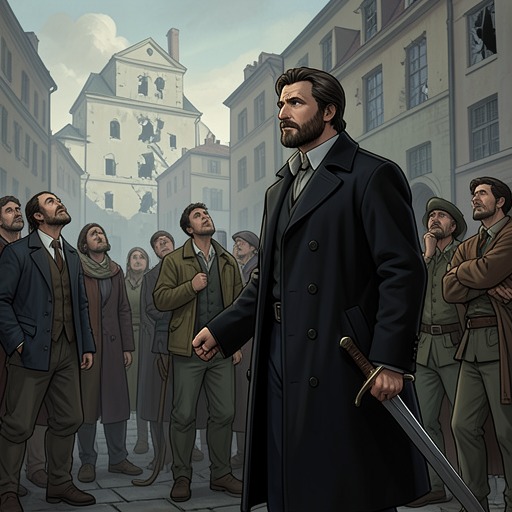
Slash’s reappearance before the History Road competition carries a deliberately intimate insult. He stands atop a vehicle with his katana and Yuan’s stolen handgun attached to him. Yuan cannot tell whether Slash parades the weapon as a trophy or simply forgot to remove it after murdering its previous owner; either possibility is degrading. The handgun is evidence of the earlier massacre, a possession taken from the dead, and a portable reminder that Slash believes Yuan’s past can be worn as an ornament.
When Slash asks who Yuan is, the question is laden with mockery because the answer should already be obvious to anyone who remembers the raid. His apparent failure to recognize Yuan turns identity into another field of combat. Yuan has changed through cultivation and survival, while Slash treats him as the same disposable Scrap. The stolen weapon therefore marks a clash between two versions of Yuan: the powerless courier whose team was destroyed and the combatant who has returned to claim meaning from the object taken at the beginning.
Slash then says he has used the handgun only to kill Scraps since, explaining that his sword is too good for them. This boast reveals the logic beneath his violence. Weapons are graded according to the social worth of their targets, and Slash presents his refusal to use the sword against Scraps as a sign of superiority rather than mercy. The handgun becomes an instrument of class contempt, while the katana becomes a symbol of the elevated status Slash claims for himself. His cruelty is thus expressed through a hierarchy of tools as much as through direct killing.
Change, Function, and Narrative Significance
Slash remains important even when Yuan’s priorities expand. Yuan must attend Arc’s lessons, free Revolver from the Gun, pursue Manhattan, and respond to the needs of refugees, yet killing Slash remains one of his stated priorities. This placement matters: Slash is no longer the only problem, but neither is he forgotten. The rivalry survives the expansion of the plot because it represents the unfinished question of whether Yuan can break free from the identity imposed on him at the opening.
The contrast between Slash and Yuan becomes sharper as Yuan moves toward a new self-conception. Yuan begins as a Scrap in a society where those without the potential to form a qi core serve cultivators and may hope only for an uncorrupted spirit pill granted by a sect. Later, Yuan declares that the Gun is part of him but that he is greater now, naming himself the Gunman. Slash’s insults once define the terms of the encounter; by the time Yuan claims the Gunman identity, the old language of trash and scraphood no longer fully contains him.
That transformation does not make Slash irrelevant. On the contrary, Slash’s contempt supplies the negative measure by which Yuan’s change can be recognized. The masked marauder treats identity as fixed: Scraps are targets, superior weapons belong to superior men, and a survivor can be reduced to the status of the person who failed to die. Yuan’s development contests each assumption. He becomes capable of choosing his purpose beyond revenge, ultimately deciding to make the world better, end tyrants and monsters, and accept Arc’s charge to defeat the demigods of ultraviolence. Slash belongs to the earlier, narrower form of that journey, where power means killing the man who caused the wound.
Slash’s decisive narrative role is therefore not limited to being a recurring antagonist. He is the first agent to make Yuan’s social humiliation physically undeniable, the killer whose actions bind grief to ambition, and the official whose place in Battletown exposes the institutional shelter given to violence. His mask, stolen handgun, and contemptuous language recur as signs of a world in which authority can murder the powerless and then call the result order. Against that world, Yuan’s movement from Scrap to Gunman—and finally toward a self-appointed protector—turns the revenge against Slash into the beginning of a broader rebellion against tyrants and monsters.