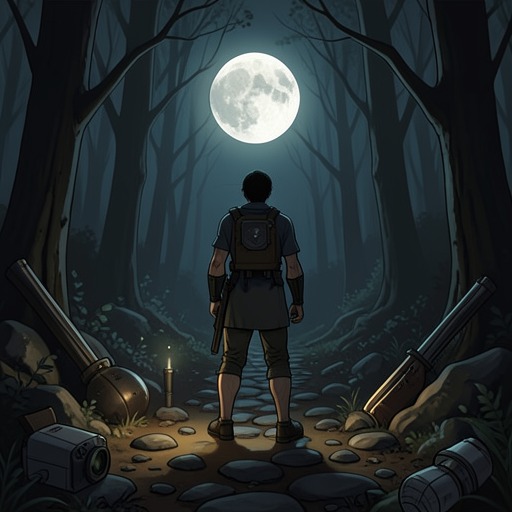
Blackmoon
GunsoulBlackmoon is a transcendent Wayfinder whose ascension transformed the moon into an instrument of spiritual scrutiny. Its decisive significance lies in the way its power makes inward truth externally consequential: anyone caught beneath its gaze has their hidden nature revealed, and the resulting exposure can destroy, purify, or redirect a mortal. Through Blackmoon, the novel opposes two forms of authority—the Gun’s inherited curse and the moon’s demand for self-knowledge—without making the latter harmless or simple.
Identity and Ascension
Blackmoon is identified as a Wayfinder who has become one with the Dao and, through that union, imposes the desire of its heart upon reality. Its ascension occurred decades before Yuan Guang’s journey and had already made Gatesville a place of terror by the time Yuan and Revolver approached it. The ruined wasteland around that route therefore carries a historical shadow: Blackmoon is not merely an apparition in the sky, but a power whose rise altered the conditions under which ordinary people and cultivators survive.
The most striking image of Blackmoon is the waxing crescent above Yuan. The moon appears as a dark orb with a narrow sliver of light, surrounded by stars like a silver eye. The image makes the celestial body seem simultaneously distant and intensely attentive. Blackmoon does not simply illuminate the world; it looks back at Yuan, recognizes him, and knows him. Its cosmic scale produces a distinctly unequal encounter: Yuan is not confronting an opponent whose body he can reach, but a consciousness capable of turning the world itself into an extension of its perception.
The Moon’s Gaze and the Revelation of the Soul
Blackmoon’s governing principle is that everyone exposed to its gaze has their inner truths revealed. This power is frequently misunderstood as moonlight, but the distinction is essential. Yuan’s Barrier can reject light, yet moonlight is only a manifestation—or symptom—of Blackmoon’s attention. The actual threat is the gaze itself, and Yuan realizes that survival requires a Barrier capable of repelling the concept of being watched by Blackmoon rather than merely blocking physical illumination.
Orient explains the spiritual logic behind this phenomenon. Moonlight reveals the true shape of the soul because mortals do not fully understand themselves: they doubt, suppress, and conceal what lies in their hearts behind emotional falsehoods. When moonlight sets those delusions on fire, the weak burn with them, while the strongest may emerge purified and reforged. The process is therefore both revelation and judgment. It attacks the distance between a person’s performed identity and their concealed desire, making self-deception a material liability.
The ordeal also belongs to the cultivation system’s concern with mind as well as body. Emotional debris obstructs the flow of qi, blinds the soul, and limits potential. Blackmoon’s power consequently has a paradoxical character. It is terrifying because it removes privacy and control, yet it can improve the rare survivor whose will is strong enough to withstand the exposure. The moonburn is not presented as an ordinary technique that guarantees advancement; it is a destructive test whose beneficial result belongs only to a precious few.
The Moonlight Sect and Kaguya
Blackmoon’s influence extends beyond the sky through the Moonlight Sect, whose hidden worshipers treat its revelations as trials on the road to enlightenment. Kaguya introduces herself to Yuan Guang as a messenger of that sect after he survives the first of Blackmoon’s ordeals. Her language frames the encounter as a spiritual initiation: conquering oneself is a long and perilous journey, and facing doubt is only the first step.
Kaguya’s arrival changes the meaning of Yuan’s experience. What first appears to be an attack by an incomprehensible celestial force is also claimed as a deliberate religious trial. The Moonlight Sect understands Blackmoon as a guide, and Kaguya contrasts that guidance with the Gun, calling Blackmoon kinder than the force responsible for the Gunsoul curse. Yet the promise is not freedom without cost. The revelation of the soul remains dangerous, and the existence of further trials makes clear that surviving one exposure does not end the path.
Blackmoon’s knowledge also reaches beyond ordinary observation. Kaguya knows Yuan’s name because, as she says, the moonlight unveils everything. Her statement confirms that Blackmoon’s attention penetrates personal boundaries that Yuan normally treats as secure. The moon therefore functions as an authority over identity itself: it can identify him before he offers an explanation and can expose truths he would prefer to keep private.
Alternative to the Gun’s Curse
Blackmoon becomes especially important to Yuan because the Moonlight Sect offers a possible alternative to his Gunsoul condition. Kaguya claims that Blackmoon can free him from the Gunsoul curse and restore his half-life. Yuan rejects the offer because his bullet-core is the seat of his soul and he would die without it. Her answer nevertheless introduces a crucial possibility: other forces could fill the void, provided Yuan had not yet crossed the Fourth Coil and committed himself to a Path.
This exchange places Blackmoon within the novel’s larger struggle over self-definition. Yuan begins life marked as a Scrap, a person born without the potential for a qi core, and later becomes a Gunsoul whose existence is bound to the Gun. His eventual mastery of the Gun Path does not erase the earlier alternative; it makes the choice more meaningful. Blackmoon represents a power that might have offered escape from inherited violence, while Yuan’s later identity as the Gunman represents a different kind of transformation—one in which the Gun remains part of him but is no longer his master.
The contrast is not simply between evil and salvation. Blackmoon’s method is coercive in its own way because its gaze forces truth upon those beneath it. Its compassion, as described by Kaguya, is inseparable from judgment and trial. The Gun imposes a curse through violent inheritance; Blackmoon imposes revelation through cosmic attention. Yuan’s refusal to abandon the bullet-core therefore becomes a decision about which form of power, danger, and identity he is willing to inhabit.
Narrative Role and Thematic Significance
Blackmoon operates as a celestial threshold guardian and as a shadowed alternative to the Gun. Its appearance forces Yuan beyond the limits of ordinary defense: physical barriers are insufficient when the enemy is not light but the idea of being seen. The encounter converts cultivation from a matter of accumulating qi into a confrontation with suppressed truth, fear, and self-deception.
The character also externalizes a central tension in Yuan’s development. He has repeatedly been defined by labels imposed from outside—Scrap, cultivator, Gunsoul—and Blackmoon’s gaze threatens to reveal whether those labels accord with his actual soul. That threat is why the moon’s attention carries more weight than a conventional attack. It does not merely endanger Yuan’s body; it challenges the identity he has constructed while moving from powerlessness toward mastery.
By the end of the supplied arc, Yuan calls himself the Gunman after quieting the Gun within him and mastering the Gun Path. Blackmoon is not shown as defeated or erased by that achievement. Its presence remains a counterforce in the architecture of the story: the moon reveals, the Gun possesses, and Yuan must determine whether identity means escaping such powers or incorporating one without surrendering to it. Blackmoon’s lasting importance lies in that unresolved opposition. It makes truth a perilous form of power and turns the choice of a Path into a choice about what kind of revealed self can survive.