Yinyang Khan
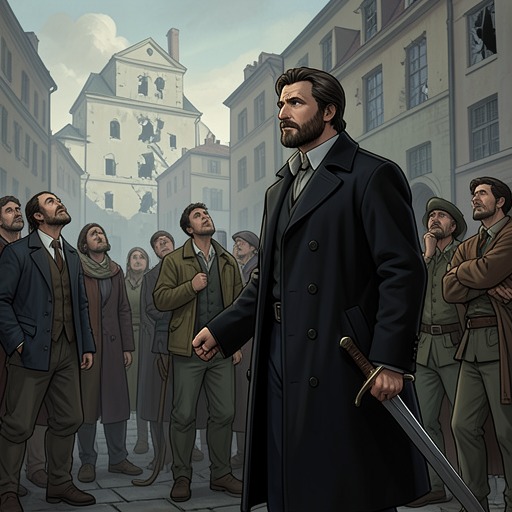
GunsoulYinyang Khan is the principal warlord of the region and one of its most powerful cultivators, ruling from Battletown through tribute, affiliated warbands, sect influence, and terror. His decisive significance lies in the way he turns cultivation, historical memory, and dormant weapons of mass destruction into instruments of personal domination: he is not merely an enemy encountered on the road, but the political and military power whose reach repeatedly constrains Yuan Guang’s choices and whose defeat transforms the balance of the Unmade World.
Identity and Regional Power
Yinyang Khan first enters the story as the suspected patron behind the warband pursuing Yuan Guang’s group. Revolver recognizes that such a force cannot have been assembled by an ordinary thug and wagers that Slash serves either a sect or a warlord, most likely Yinyang Khan. Yuan Guang already knows the name from Mingxia’s briefing on the Fanged Coast, where the Khan is identified as one of the region’s mightiest warlords and a follower of the Dyad Sect. His influence extends beyond the coast: it reaches Fleshmarket and Gatesville, and his authority is strong enough that a third of the region’s settlements pay him tribute, along with many sects.
The geography of his rule makes Battletown more than a capital. It is the center from which his military pressure radiates, and the prospect of taking refugees there becomes morally perilous. When Yuan Guang considers Battletown as the only settlement large enough to shelter displaced passengers, he immediately fears that the refugees would become slaves or victims under the Khan’s rule. This possibility reveals the practical meaning of Yinyang Khan’s power: his domain can provide scale and resources, but its protection is inseparable from possession.
Rule Through War and Spectacle
Yinyang Khan’s authority is maintained by organized violence rather than personal reputation alone. The attackers connected to Yuan Guang belong to a warband affiliated with him, while the Moonlight Sect later warns that Yuan Guang’s decisions have placed him on a collision course with the Khan’s army. The threat is therefore structural. Yuan Guang is not approaching an isolated tyrant whose influence ends at the walls of a fortress; he is moving against a regional system capable of mobilizing soldiers, sects, settlements, and political pressure.
That system also expresses itself through spectacle. From a rocky hill, Yuan Guang, Orient, Holster, and Arc can see the desert giving way to the Oil Sea, where refinery outposts pump fuel along the shore beneath a colossal settlement of neon lights and machine towers. Arc identifies the surrounding landmarks as copies of monuments from the Lost Age and condemns the Khan’s History Road as a murderous mockery of the past. The project converts history into a display of authority, making the landscape itself advertise the ruler’s power while concealing the human cost beneath its monumental surface.
The cost is literal and enormous: Yinyang Khan sacrificed nearly a hundred children merely to pave his driveway. The History Road’s grandeur is consequently inseparable from ritualized expendability. Its copied monuments do not preserve the Lost Age; they transform its remnants into a private avenue built from victims. Yuan Guang’s clenched fists at the revelation mark the point at which the Khan’s distant political threat becomes a direct moral provocation. The deaths on the racing circuit are not accidents within a dangerous contest but part of a broader order in which lives are consumed to beautify and secure tyranny.
Weapons, Duality, and the Khan’s Ambition
The Khan’s political appetite is matched by a strategic interest in dormant superweapons. He seeks the Cube of Natho because it could give him control over the slumbering Children of the Nuke, whose destructive capacity would make him the most powerful warlord in the Unmade World. A weapon capable of erasing cities with a blink would allow him to annihilate rivals and compel everyone else to obey. His pursuit therefore enlarges the stakes beyond Battletown or any single campaign: Yinyang Khan wants to convert inherited catastrophe into a permanent architecture of rule, placing the fate of entire settlements inside the hands of one conqueror.
His allegiance to the Dyad Sect is reflected in his own divided nature. When he manifests, the Khan is revealed as a being whose identity can separate into distinct bodies: one is a pale, bone-white copy of himself, lacking his lower set of arms, while the other has an obsidian body and a grinning oni mask. The division gives physical form to the duality associated with his power, but it does not make him less dangerous. Instead, it multiplies the forms through which his violence can act, turning the body of a single warlord into a small army of hostile selves.
The contrast between the Khan and Czar Zoa clarifies the character of his threat. Czar Zoa’s presence is associated with the sterile lifelessness of nuclear winter; Yinyang Khan’s massive furnace-like core radiates a more immediate and savage violence. The core burns inside his chest like an exposed engine of malice, while the smaller core belonging to his weaker split personality is obscured by the darkness of the dominant one. This imagery presents his cultivation not as disciplined transcendence but as concentrated aggression: power has become both his physical substance and the atmosphere surrounding him.
Confrontation, Defeat, and Narrative Function
The Khan’s public confidence reaches its clearest expression when he emerges from swirling light and treats the confrontation as an extension of his authority rather than a genuine contest. He can ignite the horizon with a snap of his fingers, reducing the surrounding landscape to another surface on which his power is displayed. When Arc stands between him and the Cube of Natho, he dismisses her, demands her head, and offers survival only on the condition that she withdraw and eventually serve him after he rebuilds his capital. The offer exposes the logic beneath his grandeur: every opponent is either an object to destroy or a subordinate to absorb, and even mercy is framed as ownership.
Yuan Guang’s arrival breaks the Khan’s assumption that the battlefield can be ordered according to his will. The confrontation becomes a collision between two models of power: the Khan’s authority depends on overwhelming force, divided embodiment, and the ability to make others submit, while Yuan Guang enters as an adversary whose strength has been forged through limitation, cultivation, and chosen responsibility. The turning point comes when a shot opens a bloody hole in the warlord’s skull and destroys his brain within the physical incarnation of his soul. The violence is not merely a wound to the body; it fractures the space containing the conflict, causing reality to shatter like a broken window and revealing the ruins of Battletown beneath it. Slash’s corpse disappears, leaving behind only his hungry blade and Yuan Guang’s handgun, while the Khan’s remains recover their missing lower arms before he collapses with his qi dispersing and blood pouring from his broken skull.