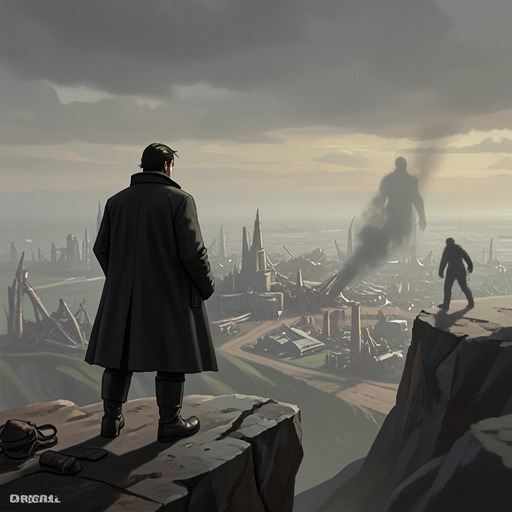
The Blade
GunsoulThe Blade is a demigod of ultraviolence and one of the major threats still active after Yuan Guang and his allies defeat or contain several other weapon-associated powers. The available evidence identifies The Blade primarily through its place in the continuing hunt against these demigods: it remains free while The Nuke has been safely contained, and it therefore represents unfinished work rather than a resolved enemy. The Blade’s decisive significance lies in what its survival does to the ending. The apparent defeat of The Gun does not end the world’s violence; it opens a broader campaign against the remaining powers that feed on suffering.
Status Among the Demigods
The Blade belongs to the same threatening class as The Nuke, The Gun, The Biohazard, and The Arson: weapon or catastrophe-associated demigods capable of tormenting the inhabitants of the Unmade World. The evidence does not specify whether The Blade is a literal blade, a humanoid manifestation, a cultic power, or another kind of spirit-machine entity. It does establish that The Blade is treated as an active demigod rather than as a rumor or historical relic.
Its status is defined by contrast with The Nuke. By the time of the later epilogue material, Mr. Long is safeguarding the Cube of Natho while the evil within it awaits destruction, and The Nuke is described as safely contained. The Blade, however, remains free. That contrast separates containment from victory: one danger has been restrained, but The Blade continues to possess the freedom to torment others.
Place in the Continuing Hunt
The Blade is one of the targets of Yuan Guang’s later campaign. Holster recalls that the group has already put down The Gun and The Bow, while continuing to pursue the Truck, the demigod of cars and vehicular manslaughter. In the same account, The Blade, The Biohazard, and The Arson are named among the powers still at large. The Blade is therefore part of an organized sequence of unfinished confrontations rather than an isolated antagonist encountered and defeated within the supplied scenes.
This placement also clarifies the scale of Yuan Guang’s new purpose. His struggle is no longer limited to personal revenge or to surviving the curse inherited through Gunsouls. After mastering the Gun Path and becoming the Gunman, he turns toward threats that continue to impose violence on ordinary people. The Blade’s inclusion in that hunt shows that the conclusion is structured as a continuation of responsibility: ending The Gun’s immediate cycle does not absolve the survivors while other demigods remain free.
Narrative Function and Unresolved Threat
The Blade has no directly narrated confrontation in the supplied evidence, and no concrete details are provided about its motives, victims, abilities, or eventual fate. That absence is meaningful at the level of plot structure. The Blade functions as an open edge in the world beyond the main conflict, a reminder that the defeat of one embodiment of violence cannot make the wasteland safe by itself.
The name also participates in the book’s recurring catalogue of destructive powers: The Nuke, The Gun, The Blade, The Biohazard, and The Arson convert familiar instruments or disasters into active agents of suffering. Yet the available material does not support assigning The Blade a specific symbolic program beyond that shared role. What can be stated securely is narrower and more consequential: The Blade remains free, it is considered dangerous enough to be hunted, and its survival keeps the larger threat of demigod violence alive after The Gun has been put down.
Significance at the Ending
The Blade’s final known condition is unresolved freedom. The later world has gained a measure of protection: Mr. Long guards the Cube of Natho, The Nuke is contained, and Yuan Guang’s mastery has quelled The Gun within him. At the same time, The Blade remains among the powers capable of tormenting others. The ending thus refuses to equate personal transformation with universal deliverance.
For that reason, The Blade serves as evidence that Yuan Guang’s victory is ethical as well as martial but also incomplete. The Gunman has achieved control over the force inside himself, yet the world still contains external forms of the same destructive inheritance. The Blade’s survival preserves the story’s forward pressure: the work of stopping violence continues beyond the closing conflict, and the promise of safety depends on action not yet completed.