Revolver
GunsoulRevolver is a Gunsoul whose life gives the Gun’s curse a human history and whose return from death transforms that history into a possibility of renewal. He first appears as a biker who finds Yuan Guang abandoned in a ditch and recognizes him as a fellow child of the Gun. The encounter establishes Revolver as both rescuer and mentor: he knows the Path of the Gun, understands the half-life granted by the Gun, and teaches Yuan that a Gunsoul’s identity is not merely a mark of weakness but a dangerous vocation. Revolver’s later struggle against bloodlust, repeated willingness to risk himself for others, and eventual restoration of his soul make him one of the clearest tests of whether the Gun’s cycle can be inherited without being obeyed.
Identity and Origins
Revolver belongs to the underclass of Gunsouls in a world where cultivation normally depends on possessing a qi core. Yuan Guang was born without the potential to form one and therefore began life as a Scrap, part of the half of the population that serves cultivators. Revolver’s intervention changes Yuan’s understanding of that limitation. With his deep voice and motorcycle, he arrives from behind Yuan’s ditch, stops beside him, and orders him to wake as a child of the Gun who does not belong there. He identifies himself as “Revolver. A Gunsoul like you. A man on the Path of the Gun,” presenting the name not simply as a nickname but as an affiliation and a way of life.
The half-life that Revolver describes is both gift and sentence. He tells Yuan that the Gun rewarded his dedication to vengeance and firearms, while warning that the reward will not be repeated. The statement places Revolver within the Gun’s succession of chosen or damaged hosts: advancement grants power, but the same power carries a curse that threatens to consume the person who bears it. Revolver therefore serves as Yuan’s first living proof that a Scrap can become a cultivator, while also embodying the cost of crossing that boundary.
His past is later connected to slavery and forced dispossession. Jared LaChaire explains that Polio’s hunters raided Revolver’s village and put a collar on him; his original name was never learned. Because he was already skilled at shooting people with a revolver, the nickname became his identity. This history gives his firearms a direct relation to survival under coercion. The weapon is not an ornamental emblem of a free gunslinger: it is the instrument through which an unnamed slave acquired a name, a reputation, and eventually a place within the Path of the Gun.
Mentor to Yuan Guang
Revolver becomes the first person to treat Yuan as a Gunsoul rather than as a Scrap waiting to be discarded. Their early conversations frame cultivation as a practical discipline rather than an abstract promise. When Yuan asks how many Coils Revolver has unlocked, the question acknowledges Revolver’s seniority and invites comparison between their progress. Later, Revolver’s notice identifies him as a Fourth Coil cultivator wanted dead for abolitionist crimes against the Yinyang Khan, the Flesh Mansion Sect, and the Fanged Caravan Company. The bounty’s instruction to bring back his head rather than take him alive shows the political scale of his opposition and confirms that his violence has been directed against systems of domination as well as individual enemies.
Revolver also teaches through restraint. He knows that killing Yuan for a bullet would have strengthened him, yet he lets Yuan live. That decision becomes one of the foundations of their bond: Revolver possesses the predatory logic of the Gun but does not reduce every encounter to consumption. Yuan remembers that Revolver saves him twice, first from Elder Polio and later from the Gun itself. The relationship is consequently more than apprenticeship. Revolver gives Yuan a firearm after Yuan rises from the ditch where Slash left him, and that weapon becomes Yuan’s first firearm as a Gunsoul and a material sign of his first step into the cultivator world.
Revolver’s own chosen weapon also shapes the teaching he offers. Arc explains that a Gunsoul must align core and body with a particular firearm; Arc resonates with sniper rifles, while Revolver’s weapon is apparent from his name. Revolver’s path is therefore not generic marksmanship but a bodily and spiritual identification with the revolver. He warns Yuan that further progress will make him look less human because the bullet-core gradually changes the body into a form suited to a gunpowder-fueled soul. The warning is intimate because Revolver has already crossed that threshold himself, and because Yuan’s transformation repeats the same danger in a new generation.
The Gunslinger in Conflict
Revolver’s reappearances are marked by speed, noise, and open defiance. When a bullet reaches the spirit-train, Yuan sees a cruiser with blazing wheels racing across the wastes, its skull-headed rider firing into the air to announce his arrival. The rider is Revolver, returning not quietly but as a force that makes his presence unmistakable. He declares that he has come to cross Elder Polio’s name off his kill list, while welcoming the chance to add more graves. His humor and enthusiasm do not lessen the brutality of his objective; they show how thoroughly vengeance has become part of his identity.
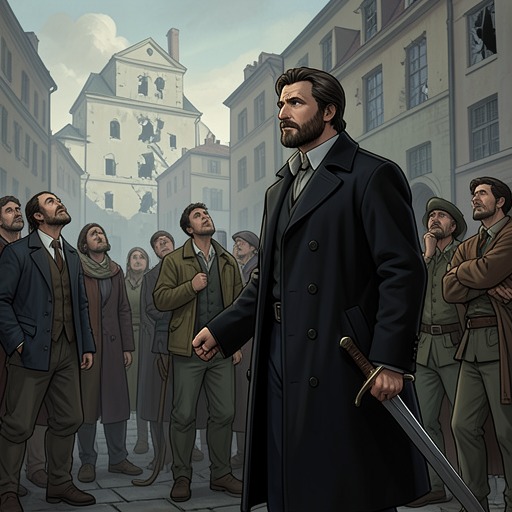
At the Bullet Church, Revolver stands on the wreckage after the bombardment, holding a revolver in each hand while the Gun announces its own approach with a rain of bullets. The image places him between two forms of firearm violence. He is visually recognizable as a Gunsoul, yet he is also resisting the larger power that turns Gunsouls into instruments of endless killing. His presence at the ruined church joins personal revenge to the wider conflict surrounding the Gun’s inheritance.
Revolver later rejoins Yuan and tells him that Yuan’s friends are aboard the train, asking whether he is ready to wager his life to save them. The question functions as a test of the values separating Revolver from the Gun. A Gunslinger can pursue vengeance, but a Gunsoul can also choose to stake his life for companions. Revolver’s demand forces Yuan to define his power through responsibility rather than through survival alone.
His own relationship with violence remains unstable. Yuan sees Revolver struggling against the bloodlust overcoming him and cannot dismiss the sight afterward. Revolver has saved Yuan’s life twice, but he is also being pulled toward the same murderous compulsion that governs the Gun. Yuan later recognizes that he had hoped to arm the sects fighting over Fleshmarket so they would slaughter one another, casualties notwithstanding. Revolver’s condition turns that strategy into a moral problem: violence aimed at enemies can still reproduce the Gun’s logic, and the person who survives may remain bound to the violence he used.
Curse, Death, and the Struggle for Agency
Revolver’s central conflict is not simply between himself and external enemies, but between his own judgment and the Gun’s appetite. The sight of him struggling against the bloodlust rising inside him becomes a lasting source of distress for Yuan Guang because Revolver has already acted as both protector and potential victim. He saved Yuan from Elder Polio and later from the Gun itself, yet his strength and history do not exempt him from the curse. The Gun’s arrival is announced by a rain of bullets, making the force that threatens Revolver feel less like an opponent he can defeat once than an inheritance that continually returns through firearms and their wielders.
That conflict reaches a breaking point when Revolver turns his gun on himself and pulls the trigger. His cruiser then carries him away across the ruins, its wheels burning as he disappears into the wasteland, apparently searching either for victims or for the release of death. The act is neither presented as a clean victory nor treated as the end of his story. It exposes the exhaustion beneath his swagger: the same man who can race toward battle, announce a kill list, and wager his life to save Yuan’s friends has become unable to trust his own continued existence. His self-directed violence therefore reveals the curse’s deepest consequence, namely that it converts survival into another form of captivity.
Death, Resurrection, and the Recovery of the Soul
Revolver’s apparent death does not end the curse; it makes its power visible as a cycle. After Yuan encounters him beside a power cruiser and four fresh corpses, Revolver stands with his back turned, looking up at the moon, and asks to be killed because he can no longer endure what the Gun has made of him. Yuan answers with a promise to free him from the curse, whether by one way or another. The exchange reverses their earlier relationship: the rescuer who once pulled Yuan from a ditch now depends on his former protegé for release, while Yuan must decide whether mercy means ending Revolver’s life or confronting the force that has taken possession of it. Revolver’s plea is also the clearest admission that his violence has ceased to be fully voluntary. His body remains a Gunsoul’s weapon, but his request shows that the person inside it still distinguishes death from surrender to the Gun.
The later confrontation brings Revolver back in a form that makes execution and salvation inseparable. He faces Yuan with a hole squarely in his skull, yet his eyes have returned to themselves even as the Gun’s malice begins drifting back in an attempt to seize him again. Revolver recognizes Yuan’s strength and invokes an Authority built around luck, loaded chambers, steel, and the chance that only one of two combatants will walk away. The ritual turns the familiar grammar of the duel against the curse: the revolver remains an instrument of lethal uncertainty, but the contest becomes a struggle over who controls its meaning. Revolver’s return is therefore not a simple resurrection. It is a temporary recovery under pressure, with the Gun still capable of reclaiming him.
Yuan ultimately survives the encounter with the Gun’s presence changed within him. Revolver can still sense it, but no longer as an overwhelming malice; it has been quelled, as though the safety has been engaged. Yuan explains that the Gun is now part of him, yet that he is greater than it, naming himself the Gunman. This altered condition allows him to do what Revolver could not do alone: separate possession from identity. When Yuan saves Revolver, Revolver thanks him not only for preserving his life but for saving his soul. The distinction is decisive. Life concerns the damaged body that can be shot, regenerate, and return; the soul is the agency that the Gun’s curse repeatedly tries to erase.
Revolver’s restoration also changes the emotional direction of his bond with Yuan. He accepts that his cruiser needs repair and polishing, responding with contentment and gratitude rather than with the fatalism that followed his self-inflicted shot. He then says that he has finished what he set out to do and never expected to live so long, but chooses to go wherever Yuan goes. His continued companionship is not a return to the old mentor role. It is a renewed choice made after the loss of control, a declaration that survival can become purposeful once the Gun no longer dictates every movement.
Later Life and Narrative Significance
Revolver’s restored life extends beyond the crisis that once made him beg for death. In the later account of his travels, he rides his cruiser as Uncle Revolver, participating in the cleanup of the trashcan farm and praising the work of the younger generation while acknowledging that their parents would be proud. The change in address matters: he is no longer defined only as a cursed Gunsoul, a bounty target, or a wandering killer. He has become part of a household and a community in which protection, maintenance, and responsibility replace the Gun’s demand for endless escalation. His concern for a boy entrusted to the Wayfinders’ care also shows the practical form his renewed ethics take; he questions whether the arrangement is wise because he remains attentive to the vulnerable rather than treating them as expendable collateral.
Revolver’s identification with the Scraps survives his transformation. Riding home, he says that he still thinks like a Scrap, and that Yuan does too; someone, he argues, must care about people who are otherwise treated as refuse. This memory preserves the social wound from which both Gunsouls emerged. Revolver does not regard cultivation as proof that he has escaped the underclass. His power instead gives him greater capacity to defend those still trapped within it. The statement also reinterprets his earlier abolitionist violence. His opposition to the Yinyang Khan, the Flesh Mansion Sect, and the Fanged Caravan Company was not merely the work of a violent outlaw seeking enemies; it belonged to a continuing refusal to accept a world in which ordinary people could be collared, exploited, and discarded.
His relationship with Yuan consequently settles into a generational partnership. Revolver calls Yuan strong and admits that Yuan has done more for him than Yuan understands: he saved not only Revolver’s body but also the soul threatened by the Gun. Yet Revolver does not surrender his own agency to his former protegé. When Yuan faces the immense barrier of the Fifth Coil, Revolver offers companionship rather than a promise of easy instruction, noting that the breakthrough took him years and that his own circumstances had not included raising a teenage daughter or hunting demon trucks. The comparison places their futures beside each other without making them identical. Revolver remains an experienced cultivator, but he is also a family figure, a driver, and a fellow traveler who accepts that the next wall must be understood personally.
The final image of Revolver riding toward Train-Town gathers the character’s contradictions into a quieter resolution. His cruiser still thrums, the hat and gunslinger persona remain, and the world still contains trash farms, dangerous creatures, and uncertain roads. What has changed is the direction of those familiar symbols. The vehicle no longer carries him toward victims or toward the release of death; it carries him home with people whose lives he has chosen to protect. Revolver therefore embodies the book’s distinction between inheriting the Gun and obeying it. He cannot erase the violence that formed him, the slavery that erased his original name, or the deaths caused under the curse. He can, however, carry those facts forward without allowing them to dictate his final purpose. His survival becomes meaningful precisely because it is converted from a half-life granted by the Gun into a life sustained by memory, loyalty, and chosen responsibility.