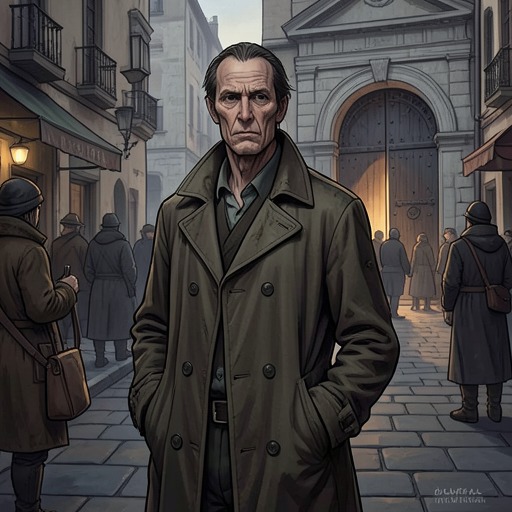
Adolf Naumann
MiddlemarchAdolf Naumann is a German painter in Rome and one of the chief renovators of Christian art. His work offers Dorothea Casaubon a vivid introduction to paintings whose religious symbols had seemed obscure or even monstrous to her; at the same time, his wish to sketch her provokes Will Ladislaw to defend her against the language of artistic possession. Naumann’s energetic confidence makes him both a guide to a living artistic movement and the occasion for a revealing conflict over how Dorothea is to be seen.
Identity and Artistic Milieu
Naumann belongs to a circle of long-haired German artists in Rome among whom Romanticism is still a vigorous, distinguishable enthusiasm rather than a settled part of general culture. The narrative introduces him through movement and urgency: while Will is absorbed by the view from the Vatican’s round vestibule, Naumann approaches, puts a hand on his shoulder, and calls him quickly to see a woman before she changes her pose. The woman is Dorothea, standing beside the sculpture then called the Cleopatra, her eyes fixed not on the marble but on a streak of sunlight across the floor. Naumann’s alertness to pose and visual composition is immediate; his manner of seeing turns a passing moment into a possible artistic subject.
Will later describes Naumann as one of the principal renovators of Christian art. In this account, the movement does more than revive inherited subjects: it enlarges the conception of sacred history, treating its great events as mysteries witnessed by successive ages and making great souls of different periods seem contemporaneous. Naumann’s art therefore rests on a view of painting as a way to make remote religious history present. It is a practice of interpretation as well as depiction, and its ambition helps explain the rich meanings Dorothea begins to discover in his pictures.
Art, Meaning, and Artistic Ambition
Naumann’s confidence extends from his subject matter to his account of artistic purpose. In conversation with Will, he argues that the universe strains toward his picture through him, since the painter’s existence and function are part of the same whole. Will counters that another force in the shape of himself may be trying to thwart the picture. Naumann answers that the outcome of the struggle is logically the same, whether the picture is made or not. The exchange makes Naumann’s belief in artistic purpose expansive and almost playful: he treats even resistance as something that can be absorbed into a universal process.
The pair’s competing ideas of meaning also appear in their work. Naumann has painted saints drawing the Car of the Church; Will, temporarily his pupil, makes an oil sketch of Tamburlaine driving conquered kings in his chariot. Will dislikes copying and wants to put something of his own into a picture. He gives the chariot a broad mythical interpretation, making it the course of physical history as it lashes dynasties along. He teases Naumann for what he considers excessive meaning, yet claims an even wider intention for his own sketch. Casaubon receives this treatment of symbolism uneasily, while Dorothea says she would need explanation to understand Will’s difficult visual shorthand. Her response distinguishes Naumann’s interpretive art, which she is beginning to read, from Will’s deliberately expansive symbolism.
When the Casaubons visit Naumann’s studio, they find him painting industriously, with no model present. His finished and unfinished works are advantageously arranged, and his plain, vivacious appearance—set off by a dove-colored blouse and maroon velvet cap—seems especially suited to receiving the beautiful young English visitor. In his confident English he gives short explanations of his subjects, apparently attending to Casaubon as much as to Dorothea. Will enthusiastically identifies particular merits in the pictures. Through their explanations, Dorothea begins to understand Madonnas beneath elaborate canopies against simple rural backgrounds, saints holding architectural models, and saints with knives lodged in their skulls. Subjects that had looked monstrous to her acquire intelligibility and a natural meaning. She even remarks that she would rather feel a painting’s beauty than have to read it as an enigma, but that she could learn to understand Naumann’s pictures sooner than Will’s wide-ranging symbolic designs.
Dorothea as Subject
Naumann asks whether Dorothea would allow him to make a slight sketch of her, expressly not for the picture under discussion but as a single study. Casaubon assumes she will oblige him; Dorothea answers at once by asking where she should stand. She submits without the affected airs and laughter often associated with posing, and Naumann adjusts her attitude, asking her to stand as Santa Clara, leaning with her cheek against her hand and looking toward a stool. The pose recalls the earlier sight of her beside the sculpture, where her hand pillowed her cheek. Naumann’s request turns that striking, incidental appearance into a deliberate artistic arrangement.
The episode also marks a difference between Naumann’s appreciative gaze and Will’s increasingly protective response. The narration observes that Naumann jokes at Casaubon’s expense and speaks enthusiastically of Dorothea’s charm, with Will joining in but with a difference. When Naumann dwells on details of her beauty, Will grows exasperated at the ordinary language he uses, especially his reference to her lips. Will cannot fully articulate the reason for his irritation, but he does not want Dorothea discussed as an ordinary woman or reduced to mere physical prettiness. His discomfort is complicated by pride: he had been drawn to the prospect of bringing her to the studio and allowing Naumann to study her loveliness—or what Will experiences as her divinity.
Conflict, Relationships, and Narrative Role
Will finally interrupts Naumann directly: “Oblige me by letting the subject drop, Naumann. Mrs. Casaubon is not to be talked of as if she were a model,” he says. Naumann stares at him, then turns the conversation to Aquinas, joking that the scholastic’s head is a good type and that such learned doctors are vain. He adds that Casaubon seemed less concerned for Dorothea’s portrait than for his own. Will responds with an angry insult, calling Casaubon a pedantic coxcomb. The scene moves from artistic discussion to personal conflict in a few exchanges: Naumann regards Dorothea as a possible subject, Will objects to the terms of that regard, and Naumann redirects his wit toward Casaubon.
Will’s protest does not erase the contradiction in his own position. He had helped make the studio visit possible and felt pride in being the person able to offer Naumann the chance to study Dorothea. But when Naumann’s admiration takes the form of naming her physical features, Will resents his presumption. The distinction is less between seeing and not seeing Dorothea than between seeing her as a source of artistic beauty and speaking of her as a model. Through this conflict, Naumann’s studio becomes a place where the novel tests the boundary between artistic representation and personal regard. His brief appearance connects the larger revival of Christian art to Dorothea’s education in looking, while his request to sketch her exposes the competing meanings that others attach to her beauty.