Jonah Featherstone
MiddlemarchJonah Featherstone, Peter Featherstone’s needy brother, embodies the mixture of expectation, suspicion, and family rivalry surrounding Peter’s final illness and funeral. He comes to Stone Court believing that his brother may remember him in a will, remains on the premises to watch for any change, and responds to Peter’s last testament with bitterness rather than gratitude.
Identity and Expectations
Jonah belongs to the poorer branch of the Featherstone family, whose members had been kept at a distance while Peter was well enough to receive visitors in his parlor. His expectation of a legacy rests not on any promise but on an interpretation of Peter’s past neglect: Jonah reasons that the man who had done nothing for his needy relations during his life might compensate them at the end. He also believes that people make surprises of their wills, and treats Peter’s illness as a reason to stay nearby in case the testament changes.
The family’s hopes are divided by wealth and proximity. Peter’s richer siblings, Solomon and Jane, assume their property gives them a stronger claim; Jonah and the other excluded relatives imagine that Peter may favor those who least expect it. The competing theories turn the sickroom into a focus for speculation, with each branch of the family alert to the possibility that someone else may gain an advantage. Jonah’s presence is thus not simply a visit to a dying brother: it is part of a watchful contest over inheritance.
At Stone Court During Peter’s Illness
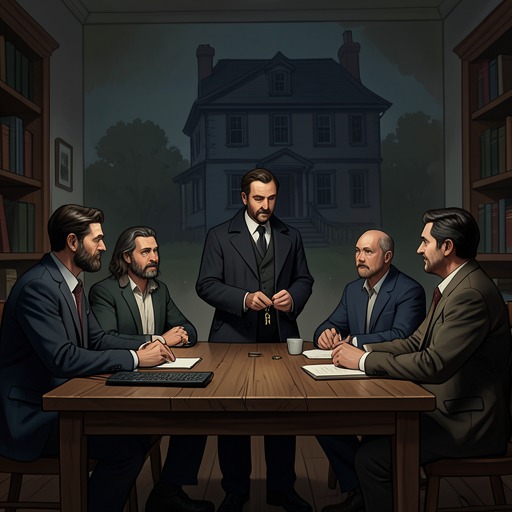
When Peter is bedridden, Jonah comes among the relatives who take turns arriving at Stone Court. Peter refuses to see many of them and sends messages of dismissal through Mary Garth. Jonah, however, does not leave after receiving food and hospitality. Having fallen on hard times, he is supported by a calling that allows him to remain away from Brassing so long as he has a place to sit and food to eat. He takes a comfortable chair in the kitchen, where he can remain near Peter while staying apart from Solomon, whom he considers greedy.
Jonah tells Mary that he will not go beyond reach of his brother while Peter remains alive. His claim to watchfulness is joined to distrust: he regards Mary as a suspicious person and follows her movements with a cold, attentive gaze. The kitchen becomes a small stage for the family’s larger anxieties, with Jonah settled among the household’s provisions while monitoring the person who helps manage Peter’s care. His self-appointed vigil gives him proximity to the estate, but no authority over its decisions.
Family Rivalry and Character
Jonah is described as the wit among the Featherstones, and he jokes with the maid-servants. That social ease does not make him generous or conciliatory. He remains suspicious of Mary and antagonistic toward Solomon, while the relatives as a group suspect one another of opportunism and fear that Peter’s property will pass to a rival branch. Their surveillance is mutual: each comes to watch, and each believes another may be plotting to benefit from the old man’s helplessness.
The funeral continues the same competition in a different setting. The assembled relatives privately calculate what they may receive and resent the possibility that Fred Vincy will inherit the land. Jonah finds time to call Solomon undeserving, while Solomon in turn calls Jonah greedy. The contrast between their public status as family mourners and their private calculations makes Jonah’s wit part of a broader portrait of inheritance as a force that converts kinship into rivalry. His own hopes are not exceptional; they are one version of a shared struggle over a limited estate.
The Will and Its Aftermath
At the reading of Peter’s will, Jonah reacts sharply when the terms become clear. He says that Peter had always been a hypocrite, but concedes that this will settles the matter against the family’s expectations. Had he known what Peter intended, Jonah claims, even a wagon and six horses would not have kept him from coming from Brassing. His immediate thought is to change his appearance and return, an ironic sign that he had imagined the will might reward a show of devotion made at the last moment.
Mrs. Cranch laments the expense of travelling and the time her son has spent sitting idle, while Solomon declares that Peter’s final provision will not redeem his life. Jonah’s own response is less a moral judgment than a disappointed recognition that the hoped-for inheritance has not materialized. His arc ends with the reversal of his expectation: he has kept watch through Peter’s illness, but proximity, blood relation, and vigilance have not secured him a share.
Narrative Significance
Jonah’s small but recurring presence connects Peter’s private illness to the wider social contest over property. His stay in the kitchen, his suspicion of Mary, his hostility toward Solomon, and his response to the will show how the prospect of inheritance shapes conduct before any legacy is known. The family’s hopes depend on conjecture, and the will’s eventual terms expose the distance between imagined entitlement and what Peter actually leaves.
The portrayal also gives the inheritance episode a comic edge without making its consequences abstract. Jonah’s cleverness helps him interpret the family’s maneuvers, but it does not give him power over Peter’s decision. At Stone Court, family loyalty is repeatedly invoked as a possible claim on money; once the will is read, those claims prove weaker than the testator’s own choice. Jonah is left as a memorable figure in that collision of kinship, self-interest, and disappointed expectation.