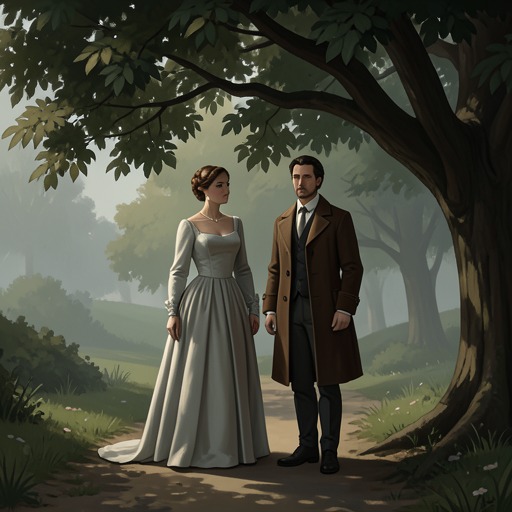
Sir James Chettam
MiddlemarchSir James Chettam is a wealthy baronet whose devotion to Dorothea Brooke survives her marriage to Edward Casaubon and changes from disappointed courtship into persistent family loyalty. His support for her plans to improve cottages, and later for the Garth family’s work, expresses a practical benevolence; his efforts to control Dorothea’s choices and exclude Will Ladislaw show how that benevolence can become paternalistic. In the end he remains one of Dorothea’s best friends, even when she must resist his advice.
Identity and Early Attachments
When Dorothea and Celia first hear that Sir James will dine at Tipton Grange, he is already known as a prospective suitor. He is part of the local landed world, and his later actions repeatedly turn concern into practical assistance: he seeks out estate managers, proposes employment for Will, and offers to accompany Dorothea when she wishes to return to Lowick. His position gives him resources and influence, but the novel also exposes the assumptions that accompany them.
Sir James’s attachment to Dorothea becomes clear when Mrs. Cadwallader tells Mr. Cadwallader that Dorothea is engaged to Casaubon. Mr. Cadwallader tries to hide his hurt behind a nervous smile and a movement of his boot-whip. The news does not make Sir James abandon Dorothea’s cottage project. He continues to support it, and Dorothea recognizes the rectitude of his persistence: what began partly as a lover’s attentiveness has become a landlord’s duty. Her appreciation of his conduct gives their connection a form that does not depend on her returning his love.
Practical Benevolence and Public Affairs
Sir James’s support for Dorothea’s cottage plan is more than a courteous gesture. He is willing to carry out her proposal on his own estate, even though he understands that improved cottages may not produce a rent sufficient to make the investment pay. He treats the work as worthwhile despite its financial disadvantage. That readiness to spend money on a practical improvement is of a piece with his later willingness to use his influence on behalf of people he considers deserving.
His regard for Dorothea does not remain confined to her private life. At Freshitt, he objects to Mr. Brooke’s new political course, but also takes care to hear Will’s view of the proposed candidacy. Will argues against Brooke standing, and Sir James hopes he may persuade Brooke to abandon the nomination. Sir James’s caution is not simply obstruction: he is uneasy about Brooke’s judgment and willing to consult someone whose political position differs from his own.
He also helps restore Caleb Garth’s professional prospects. Sir James offers Garth the management of the Freshitt estates and explains that Brooke has asked him to find out whether Garth would resume the agency of the Tipton property as well. Sir James wants both estates under one management and assures Garth that the arrangement can be made on acceptable terms. The offer joins his own interest in competent estate management to a practical act of support for a family that needs work.
Dorothea, Casaubon, and Will Ladislaw
Sir James’s concern becomes more forceful after Dorothea learns that Casaubon’s will contains a condition affecting her if she marries Will. He regards the codicil as a grave injustice: Casaubon, he argues, has compromised Dorothea by attaching such a restriction to a will made when her family trusted him. His response is protective, but it also quickly turns into a plan for managing the people around her. He wants business kept from Dorothea while she is unwell, proposes that she stay with Celia, and urges Brooke to send Will out of the country, even suggesting that money be spent to find him a post abroad.
Sir James believes his position as Dorothea’s brother-in-law entitles him to object to Will remaining nearby. His language places family dignity and reputation at the center of the matter; he sees Will’s presence as an insult and as a danger to Dorothea. When Dorothea asks to go to Lowick to look over papers, those around her disapprove, but Sir James eventually drives her there the next day. His assistance does not mean he accepts her independence of judgment. He helps her carry out the journey while remaining uneasy about what she may decide.
That unease is visible when Will visits. Sir James’s dislike is strong enough that Dorothea’s calm farewell to Will and her immediate question about Celia oblige him to behave as though nothing has annoyed him. He is reluctant even to entertain the possibility that Dorothea might love Will. Later, hearing that Dorothea does not intend to marry again and will return to her former plans, he makes no objection. He regards a widow’s second marriage as a kind of desecration, although he knows that this view conflicts with the world’s expectation that a young widow will remarry. His approval of her solitude therefore protects her from one social expectation even as his attitude remains shaped by another restrictive ideal.
Protection, Judgment, and Change
By the time of the scandal surrounding Nicholas Bulstrode and Tertius Lydgate, Sir James is no longer the deferential bachelor who readily accepted Dorothea’s views. He admires her, but fears that she may fall into another illusion after her marriage to Casaubon. When she wants to act in support of Lydgate, Sir James argues that she cannot undertake to manage Lydgate’s life for him: Lydgate must learn his own position and act for himself. He also urges Dorothea to hold back from involvement in Bulstrode’s affairs until more is known, invoking the judgment of those who understand the world better.
His counsel illustrates the limit in his care. Sir James wants to shield Dorothea from harm and thinks that his worldly experience should guide her, but his advice risks turning protection into restraint. Dorothea’s decision to go forward despite his objections shows that she can value his friendship without accepting his authority. He nevertheless accompanies her to the Grange, helping her complete her expedition without abandoning her resolution.
Sir James’s arc is not a simple progression from suitor to disinterested guardian. He remains suspicious of Will, protective of family respectability, and inclined to question Dorothea’s judgment; he also persists in useful work after losing the hope of marrying her, supports improvements she values, and helps others secure practical opportunities. The tension between those impulses makes his loyalty consequential: he is genuinely generous, but his generosity is most admirable when it serves another person’s chosen purposes rather than substituting his judgment for theirs.