Rosamond Vincy
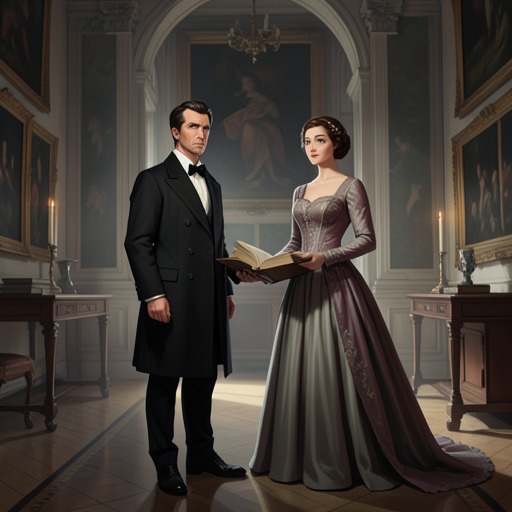
MiddlemarchRosamond Vincy is Middlemarch’s admired beauty and a star pupil of Mrs. Lemon’s School, but her accomplishments and romantic polish conceal a powerful investment in social advancement. Her courtship and marriage to Tertius Lydgate turn on a mutual misreading: each imagines the other as a partner in a private ideal, and the household they establish makes the distance between those ideals materially consequential.
Identity and Social Position
Rosamond is the daughter of Walter Vincy and a member of an old manufacturing family that has maintained a substantial household for three generations. The Vincys’ wide kinship and social connections make them a prominent local family; Rosamond’s mother is connected to Peter Featherstone through her sister’s marriage, and the family is also related to Nicholas Bulstrode through Walter Vincy’s sister. Rosamond’s place within this network gives her a familiar provincial standing, but her ambitions reach beyond it.
At Mrs. Lemon’s School, the chief school in the county, Rosamond is held up as an example of the accomplished young woman. Her education includes the expected accomplishments and even practical social polish, such as entering and leaving a carriage. Mrs. Lemon praises her learning, speech, and musical execution. The narrator presents her beauty as an immediate presence that can outweigh the schoolmistress’s praise: her figure, fair hair, and blue eyes invite admirers to read exceptional meaning into her appearance. The portrait also complicates that admiration. Rosamond’s charm includes an almost complete blindness to the inner lives and aims that do not serve her own picture of the future.
Courtship as an Imagined Future
When Rosamond and Lydgate meet, she treats a small exchange as the arrival of a long-anticipated romance. After she makes a lightly dismissive remark about Middlemarch, Lydgate reaches the whip she is going to collect and hands it to her. Their eyes meet; Rosamond blushes and leaves feeling that something decisive has happened. The scene confirms for her what she had already imagined: ever since Lydgate’s arrival in town, she has constructed a future in which a stranger becomes her lover and husband.
The stranger matters as much as the man. Rosamond’s preferred romantic hero is not a Middlemarcher and has no local connections like her own; increasingly, her fantasy calls for a relation to a baronet. She reads Lydgate’s distinction, family background, and talent as parts of a single promise. His good birth is especially important because it suggests a route toward higher social standing and escape from the people she regards as vulgar. She assumes that her interest is love, and that he must have fallen in love with her at first sight. The narrative’s irony lies in the gap between the encounter’s significance to Rosamond and Lydgate’s far less developed understanding of it.
Two Different Ideas of Marriage
Lydgate does not initially understand himself to be the object of Rosamond’s sustained attention. He remembers her accomplishments and beauty, but believes he has offered no more than the admiration and compliments convention requires. Rosamond, by contrast, records his words and looks as opening scenes in a romance whose climax she has already anticipated. Her imagination gives little space to the hero’s serious work or inward life; his profession and intelligence matter, but his birth and the prospect of improved rank matter more.
The mismatch has a counterpart in Lydgate’s own expectations. When he imagines marriage, he sees Rosamond as a cultivated and docile helpmate who will admire his intellectual ambitions, keep an orderly home and accounts, and add music and romance without interfering with his work. He imagines domestic life as furthering his vocation, not obstructing it. Rosamond’s private design, meanwhile, depends on what Lydgate can signify socially and on the refined life she expects marriage to secure. Their courtship is therefore not simply a meeting of two people attracted to one another; it is the collision of complementary-looking but incompatible fantasies about what a wife, a husband, and a household should be.
As their engagement becomes settled, Rosamond agrees that the wedding work can be hastened and asks Lydgate to write to her father about fixing a date. In a moment of tenderness, Lydgate believes he has found the ideal woman who will revere his studies and make his domestic life beautiful. The practical preparations already carry the assumptions that will shape their married life: on a visit to Brassing, he buys an expensive dinner service because he thinks furnishings should be done properly and dislikes ugly crockery. Rosamond’s mother approves of it as just what Rosamond ought to have. The purchase makes visible how quickly their shared language of refinement becomes a commitment to expense.
Marriage, Household Spending, and Debt
Rosamond’s expectations of domestic comfort are formed in a household accustomed to spending generously. She understands good housekeeping as ordering the best of everything; lesser choices, in her view, will not do. Lydgate shares a different version of the same assumption: if something is to be done, it must be done properly. Neither treats economies as necessary, and he does not challenge her invitations even when he finds the guests tiresome, partly because he regards sociability and suitable entertainment as professional prudence.
The consequences emerge through the household accounts. Setting up their home and preparing for marriage costs Lydgate four or five hundred pounds more than his available capital. After a year, household expenses, horses, and other costs approach a thousand pounds, while his medical practice brings in less than five hundred, much of it still unpaid. Rent on a house and garden, life insurance, and the expectation of keeping two horses add to the pressure. Rosamond’s generous ordering and Lydgate’s belief that every purchase must be properly made reinforce one another, while his professional income falls short of the figures he had expected. What he had regarded as a matter of taste becomes an urgent debt problem.
The novel sets Rosamond’s spending expectations beside Lydgate’s medical attention to poor patients, whose means require him to adjust prescriptions and diets. Yet he fails to apply the same practical scrutiny to his own household. That contrast is not offered as a simple accusation against Rosamond alone: both spouses participate in a domestic ideal built around appearances and comfort, and neither initially measures its cost against their resources. Still, the assumptions are not equally placed. Rosamond’s idea of a good home depends on consumption, while Lydgate’s professional income and obligations bear the accumulating financial consequences.
Character and Narrative Significance
Rosamond’s defining conflict is between her polished competence in the social world and her limited understanding of the desires that animate people around her. She can identify a faint suggestion of rank and make it central to her romantic expectations, yet she does not recognize how little Lydgate’s early attention amounts to or how fully his working ambitions differ from her own. Her beauty, education, and self-possession give her room to shape events—her father, for example, is susceptible to her mild persistence—but that influence does not mean she can control what marriage will become.
Her story connects romantic illusion to the material organization of domestic life. The same ideal that makes Lydgate seem a suitable hero also makes a refined household seem the natural proof of a successful marriage. The expensive dinner service, horses, entertaining, and deficit between income and expenditure reveal the cost of treating those expectations as self-evident. Rosamond is therefore more than an admired beauty or a foil to Lydgate’s scientific vocation: her courtship and marriage show how social ambition, gendered expectations, and habitual consumption can turn imagined happiness into a shared financial and emotional predicament.